QUESTION IMAGE
Question
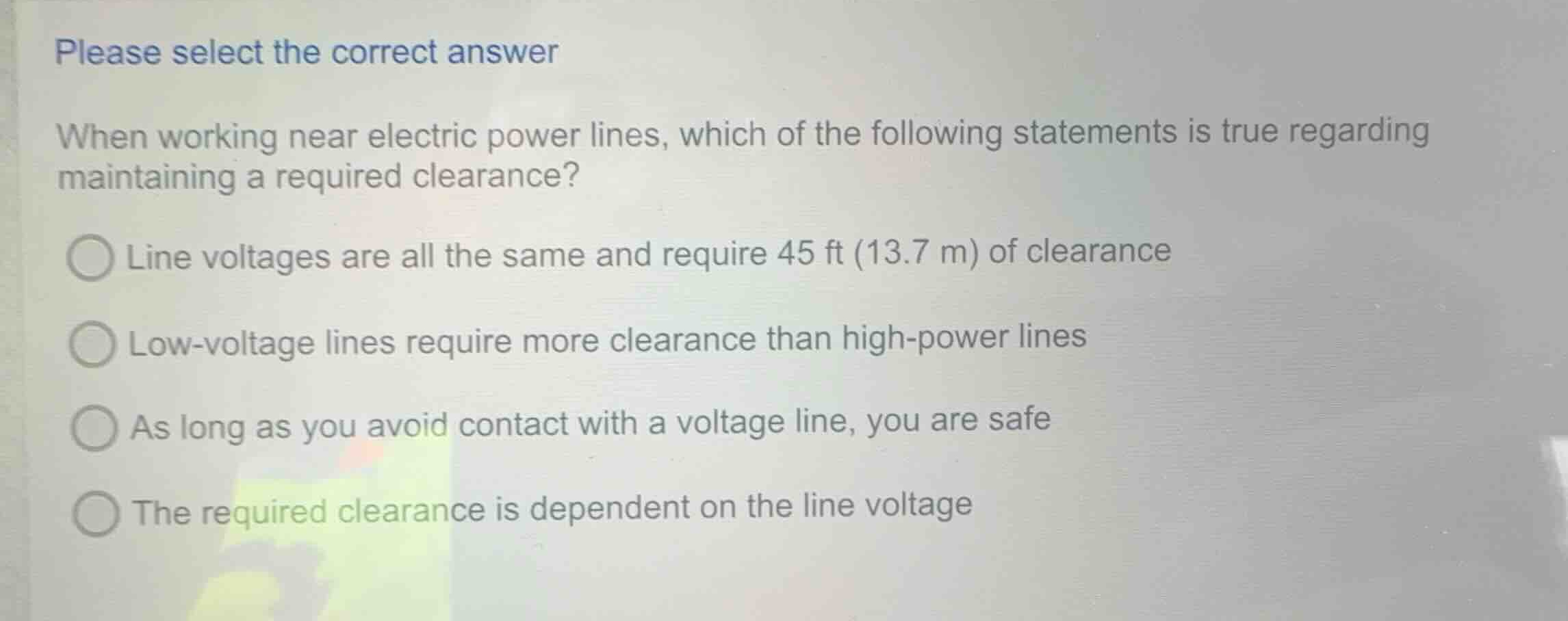
please select the correct answer
when working near electric power lines, which of the following statements is true regarding maintaining a required clearance?
line voltages are all the same and require 45 ft (13.7 m) of clearance
low-voltage lines require more clearance than high-power lines
as long as you avoid contact with a voltage line, you are safe
the required clearance is dependent on the line voltage
Analyze electrical safety standards for power line clearance
The required safe clearance distance when working near overhead power lines is not a single fixed number for all lines, nor is it the same for low and high voltages. According to OSHA and ANSI safety standards, the minimum safe approach distance increases as the line voltage increases to prevent electrical arcing.
Evaluate the given options
- Option 1: Incorrect. Line voltages vary significantly and do not all require a flat 45 ft clearance.
- Option 2: Incorrect. Higher-voltage lines require greater clearance distances than lower-voltage lines because high voltage can arc across larger air gaps.
- Option 3: Incorrect. Electricity can arc across an air gap to a grounded object or person without direct physical contact.
- Option 4: Correct. The minimum required clearance distance is directly dependent on the voltage of the power line.

Snap & solve any problem in the app
Get step-by-step solutions on Sovi AI
Photo-based solutions with guided steps
Explore more problems and detailed explanations
- Line voltages are all the same and require 45 ft (13.7 m) of clearance
- Low-voltage lines require more clearance than high-power lines
- As long as you avoid contact with a voltage line, you are safe
- The required clearance is dependent on the line voltage (Correct answer)