QUESTION IMAGE
Question
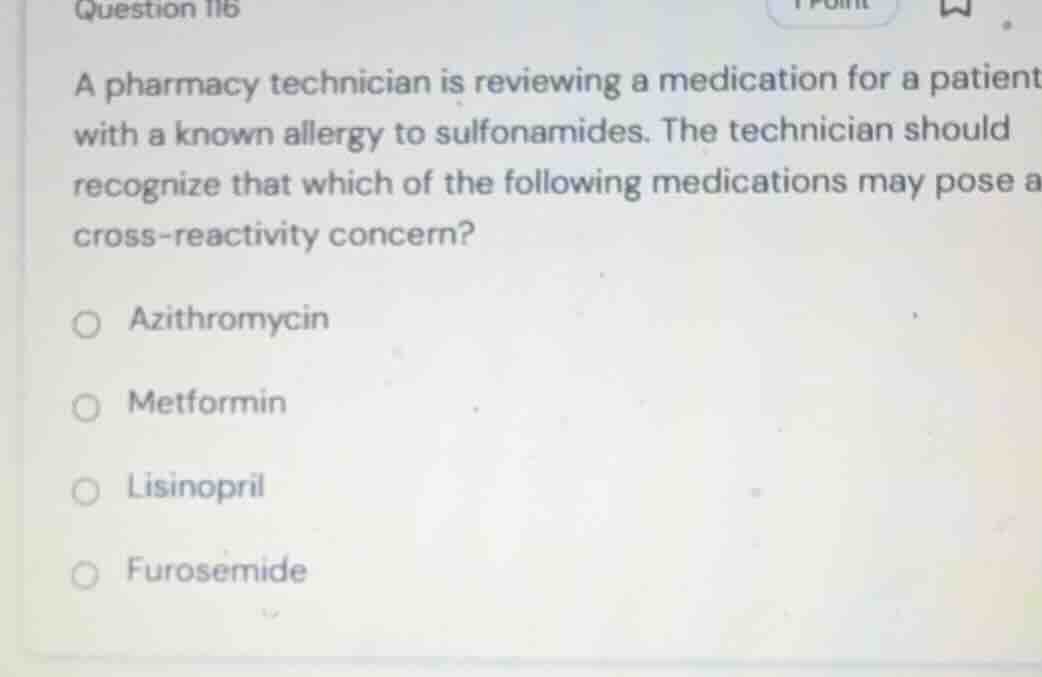
a pharmacy technician is reviewing a medication for a patient with a known allergy to sulfonamides. the technician should recognize that which of the following medications may pose a cross-reactivity concern?
azithromycin
metformin
lisinopril
furosemide
Identify the patient's allergy and the clinical concern
The patient has a documented allergy to sulfonamides (commonly referred to as "sulfa" drugs). The clinical concern is cross-reactivity, which occurs when a patient allergic to one drug class experiences an allergic reaction to a structurally similar drug from another class.
Analyze the chemical structure of the options
To determine which medication poses a cross-reactivity risk, we examine the chemical structures of the listed options:
- Azithromycin: A macrolide antibiotic. It does not contain a sulfonamide moiety.
- Metformin: A biguanide oral hypoglycemic agent. It does not contain a sulfonamide moiety.
- Lisinopril: An ACE inhibitor. It does not contain a sulfonamide moiety.
- Furosemide: A loop diuretic. It contains a sulfonamide functional group (\(-\text{SO}_2\text{NH}_2\)) in its chemical structure.
Evaluate cross-reactivity risk
Although the risk of cross-reactivity between sulfonamide antibiotics (like sulfamethoxazole) and non-arylamine sulfonamides (like loop diuretics, thiazide diuretics, and sulfonylureas) is considered low to moderate in clinical practice, furosemide is chemically classified as a sulfonamide derivative. Therefore, it carries a potential warning and theoretical risk of cross-reactivity in patients with a severe sulfonamide allergy.

Snap & solve any problem in the app
Get step-by-step solutions on Sovi AI
Photo-based solutions with guided steps
Explore more problems and detailed explanations
- Azithromycin
- Metformin
- Lisinopril
- Furosemide (Correct answer)