QUESTION IMAGE
Question
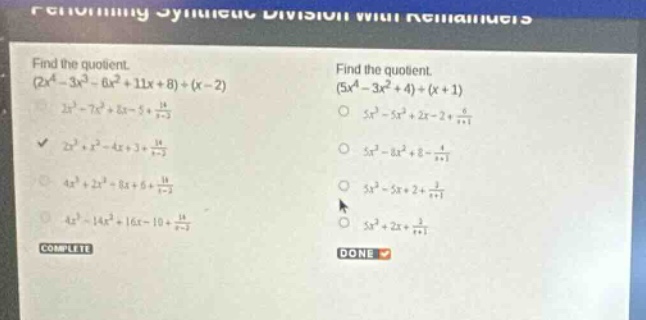
performing synthetic division with remainders
find the quotient.
\\((2x^4 - 3x^3 - 6x^2 + 11x + 8) \div (x - 2)\\)
- \\(2x^3 - 7x^2 + 8x - 5 + \frac{18}{x-2}\\)
- \\(2x^3 + x^2 - 4x + 3 + \frac{14}{x-2}\\)
- \\(4x^3 + 2x^2 - 8x + 6 + \frac{14}{x-2}\\)
- \\(4x^3 - 14x^2 + 16x - 10 + \frac{18}{x-2}\\)
find the quotient.
\\((5x^4 - 3x^2 + 4) \div (x + 1)\\)
- \\(5x^3 - 5x^2 + 2x - 2 + \frac{6}{x+1}\\)
- \\(5x^3 - 8x^2 + 8 - \frac{4}{x+1}\\)
- \\(5x^3 - 5x + 2 + \frac{2}{x+1}\\)
- \\(5x^2 + 2x + \frac{2}{x+1}\\)
🆕 New Concept Discovered: Synthetic Division with Remainders
A shortcut method to divide polynomials by linear factors.
Step 1: Set up the synthetic division
To divide \( (5x^4 - 3x^2 + 4) \div (x + 1) \), we first write down the coefficients of the dividend. We must include a \( 0 \) coefficient for any missing terms (the \( x^3 \) and \( x^1 \) terms):
The coefficients are:
Since we are dividing by \( x + 1 \), the value we use for division is \( c = -1 \).
Step 2: Perform the division steps
Bring down the first coefficient, then multiply by \( -1 \) and add repeatedly:
 -1 |   5    0   -3    0    4
    |       -5    5   -2    2
    -------------------------
5 -5 2 -2 6- Bring down \( 5 \).
- Multiply: \( 5 \times (-1) = -5 \). Add: \( 0 + (-5) = -5 \).
- Multiply: \( -5 \times (-1) = 5 \). Add: \( -3 + 5 = 2 \).
- Multiply: \( 2 \times (-1) = -2 \). Add: \( 0 + (-2) = -2 \).
- Multiply: \( -2 \times (-1) = 2 \). Add: \( 4 + 2 = 6 \).
Step 3: Write the final quotient
The numbers at the bottom represent the coefficients of the quotient polynomial (which is one degree lower than the original polynomial) and the final number is the remainder:
- Coefficients: \( 5, -5, 2, -2 \)
- Remainder: \( 6 \)
This translates to:

Snap & solve any problem in the app
Get step-by-step solutions on Sovi AI
Photo-based solutions with guided steps
Explore more problems and detailed explanations
The correct option is the first one: