Sovi.AI - AI Math Tutor

Scan to solve math questions

QUESTION IMAGE

in the past, indias people were divided into castes. how did being in a…

Question

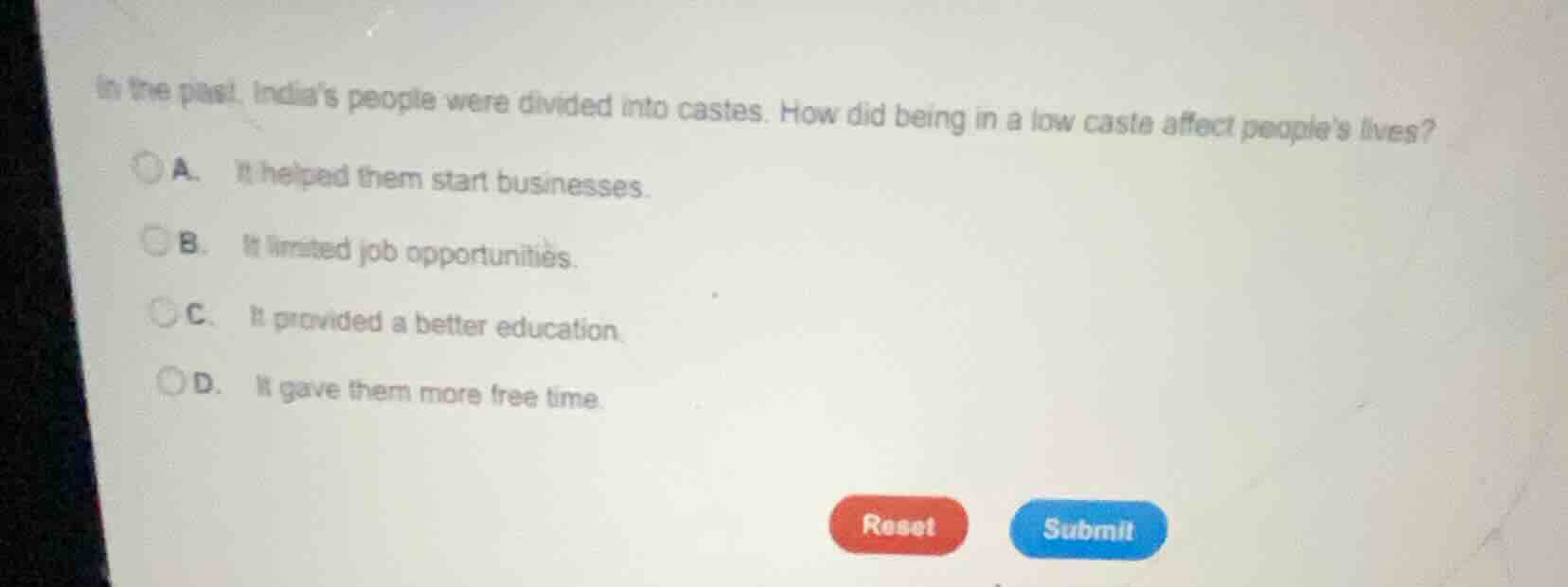
in the past, indias people were divided into castes. how did being in a low caste affect peoples lives?

a. it helped them start businesses.
b. it limited job opportunities.
c. it provided a better education.
d. it gave them more free time.

Explanation:

Response

<pre_analysis>
{
"quality": "clear",
"question_count": 1,
"skills_matched": [
"direct_cot",
"multiple_choice_formatter",
"explain_then_answer",
"tutor"
],
"needs_drawing": false,
"concepts_used": [],
"new_concepts": [
"Caste System",
"Social Stratification",
"Indian History"
],
"current_concepts": [
"Caste System",
"Social Stratification",
"Indian History"
]
}
</pre_analysis>

<reasoning>

Understand the caste system

The traditional Indian caste system is a rigid social hierarchy that historically determined an individual's social status, occupation, and interactions from birth. It divided society into distinct hereditary groups, with the lowest groups facing severe social and economic restrictions.

Analyze the impact of low caste status

Being born into a low caste meant that individuals were restricted to specific, often marginalized, occupations. They were denied access to quality education, clean water sources, and religious spaces, and they faced strict social barriers that prevented upward mobility.

Evaluate the given options

  • Option A (It helped them start businesses): Incorrect. Low-caste individuals faced severe economic restrictions and lacked the capital, rights, and social standing to easily start businesses.
  • Option B (It limited job opportunities): Correct. The caste system strictly dictated occupations based on birth, confining lower castes to menial labor and preventing them from pursuing other careers.
  • Option C (It provided a better education): Incorrect. Educational opportunities were historically reserved for the higher castes, while lower castes were systematically excluded.
  • Option D (It gave them more free time): Incorrect. Lower-caste individuals typically performed demanding physical labor and did not receive more leisure time.

</reasoning>

<answer>
<mcq-option>(A) It helped them start businesses.</mcq-option>
<mcq-correct>(B) It limited job opportunities.</mcq-correct>
<mcq-option>(C) It provided a better education.</mcq-option>
<mcq-option>(D) It gave them more free time.</mcq-option>
</answer>

<post_analysis>
{
"subject": "Social Science",
"question_type": "Multiple Choice",
"knowledge_point": [
"Social Science",
"World History",
"Caste System"
]
}
</post_analysis>

Answer:

<pre_analysis>
{
"quality": "clear",
"question_count": 1,
"skills_matched": [
"direct_cot",
"multiple_choice_formatter",
"explain_then_answer",
"tutor"
],
"needs_drawing": false,
"concepts_used": [],
"new_concepts": [
"Caste System",
"Social Stratification",
"Indian History"
],
"current_concepts": [
"Caste System",
"Social Stratification",
"Indian History"
]
}
</pre_analysis>

<reasoning>

Understand the caste system

The traditional Indian caste system is a rigid social hierarchy that historically determined an individual's social status, occupation, and interactions from birth. It divided society into distinct hereditary groups, with the lowest groups facing severe social and economic restrictions.

Analyze the impact of low caste status

Being born into a low caste meant that individuals were restricted to specific, often marginalized, occupations. They were denied access to quality education, clean water sources, and religious spaces, and they faced strict social barriers that prevented upward mobility.

Evaluate the given options

  • Option A (It helped them start businesses): Incorrect. Low-caste individuals faced severe economic restrictions and lacked the capital, rights, and social standing to easily start businesses.
  • Option B (It limited job opportunities): Correct. The caste system strictly dictated occupations based on birth, confining lower castes to menial labor and preventing them from pursuing other careers.
  • Option C (It provided a better education): Incorrect. Educational opportunities were historically reserved for the higher castes, while lower castes were systematically excluded.
  • Option D (It gave them more free time): Incorrect. Lower-caste individuals typically performed demanding physical labor and did not receive more leisure time.

</reasoning>

<answer>
<mcq-option>(A) It helped them start businesses.</mcq-option>
<mcq-correct>(B) It limited job opportunities.</mcq-correct>
<mcq-option>(C) It provided a better education.</mcq-option>
<mcq-option>(D) It gave them more free time.</mcq-option>
</answer>

<post_analysis>
{
"subject": "Social Science",
"question_type": "Multiple Choice",
"knowledge_point": [
"Social Science",
"World History",
"Caste System"
]
}
</post_analysis>