QUESTION IMAGE
Question
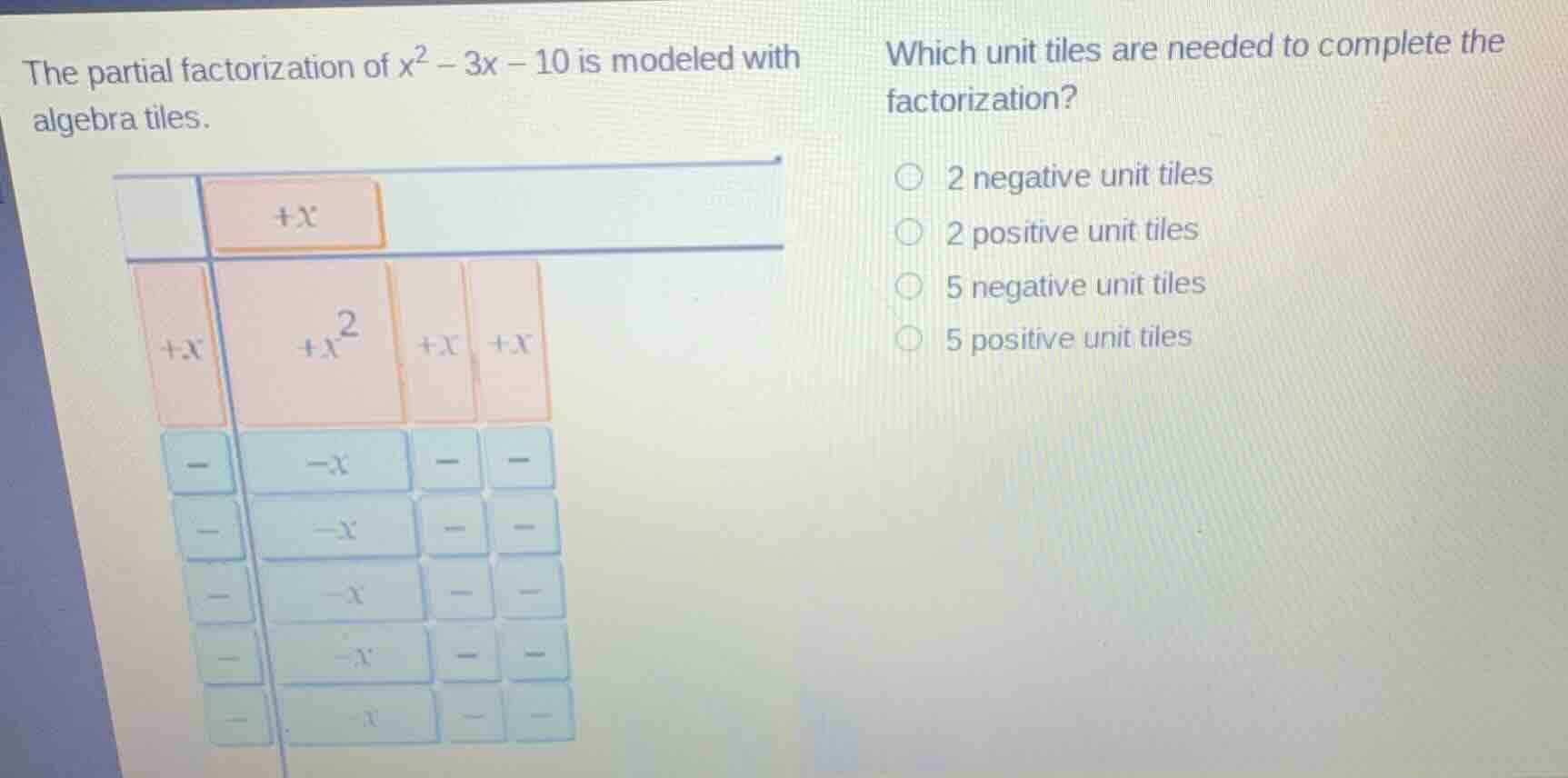
the partial factorization of (x^2 - 3x - 10) is modeled with algebra tiles.
which unit tiles are needed to complete the factorization?
- 2 negative unit tiles
- 2 positive unit tiles
- 5 negative unit tiles
- 5 positive unit tiles
<pre_analysis>
{
"quality": "clear",
"question_count": 1,
"skills_matched": [
"step_cot",
"multiple_choice_formatter",
"explain_then_answer",
"quick",
"mastery_adaptive_brevity"
],
"needs_drawing": false,
"concepts_used": [
"Algebra Tiles",
"Factoring Polynomials"
],
"new_concepts": [],
"current_concepts": [
"Algebra Tiles",
"Factoring Polynomials"
]
}
</pre_analysis>
<reasoning>
Determine the factors from the algebra tile model
The model shows a partial factorization of the trinomial \(x^2 - 3x - 10\).
The vertical factor on the left has:
- One \(+x\) tile
- Five \(-1\) tiles
This represents the factor \((x - 5)\).
The horizontal factor on the top has:
- One \(+x\) tile
- A blank space for the remaining unit tiles.
Find the missing factor algebraically
Using the known factor \((x - 5)\):
\[
x^2 - 3x - 10 = (x - 5)(x + 2)
\]
Thus, the missing horizontal factor is \((x + 2)\).
Identify the missing unit tiles
The horizontal factor must be \(x + 2\).
Since the top row already has one \(+x\) tile, we need:
- Two \(+1\) tiles (positive unit tiles) to complete the top factor.
This corresponds to filling the remaining grid cells with 10 negative unit tiles (since \(-5 \times 2 = -10\)), which matches the 10 negative unit tiles shown in the grid.
Therefore, 2 positive unit tiles are needed at the top to complete the factorization.
</reasoning>
<answer>
<mcq-option>2 negative unit tiles</mcq-option>
<mcq-correct>2 positive unit tiles</mcq-correct>
<mcq-option>5 negative unit tiles</mcq-option>
<mcq-option>5 positive unit tiles</mcq-option>
</answer>
<post_analysis>
{
"subject": "Mathematics",
"question_type": "Multiple Choice",
"knowledge_point": [
"Mathematics",
"Algebra",
"Algebra Tiles"
]
}
</post_analysis>
Snap & solve any problem in the app
Get step-by-step solutions on Sovi AI
Photo-based solutions with guided steps
Explore more problems and detailed explanations
<pre_analysis>
{
"quality": "clear",
"question_count": 1,
"skills_matched": [
"step_cot",
"multiple_choice_formatter",
"explain_then_answer",
"quick",
"mastery_adaptive_brevity"
],
"needs_drawing": false,
"concepts_used": [
"Algebra Tiles",
"Factoring Polynomials"
],
"new_concepts": [],
"current_concepts": [
"Algebra Tiles",
"Factoring Polynomials"
]
}
</pre_analysis>
<reasoning>
Determine the factors from the algebra tile model
The model shows a partial factorization of the trinomial \(x^2 - 3x - 10\).
The vertical factor on the left has:
- One \(+x\) tile
- Five \(-1\) tiles
This represents the factor \((x - 5)\).
The horizontal factor on the top has:
- One \(+x\) tile
- A blank space for the remaining unit tiles.
Find the missing factor algebraically
Using the known factor \((x - 5)\):
\[
x^2 - 3x - 10 = (x - 5)(x + 2)
\]
Thus, the missing horizontal factor is \((x + 2)\).
Identify the missing unit tiles
The horizontal factor must be \(x + 2\).
Since the top row already has one \(+x\) tile, we need:
- Two \(+1\) tiles (positive unit tiles) to complete the top factor.
This corresponds to filling the remaining grid cells with 10 negative unit tiles (since \(-5 \times 2 = -10\)), which matches the 10 negative unit tiles shown in the grid.
Therefore, 2 positive unit tiles are needed at the top to complete the factorization.
</reasoning>
<answer>
<mcq-option>2 negative unit tiles</mcq-option>
<mcq-correct>2 positive unit tiles</mcq-correct>
<mcq-option>5 negative unit tiles</mcq-option>
<mcq-option>5 positive unit tiles</mcq-option>
</answer>
<post_analysis>
{
"subject": "Mathematics",
"question_type": "Multiple Choice",
"knowledge_point": [
"Mathematics",
"Algebra",
"Algebra Tiles"
]
}
</post_analysis>