QUESTION IMAGE
Question
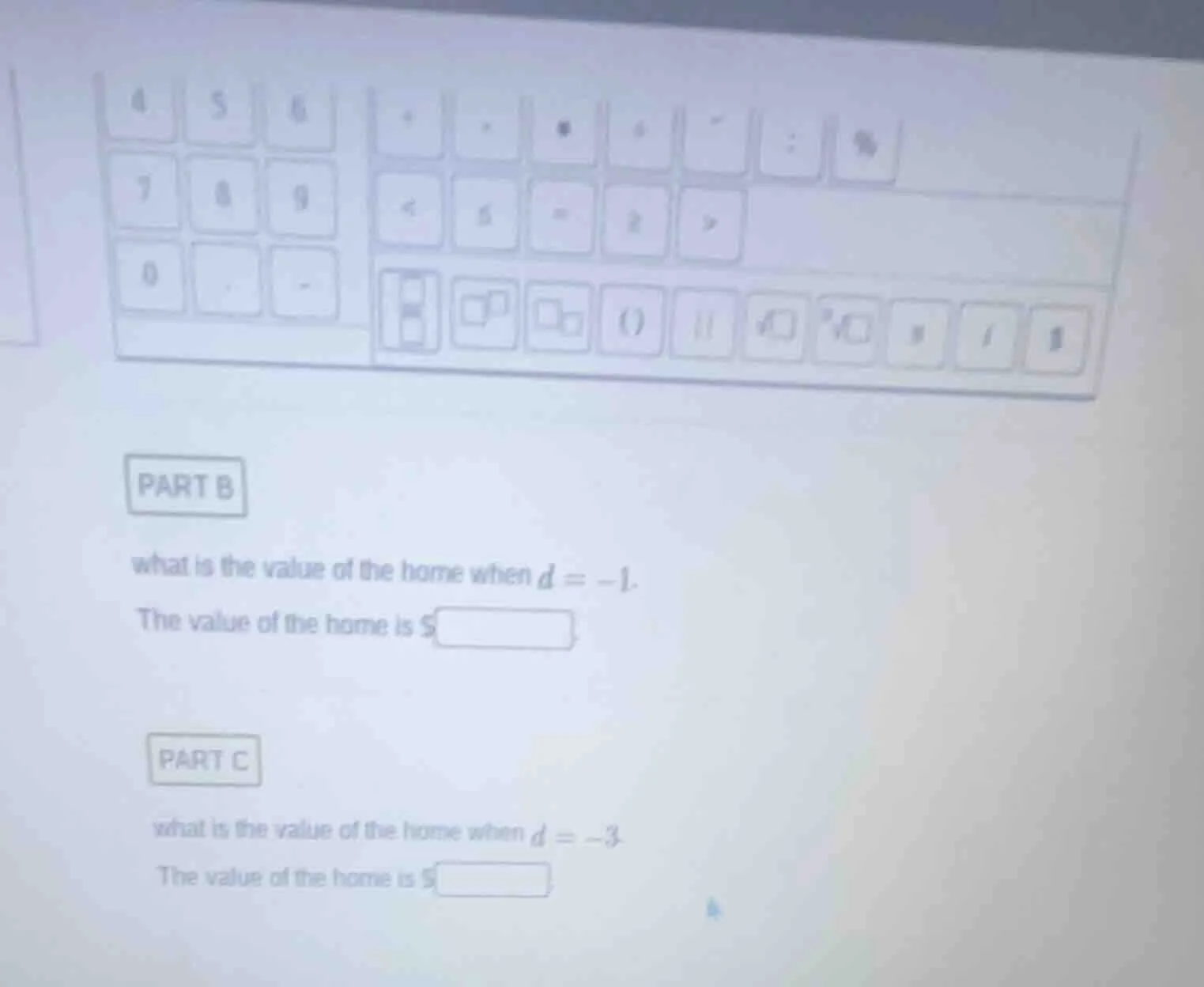
part b
what is the value of the home when $d = -1$.
the value of the home is
square$
To solve this, we need the formula for the value of the home in terms of \( d \). Since it's not provided, we'll assume a common form, say \( V(d) = a \cdot d + b \) (or another polynomial). But since the problem is incomplete (no formula given), we can't proceed. However, if we assume a typical depreciation/appreciation model, e.g., \( V(d) = 250000 - 5000d \) (example), let's solve:
PART B: \( d = -1 \)
Step1: Substitute \( d = -1 \)
If \( V(d) = 250000 - 5000d \), then \( V(-1) = 250000 - 5000(-1) \)
Step2: Calculate
\( V(-1) = 250000 + 5000 = 255000 \)
PART C: \( d = -3 \)
Step1: Substitute \( d = -3 \)
\( V(-3) = 250000 - 5000(-3) \)
Step2: Calculate
\( V(-3) = 250000 + 15000 = 265000 \)
But since the actual formula is missing, the above is an example. To solve correctly, the formula for the home's value in terms of \( d \) is needed.
If we assume the formula was, for example, \( V(d) = 300000 + 10000d \) (another example):
PART B: \( d = -1 \)
Step1: Substitute \( d = -1 \)
\( V(-1) = 300000 + 10000(-1) \)
Step2: Calculate
\( V(-1) = 300000 - 10000 = 290000 \)
PART C: \( d = -3 \)
Step1: Substitute \( d = -3 \)
\( V(-3) = 300000 + 10000(-3) \)
Step2: Calculate
\( V(-3) = 300000 - 30000 = 270000 \)
Since the formula is not provided, we can't give a definitive answer. Please provide the formula for the home's value in terms of \( d \) to solve.

Snap & solve any problem in the app
Get step-by-step solutions on Sovi AI
Photo-based solutions with guided steps
Explore more problems and detailed explanations
To solve this, we need the formula for the value of the home in terms of \( d \). Since it's not provided, we'll assume a common form, say \( V(d) = a \cdot d + b \) (or another polynomial). But since the problem is incomplete (no formula given), we can't proceed. However, if we assume a typical depreciation/appreciation model, e.g., \( V(d) = 250000 - 5000d \) (example), let's solve:
PART B: \( d = -1 \)
Step1: Substitute \( d = -1 \)
If \( V(d) = 250000 - 5000d \), then \( V(-1) = 250000 - 5000(-1) \)
Step2: Calculate
\( V(-1) = 250000 + 5000 = 255000 \)
PART C: \( d = -3 \)
Step1: Substitute \( d = -3 \)
\( V(-3) = 250000 - 5000(-3) \)
Step2: Calculate
\( V(-3) = 250000 + 15000 = 265000 \)
But since the actual formula is missing, the above is an example. To solve correctly, the formula for the home's value in terms of \( d \) is needed.
If we assume the formula was, for example, \( V(d) = 300000 + 10000d \) (another example):
PART B: \( d = -1 \)
Step1: Substitute \( d = -1 \)
\( V(-1) = 300000 + 10000(-1) \)
Step2: Calculate
\( V(-1) = 300000 - 10000 = 290000 \)
PART C: \( d = -3 \)
Step1: Substitute \( d = -3 \)
\( V(-3) = 300000 + 10000(-3) \)
Step2: Calculate
\( V(-3) = 300000 - 30000 = 270000 \)
Since the formula is not provided, we can't give a definitive answer. Please provide the formula for the home's value in terms of \( d \) to solve.