QUESTION IMAGE
Question
part c - transform boundaries in convergent zones
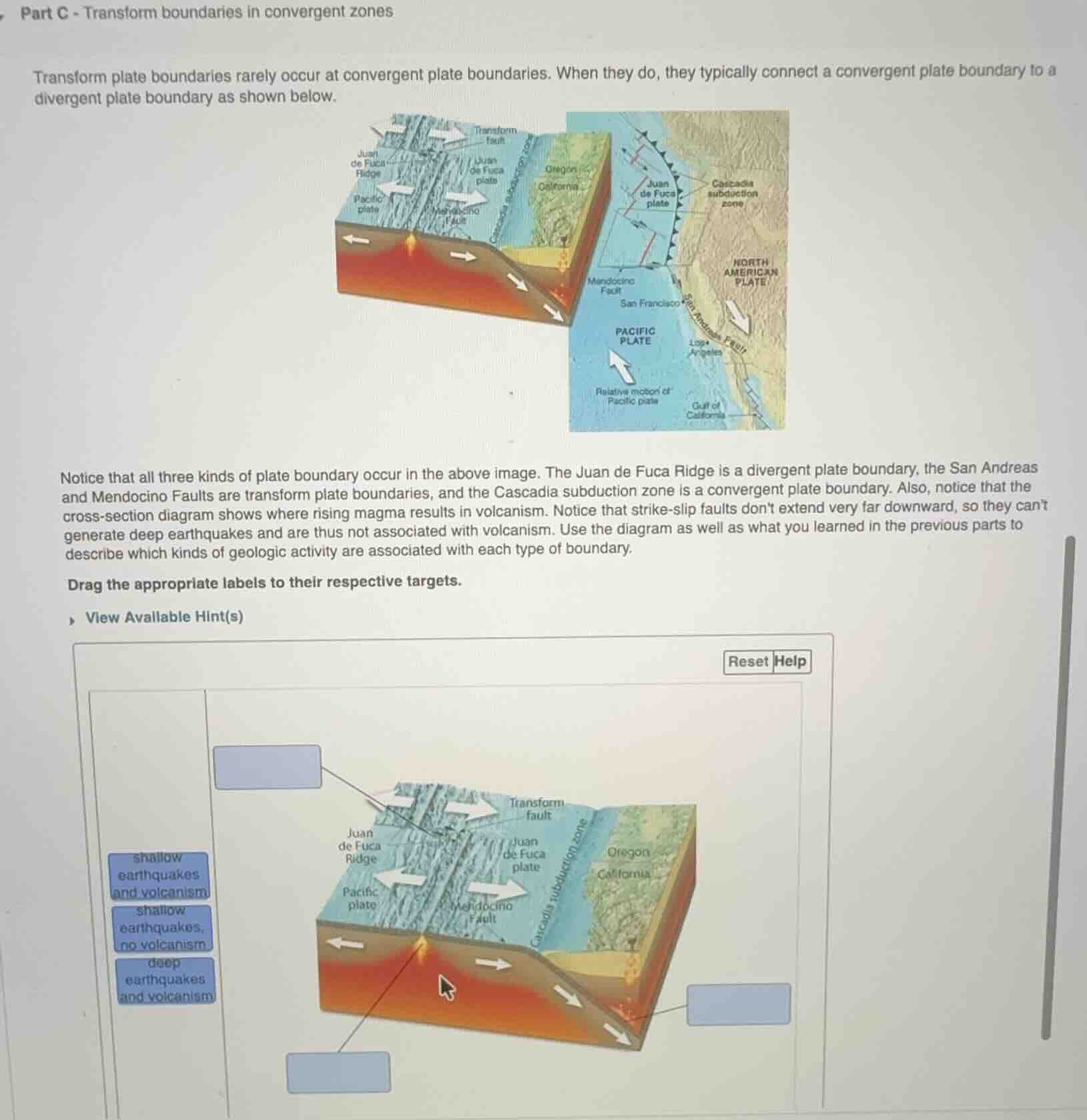
transform plate boundaries rarely occur at convergent plate boundaries. when they do, they typically connect a convergent plate boundary to a divergent plate boundary as shown below.
notice that all three kinds of plate boundary occur in the above image. the juan de fuca ridge is a divergent plate boundary, the san andreas and mendocino faults are transform plate boundaries, and the cascadia subduction zone is a convergent plate boundary. also, notice that the cross-section diagram shows where rising magma results in volcanism. notice that strike-slip faults dont extend very far downward, so they cant generate deep earthquakes and are thus not associated with volcanism. use the diagram as well as what you learned in the previous parts to describe which kinds of geologic activity are associated with each type of boundary.
drag the appropriate labels to their respective targets.
Identify the plate boundaries
We identify the three plate boundaries indicated by the arrows pointing to the target boxes:
- The top-left target points to the Juan de Fuca Ridge, which is a divergent plate boundary.
- The bottom-middle target points to the Mendocino Fault (or the transform fault connecting the ridge and subduction zone), which is a transform plate boundary.
- The bottom-right target points to the Cascadia subduction zone, which is a convergent plate boundary.
Analyze geologic activity for each boundary
We match each boundary with its corresponding geologic activity based on the text and plate tectonics:
- Divergent Boundary (Juan de Fuca Ridge): Rising magma creates new oceanic crust, resulting in volcanism. Because the lithosphere is thin and hot, earthquakes are shallow. Thus, it is associated with shallow earthquakes and volcanism.
- Transform Boundary (Mendocino Fault): The text states that strike-slip faults do not extend very far downward, so they cannot generate deep earthquakes and are not associated with volcanism. Thus, it is associated with shallow earthquakes, no volcanism.
- Convergent Boundary (Cascadia subduction zone): Subduction zones involve a plate sinking deep into the mantle, which generates deep earthquakes along the Benioff zone. Melting of the subducting plate also leads to volcanic arc formation. Thus, it is associated with deep earthquakes and volcanism.
Map labels to targets
We map the three available labels to their respective targets:
- Target pointing to Juan de Fuca Ridge (top-left): shallow earthquakes and volcanism
- Target pointing to Mendocino Fault (bottom-middle): shallow earthquakes, no volcanism
- Target pointing to Cascadia subduction zone (bottom-right): deep earthquakes and volcanism

Snap & solve any problem in the app
Get step-by-step solutions on Sovi AI
Photo-based solutions with guided steps
Explore more problems and detailed explanations
- Juan de Fuca Ridge (top-left box): shallow earthquakes and volcanism
- Mendocino Fault / Transform Fault (bottom-middle box): shallow earthquakes, no volcanism
- Cascadia subduction zone (bottom-right box): deep earthquakes and volcanism