QUESTION IMAGE
Question
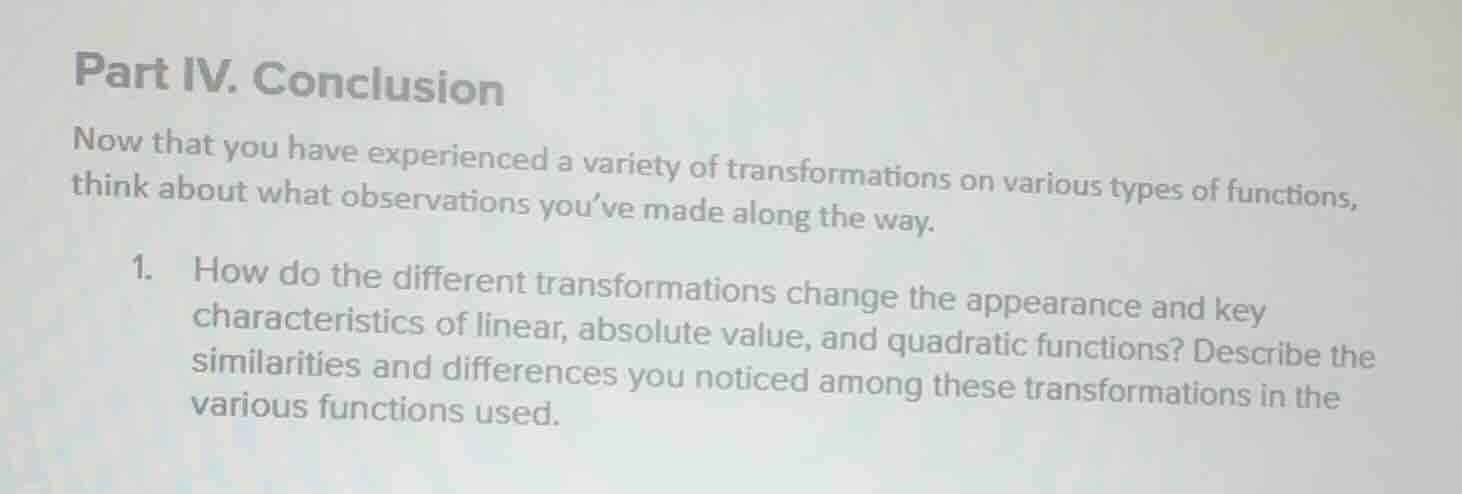
part iv. conclusion
now that you have experienced a variety of transformations on various types of functions, think about what observations youve made along the way.
- how do the different transformations change the appearance and key characteristics of linear, absolute value, and quadratic functions? describe the similarities and differences you noticed among these transformations in the various functions used.
General rules of function transformations
For any parent function \(f(x)\), the transformed function \(g(x) = a \cdot f(b(x - h)) + k\) behaves consistently:
- \(h\) shifts the graph horizontally (right if \(h > 0\), left if \(h < 0\)).
- \(k\) shifts the graph vertically (up if \(k > 0\), down if \(k < 0\)).
- \(a\) vertically stretches (\(|a| > 1\)) or compresses (\(0 < |a| < 1\)) the graph, and reflects it across the x-axis if \(a < 0\).
- \(b\) horizontally compresses (\(|b| > 1\)) or stretches (\(0 < |b| < 1\)) the graph, and reflects it across the y-axis if \(b < 0\).
Similarities among linear, absolute value, and quadratic transformations
- Rigid transformations (translations by \(h\) and \(k\)) shift the key reference points of all three functions in the exact same way:
- Linear: shifts the y-intercept or any reference point \((x, y) \to (x+h, y+k)\).
- Absolute Value: shifts the vertex \((0,0) \to (h,k)\).
- Quadratic: shifts the vertex \((0,0) \to (h,k)\).
- Non-rigid transformations (stretches, compressions, and reflections) affect the orientation and steepness/width of all three functions consistently. A negative leading coefficient \(a < 0\) reflects both the absolute value V-shape and the quadratic U-shape downward.
Differences among linear, absolute value, and quadratic transformations
- Symmetry: Absolute value and quadratic functions have a vertical axis of symmetry (\(x = h\)) that shifts with horizontal translations. Linear functions do not have this type of reflective symmetry.
- Rate of Change:
- Linear transformations preserve a constant slope throughout the entire domain.
- Absolute value transformations preserve two constant, opposite slopes on either side of the vertex.
- Quadratic transformations alter a continuously changing rate of change (the parabola becomes wider or narrower, but the slope is never constant).
- Horizontal vs. Vertical Stretches: For linear functions, a horizontal stretch is algebraically indistinguishable from a vertical compression. For quadratics and absolute value functions, horizontal and vertical transformations are distinct, though they still affect the overall width of the V-shape or U-shape.

Snap & solve any problem in the app
Get step-by-step solutions on Sovi AI
Photo-based solutions with guided steps
Explore more problems and detailed explanations
Similarities
- Consistent Shift Rules: For all three function families, horizontal translations \(f(x-h)\) shift the graph horizontally by \(h\) units, and vertical translations \(f(x)+k\) shift the graph vertically by \(k\) units.
- Vertex/Reference Point Tracking: The vertex of both the absolute value function \(y = |x|\) and the quadratic function \(y = x^2\) shifts from \((0,0)\) to \((h,k)\). Similarly, any reference point on a line shifts by \((+h, +k)\).
- Reflections: A negative vertical multiplier (\(a < 0\)) reflects all three graphs across the x-axis, turning the V-shape of the absolute value and the U-shape of the quadratic upside down.
Differences
- Symmetry: Absolute value and quadratic functions possess a vertical axis of symmetry (\(x = h\)) that shifts with horizontal translations, whereas linear functions do not have a line of symmetry.
- Rate of Change:
- Linear: Transformations change the constant slope, but the rate of change remains uniform across the entire line.
- Absolute Value: Transformations change the slopes of the two linear branches, which remain constant but opposite in sign on either side of the vertex.
- Quadratic: Transformations alter a continuously changing rate of change, stretching or compressing the curved parabolic shape.
- Redundancy of Horizontal Stretches: For linear functions, a horizontal stretch/compression is mathematically equivalent to a vertical compression/stretch. For quadratic and absolute value functions, horizontal and vertical transformations are distinct operations.