QUESTION IMAGE
Question
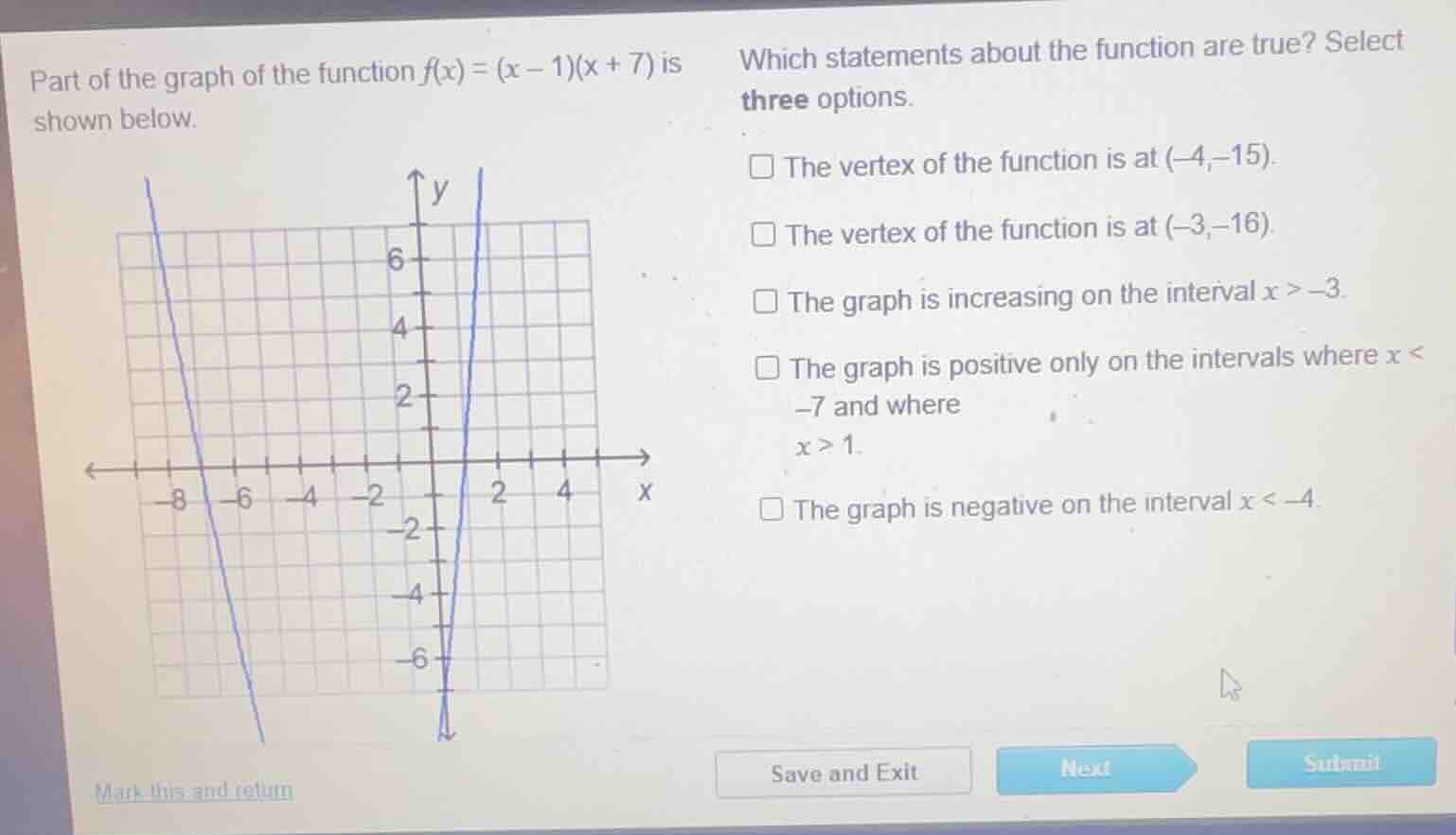
part of the graph of the function \\(f(x) = (x - 1)(x + 7)\\) is shown below.
which statements about the function are true? select three options.
the vertex of the function is at \\((-4, -15)\\).
the vertex of the function is at \\((-3, -16)\\).
the graph is increasing on the interval \\(x > -3\\).
the graph is positive only on the intervals where \\(x < -7\\) and where \\(x > 1\\).
the graph is negative on the interval \\(x < -4\\).
<pre_analysis>
{
"quality": "clear",
"question_count": 1,
"skills_matched": [
"step_cot",
"multiple_choice_formatter",
"explain_then_answer",
"tutor"
],
"needs_drawing": false,
"concepts_used": [
"Quadratic Vertex",
"Intercept Form"
],
"new_concepts": [
"Quadratic Intervals of Increase",
"Quadratic Sign Intervals"
],
"current_concepts": [
"Quadratic Vertex",
"Intercept Form",
"Quadratic Intervals of Increase",
"Quadratic Sign Intervals"
]
}
</pre_analysis>
<reasoning>
Find the x-intercepts and vertex
Using the Intercept Form knowledge point, we identify the x-intercepts of the function \(f(x) = (x - 1)(x + 7)\) by setting \(f(x) = 0\):
\[
x = 1 \quad \text{and} \quad x = -7
\]
Using the Quadratic Vertex knowledge point, the x-coordinate of the vertex \(h\) is the midpoint of the intercepts:
\[
h = \frac{1 + (-7)}{2} = -3
\]
We find the y-coordinate \(k\) by evaluating \(f(-3)\):
\[
k = f(-3) = (-3 - 1)(-3 + 7) = (-4)(4) = -16
\]
Thus, the vertex is at \((-3, -16)\).
Determine the interval of increase
Since the leading coefficient of \(f(x) = x^2 + 6x - 7\) is positive (\(a = 1 > 0\)), the parabola opens upward.
The graph decreases to the left of the vertex and increases to the right of the vertex.
Therefore, the graph is increasing on the interval:
\[
x > -3
\]
Determine where the graph is positive
The graph is positive (above the x-axis) outside the region between its x-intercepts.
Since the intercepts are at \(x = -7\) and \(x = 1\), the function is positive on the intervals:
\[
x < -7 \quad \text{and} \quad x > 1
\]
Evaluate the remaining statements
- "The vertex of the function is at \((-4, -15)\)": False, the vertex is at \((-3, -16)\).
- "The vertex of the function is at \((-3, -16)\)": True.
- "The graph is increasing on the interval \(x > -3\)": True.
- "The graph is positive only on the intervals where \(x < -7\) and where \(x > 1\)": True.
- "The graph is negative on the interval \(x < -4\)": False, the graph is negative on the interval \(-7 < x < 1\).
</reasoning>
<answer>
<mcq-option>The vertex of the function is at \((-4,-15)\).</mcq-option>
<mcq-correct>The vertex of the function is at \((-3,-16)\).</mcq-correct>
<mcq-correct>The graph is increasing on the interval \(x > -3\).</mcq-correct>
<mcq-correct>The graph is positive only on the intervals where \(x < -7\) and where \(x > 1\).</mcq-correct>
<mcq-option>The graph is negative on the interval \(x < -4\).</mcq-option>
</answer>
<post_analysis>
{
"subject": "Mathematics",
"question_type": "Multiple Choice",
"knowledge_point": [
"Mathematics",
"Algebra",
"Quadratic Vertex"
]
}
</post_analysis>
Snap & solve any problem in the app
Get step-by-step solutions on Sovi AI
Photo-based solutions with guided steps
Explore more problems and detailed explanations
<pre_analysis>
{
"quality": "clear",
"question_count": 1,
"skills_matched": [
"step_cot",
"multiple_choice_formatter",
"explain_then_answer",
"tutor"
],
"needs_drawing": false,
"concepts_used": [
"Quadratic Vertex",
"Intercept Form"
],
"new_concepts": [
"Quadratic Intervals of Increase",
"Quadratic Sign Intervals"
],
"current_concepts": [
"Quadratic Vertex",
"Intercept Form",
"Quadratic Intervals of Increase",
"Quadratic Sign Intervals"
]
}
</pre_analysis>
<reasoning>
Find the x-intercepts and vertex
Using the Intercept Form knowledge point, we identify the x-intercepts of the function \(f(x) = (x - 1)(x + 7)\) by setting \(f(x) = 0\):
\[
x = 1 \quad \text{and} \quad x = -7
\]
Using the Quadratic Vertex knowledge point, the x-coordinate of the vertex \(h\) is the midpoint of the intercepts:
\[
h = \frac{1 + (-7)}{2} = -3
\]
We find the y-coordinate \(k\) by evaluating \(f(-3)\):
\[
k = f(-3) = (-3 - 1)(-3 + 7) = (-4)(4) = -16
\]
Thus, the vertex is at \((-3, -16)\).
Determine the interval of increase
Since the leading coefficient of \(f(x) = x^2 + 6x - 7\) is positive (\(a = 1 > 0\)), the parabola opens upward.
The graph decreases to the left of the vertex and increases to the right of the vertex.
Therefore, the graph is increasing on the interval:
\[
x > -3
\]
Determine where the graph is positive
The graph is positive (above the x-axis) outside the region between its x-intercepts.
Since the intercepts are at \(x = -7\) and \(x = 1\), the function is positive on the intervals:
\[
x < -7 \quad \text{and} \quad x > 1
\]
Evaluate the remaining statements
- "The vertex of the function is at \((-4, -15)\)": False, the vertex is at \((-3, -16)\).
- "The vertex of the function is at \((-3, -16)\)": True.
- "The graph is increasing on the interval \(x > -3\)": True.
- "The graph is positive only on the intervals where \(x < -7\) and where \(x > 1\)": True.
- "The graph is negative on the interval \(x < -4\)": False, the graph is negative on the interval \(-7 < x < 1\).
</reasoning>
<answer>
<mcq-option>The vertex of the function is at \((-4,-15)\).</mcq-option>
<mcq-correct>The vertex of the function is at \((-3,-16)\).</mcq-correct>
<mcq-correct>The graph is increasing on the interval \(x > -3\).</mcq-correct>
<mcq-correct>The graph is positive only on the intervals where \(x < -7\) and where \(x > 1\).</mcq-correct>
<mcq-option>The graph is negative on the interval \(x < -4\).</mcq-option>
</answer>
<post_analysis>
{
"subject": "Mathematics",
"question_type": "Multiple Choice",
"knowledge_point": [
"Mathematics",
"Algebra",
"Quadratic Vertex"
]
}
</post_analysis>