QUESTION IMAGE
Question
part c
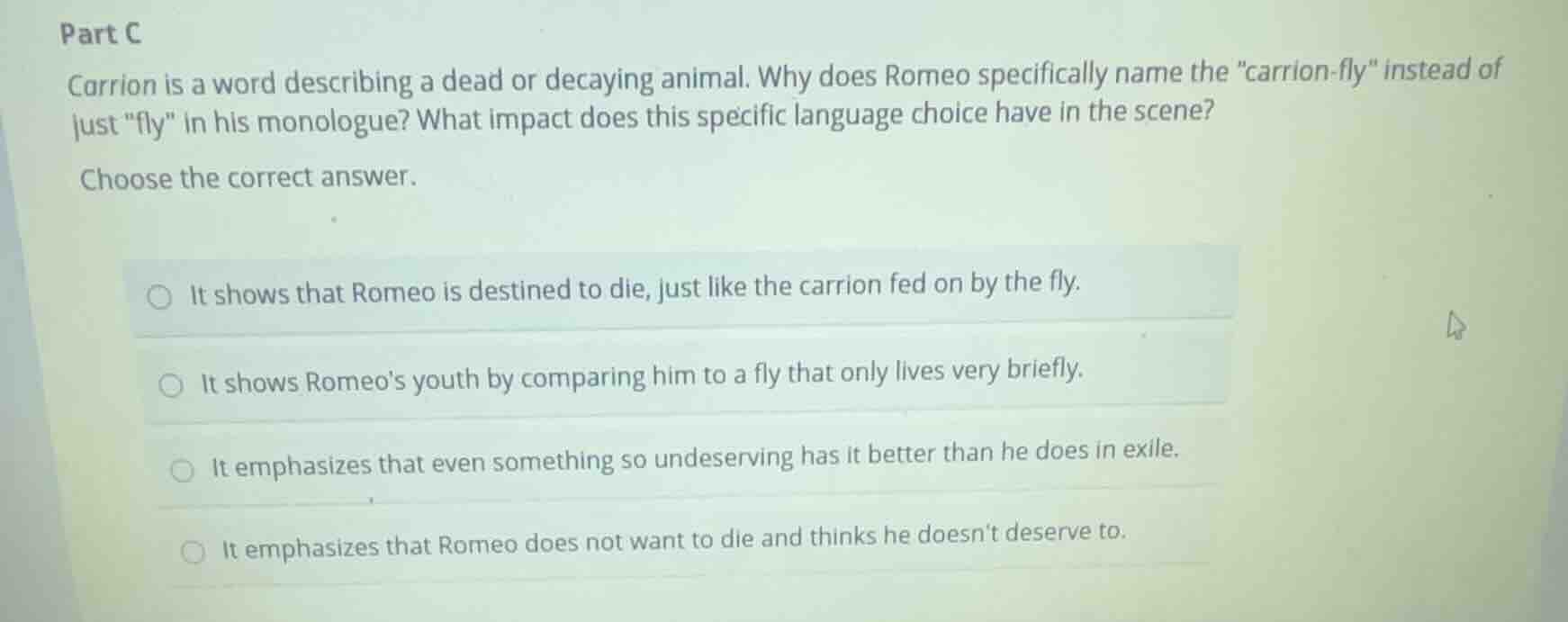
carrion is a word describing a dead or decaying animal. why does romeo specifically name the \carrion-fly\ instead of just \fly\ in his monologue? what impact does this specific language choice have in the scene?
choose the correct answer.
it shows that romeo is destined to die, just like the carrion fed on by the fly.
it shows romeos youth by comparing him to a fly that only lives very briefly.
it emphasizes that even something so undeserving has it better than he does in exile.
it emphasizes that romeo does not want to die and thinks he doesnt deserve to.
Analyze the meaning of "carrion-fly"
Romeo uses "carrion-fly" in Act 3, Scene 3 to contrast his banishment with the freedom of a low, disgusting insect. A carrion-fly feeds on dead, decaying flesh, making it a highly undeserving and filthy creature.
Evaluate the impact of the language choice
By specifying "carrion-fly" instead of just "fly," Romeo highlights how even the most vile, unworthy, and low creature has the privilege to look at and touch Juliet, whereas he, being banished, cannot. This emphasizes his despair and the idea that even something so undeserving has a better state than he does in exile.
Match with the correct option
The third option directly states: "It emphasizes that even something so undeserving has it better than he does in exile." This matches the analysis of Romeo's dramatic hyperbole.

Snap & solve any problem in the app
Get step-by-step solutions on Sovi AI
Photo-based solutions with guided steps
Explore more problems and detailed explanations
- (A) It shows that Romeo is destined to die, just like the carrion fed on by the fly.
- (B) It shows Romeo's youth by comparing him to a fly that only lives very briefly.
- (C) It emphasizes that even something so undeserving has it better than he does in exile. (Correct answer)
- (D) It emphasizes that Romeo does not want to die and thinks he doesn't deserve to.