QUESTION IMAGE
Question
part b
18 free-response questions
60 marks
show your working where appropriate.
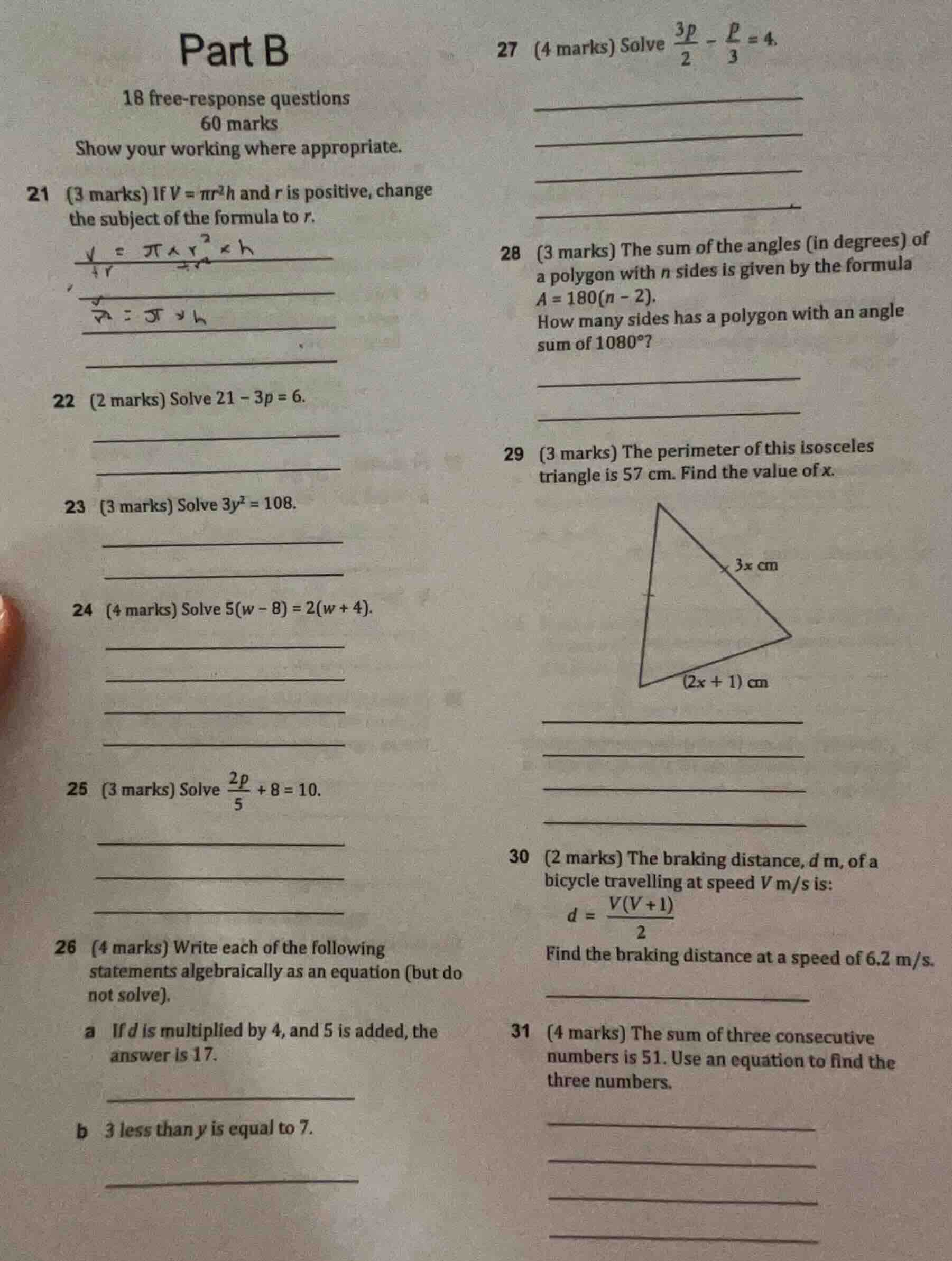
21 (3 marks) if \\(v = \pi r^2 h\\) and \\(r\\) is positive, change the subject of the formula to \\(r\\).
22 (2 marks) solve \\(21 - 3p = 6\\).
23 (3 marks) solve \\(3y^2 = 108\\).
24 (4 marks) solve \\(5(w - 8) = 2(w + 4)\\).
25 (3 marks) solve \\(\frac{2p}{5} + 8 = 10\\).
26 (4 marks) write each of the following statements algebraically as an equation (but do not solve).
a if \\(d\\) is multiplied by 4, and 5 is added, the answer is 17.
b 3 less than \\(y\\) is equal to 7.
27 (4 marks) solve \\(\frac{3p}{2} - \frac{p}{3} = 4\\).
28 (3 marks) the sum of the angles (in degrees) of a polygon with \\(n\\) sides is given by the formula \\(a = 180(n - 2)\\).
how many sides has a polygon with an angle sum of \\(1080^\circ\\)?
29 (3 marks) the perimeter of this isosceles triangle is 57 cm. find the value of \\(x\\).
an isosceles triangle is shown with two equal sides labeled \\(3x\text{ cm}\\) and the base labeled \\((2x + 1)\text{ cm}\\).
30 (2 marks) the braking distance, \\(d\text{ m}\\), of a bicycle travelling at speed \\(v\text{ m/s}\\) is:
\\d = \frac{v(v + 1)}{2}\\
find the braking distance at a speed of \\(6.2\text{ m/s}\\).
31 (4 marks) the sum of three consecutive numbers is 51. use an equation to find the three numbers.
⚡ Using what you learned: understanding linear equations
Step 1: Solve Question 21
Rearrange \( V = \pi r^2 h \) to make \( r \) the subject, given \( r > 0 \):
Step 2: Solve Question 22
Solve \( 21 - 3p = 6 \):
Step 3: Solve Question 23
Solve \( 3y^2 = 108 \):
Step 4: Solve Question 24
Solve \( 5(w - 8) = 2(w + 4) \):
Step 5: Solve Question 25
Solve \( \frac{2p}{5} + 8 = 10 \):
Step 6: Solve Question 26
Translate statements into algebraic equations:
- a "If \( d \) is multiplied by 4, and 5 is added, the answer is 17":
- b "3 less than \( y \) is equal to 7":
Step 7: Solve Question 27
Solve \( \frac{3p}{2} - \frac{p}{3} = 4 \). Multiply all terms by the lowest common denominator, 6:
Step 8: Solve Question 28
Solve \( 180(n - 2) = 1080 \):
Step 9: Solve Question 29
The triangle is isosceles. Based on the markings, the two sides of length \( 3x\text{ cm} \) are equal. The perimeter is \( 57\text{ cm} \):
Step 10: Solve Question 30
Substitute \( V = 6.2 \) into \( d = \frac{V(V + 1)}{2} \):
Step 11: Solve Question 31
Let the three consecutive numbers be \( x \), \( x + 1 \), and \( x + 2 \):
The three numbers are \( 16 \), \( 17 \), and \( 18 \).

Snap & solve any problem in the app
Get step-by-step solutions on Sovi AI
Photo-based solutions with guided steps
Explore more problems and detailed explanations
- 21: \( r = \sqrt{\frac{V}{\pi h}} \)
- 22: \( p = 5 \)
- 23: \( y = \pm 6 \)
- 24: \( w = 16 \)
- 25: \( p = 5 \)
- 26 a: \( 4d + 5 = 17 \)
- 26 b: \( y - 3 = 7 \)
- 27: \( p = \frac{24}{7} \) (or \( 3\frac{3}{7} \))
- 28: \( 8 \) sides
- 29: \( x = 7 \)
- 30: \( 22.32\text{ m} \)
- 31: \( 16, 17, 18 \)