QUESTION IMAGE
Question
this is a 2 - page document!
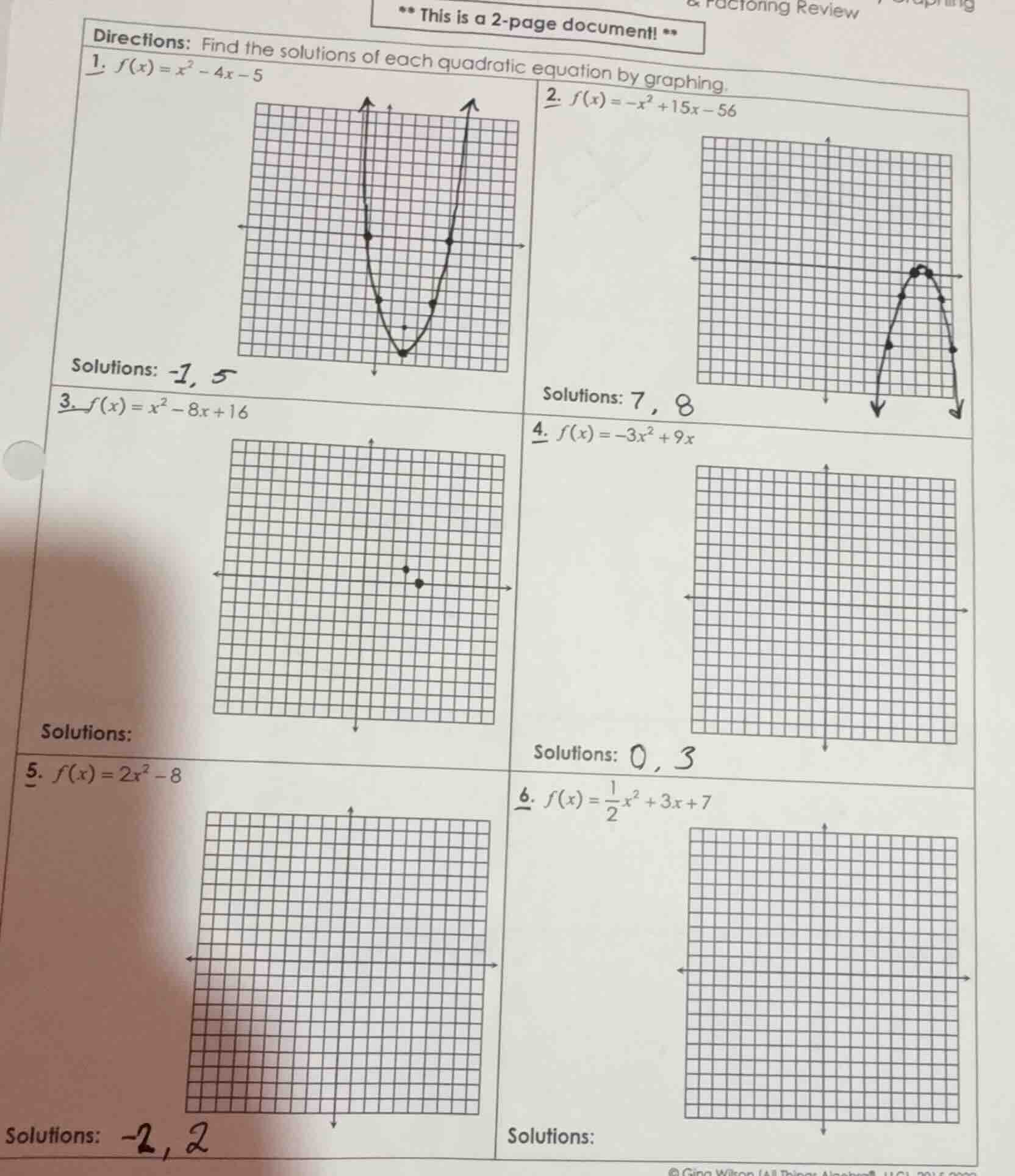
directions: find the solutions of each quadratic equation by graphing.
- $f(x)=x^2 - 4x - 5$
graph of the parabola for $f(x)=x^2 - 4x - 5$
solutions: -1, 5
- $f(x)=-x^2 + 15x - 56$
graph of the parabola for $f(x)=-x^2 + 15x - 56$
solutions: 7, 8
- $f(x)=x^2 - 8x + 16$
graph of the parabola for $f(x)=x^2 - 8x + 16$
solutions:
- $f(x)=-3x^2 + 9x$
graph of the parabola for $f(x)=-3x^2 + 9x$
solutions: 0, 3
- $f(x)=2x^2 - 8$
graph of the parabola for $f(x)=2x^2 - 8$
solutions: -2, 2
- $f(x)=\frac{1}{2}x^2 + 3x + 7$
graph of the parabola for $f(x)=\frac{1}{2}x^2 + 3x + 7$
solutions:
Problem 3: \( f(x) = x^2 - 8x + 16 \)
Step 1: Recognize the quadratic form
The function is a quadratic \( f(x)=x^2 - 8x + 16 \). We can factor it or use the vertex form. Notice that \( x^2 - 8x + 16=(x - 4)^2 \) (since \( (a - b)^2=a^2-2ab + b^2 \), here \( a = x \), \( 2ab=8x\Rightarrow b = 4 \)).
Step 2: Find the solution
To find the solutions, we set \( f(x)=0 \), so \( (x - 4)^2=0 \). Taking the square root of both sides, we get \( x-4 = 0\Rightarrow x = 4 \). Since the square of a number is zero only when the number itself is zero, this is a repeated root.
Step 1: Use the quadratic formula
For a quadratic equation \( ax^2+bx + c = 0 \), the solutions are given by \( x=\frac{-b\pm\sqrt{b^2 - 4ac}}{2a} \). Here, \( a=\frac{1}{2} \), \( b = 3 \), \( c = 7 \).
Step 2: Calculate the discriminant
First, calculate the discriminant \( D=b^2-4ac=(3)^2-4\times\frac{1}{2}\times7=9 - 14=- 5 \).
Step 3: Analyze the discriminant
Since the discriminant \( D=-5<0 \), the quadratic equation \( \frac{1}{2}x^2+3x + 7 = 0 \) has no real solutions (it has complex solutions, but if we are looking for real - valued solutions from the graph, since the parabola \( y = \frac{1}{2}x^2+3x + 7 \) opens upwards (because \( a=\frac{1}{2}>0 \)) and the discriminant is negative, the graph does not intersect the \( x \) - axis, so there are no real solutions.

Snap & solve any problem in the app
Get step-by-step solutions on Sovi AI
Photo-based solutions with guided steps
Explore more problems and detailed explanations
\( 4 \) (with multiplicity 2)