QUESTION IMAGE
Question
overview of federalism
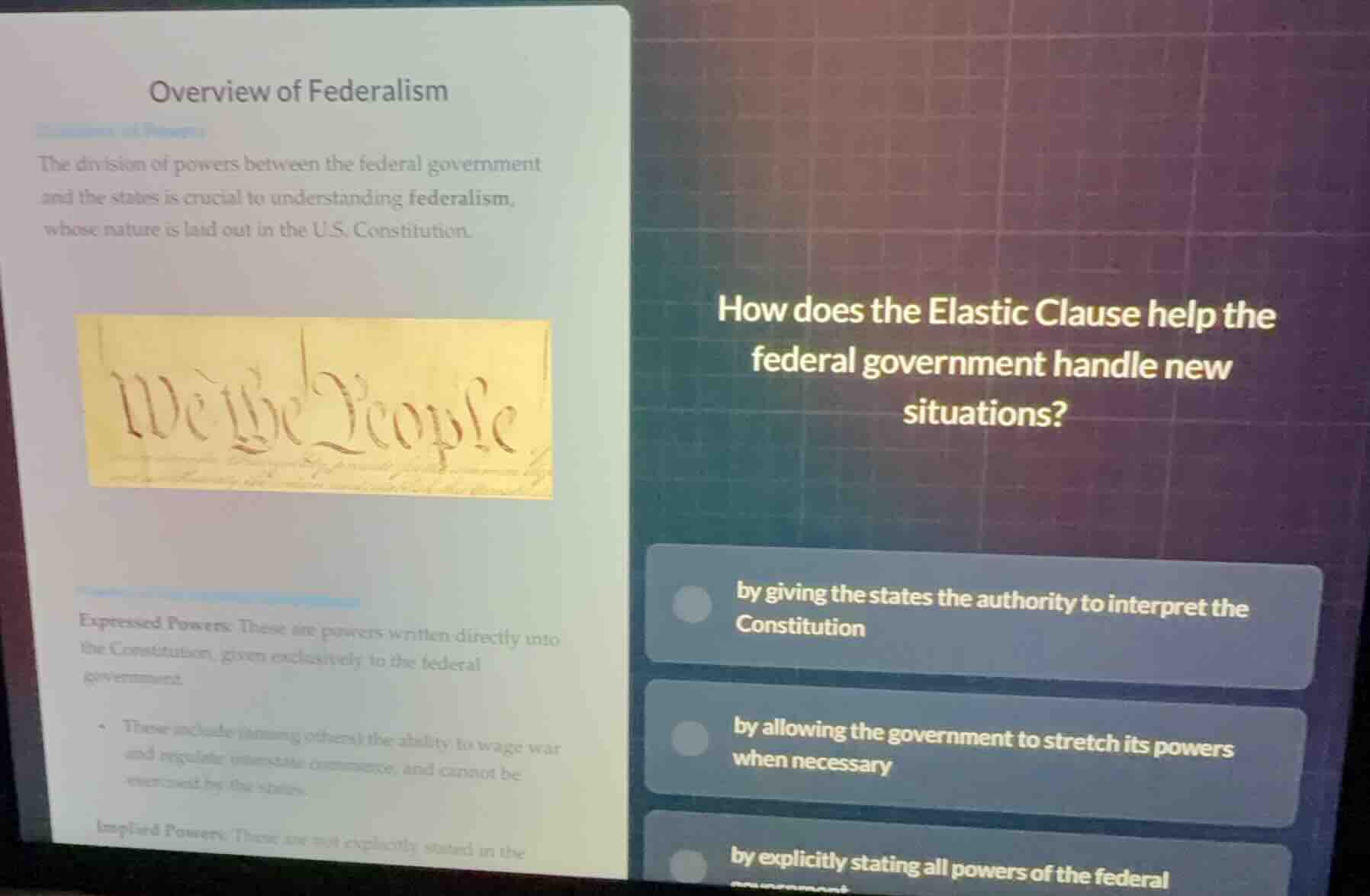
the division of powers between the federal government and the states is crucial to understanding federalism, whose nature is laid out in the u.s. constitution.
expressed powers: these are powers written directly into the constitution, given exclusively to the federal government.
- these include (among others) the ability to wage war and regulate interstate commerce, and cannot be exercised by the states.
implied powers: these are not explicitly stated in the
how does the elastic clause help the federal government handle new situations?
- by giving the states the authority to interpret the constitution
- by allowing the government to stretch its powers when necessary
- by explicitly stating all powers of the federal
The Elastic Clause (also called the Necessary and Proper Clause) is part of the U.S. Constitution that grants the federal government the ability to exercise powers not explicitly written, but that are necessary and proper to carry out its expressed powers. This flexibility lets it address unforeseen, new situations by stretching its authority as needed. The other options are incorrect: states do not get authority to interpret the Constitution for federal power via this clause, and it does not explicitly list all federal powers.

Snap & solve any problem in the app
Get step-by-step solutions on Sovi AI
Photo-based solutions with guided steps
Explore more problems and detailed explanations
by allowing the government to stretch its powers when necessary