QUESTION IMAGE
Question
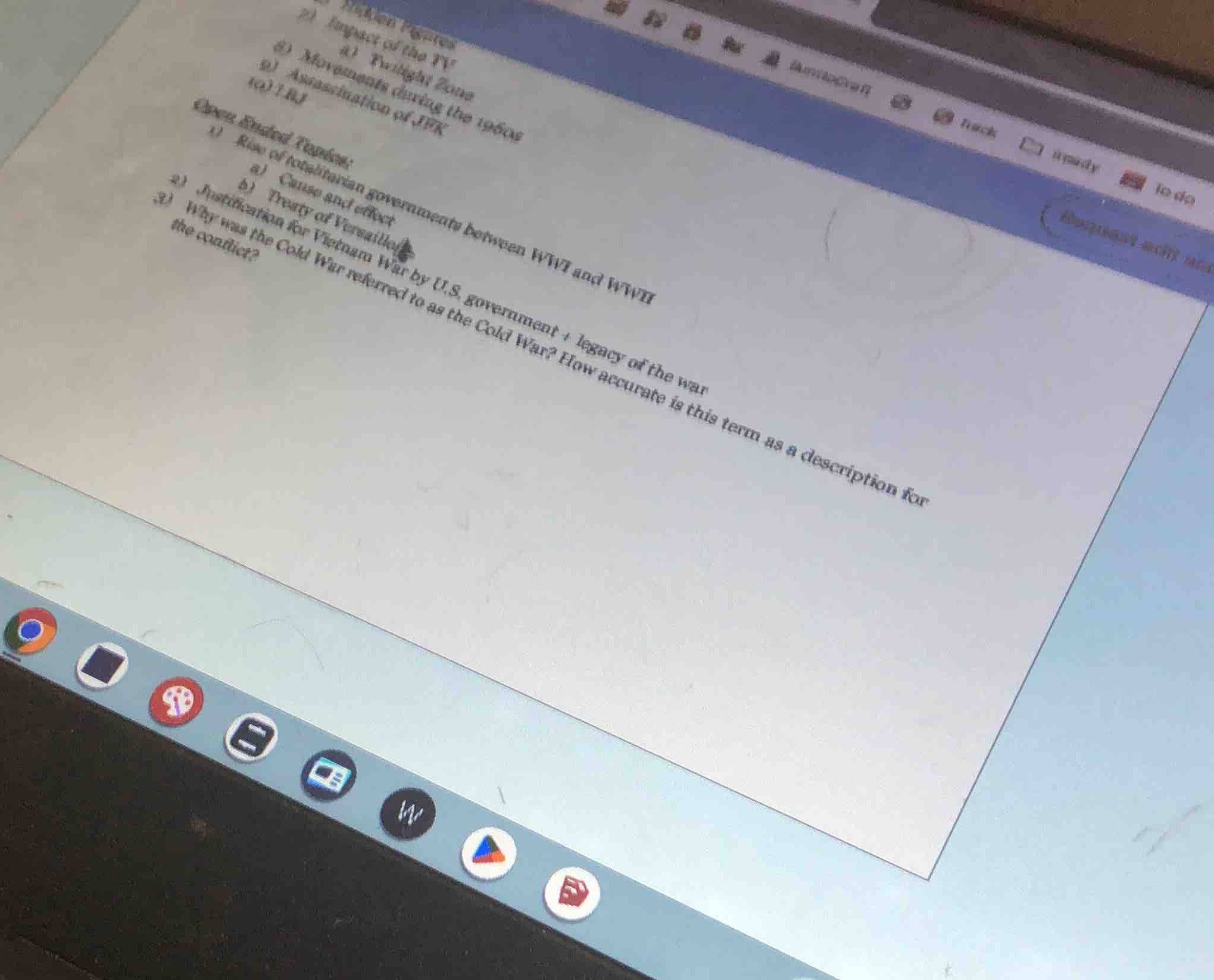
open ended topics:
- rise of totalitarian governments between wwi and wwii
a) cause and effect
b) treaty of versailles
- justification for vietnam war by u.s. government + legacy of the war
- why was the cold war referred to as the cold war? how accurate is this term as a description for the conflict?
Analyze totalitarian rise between WWI and WWII
The rise of totalitarian regimes (Fascist Italy, Nazi Germany, Soviet Union) was driven by post-WWI economic devastation, hyperinflation, and social unrest. The Treaty of Versailles fueled deep national resentment in Germany by imposing harsh reparations, territorial losses, and the "war guilt" clause, which demagogues exploited to dismantle democratic institutions.
Analyze Vietnam War justification and legacy
The U.S. government justified involvement using the Domino Theory, arguing that if South Vietnam fell to communism, neighboring nations would follow. The legacy of the war includes deep domestic political division, a widespread distrust of government intervention (Vietnam Syndrome), and devastating human and environmental costs in Southeast Asia.
Analyze the term "Cold War" and its accuracy
The conflict was called "Cold" because the United States and the Soviet Union never engaged in direct, large-scale military warfare. However, the term is only partially accurate; while "cold" in Europe, the conflict was extremely "hot" in the Global South, where millions died in devastating proxy wars, such as those in Korea, Vietnam, and Angola.

Snap & solve any problem in the app
Get step-by-step solutions on Sovi AI
Photo-based solutions with guided steps
Explore more problems and detailed explanations
Question 1
- Cause and Effect: Economic instability, high unemployment, and social chaos following World War I allowed authoritarian leaders to promise order and national rebirth, leading to the rise of totalitarian states.
- Treaty of Versailles: The treaty severely punished Germany, creating economic ruin and intense national humiliation, which Adolf Hitler directly exploited to gain public support and seize power.
Question 2
- Justification: The United States justified its military intervention through the "Domino Theory"—the belief that allowing South Vietnam to fall to communism would trigger a chain reaction of communist takeovers across Southeast Asia.
- Legacy: The war resulted in massive casualties, widespread environmental damage from chemical agents, a lasting skepticism among the American public toward foreign military interventions, and the eventual unification of Vietnam under a communist government.
Question 3
- Origin of the Term: The conflict was called the "Cold War" because the two primary superpowers, the United States and the Soviet Union, never directly declared war or fought each other on a traditional battlefield.
- Accuracy: The term is highly accurate regarding direct superpower conflict, which was limited to political tension, espionage, and nuclear brinkmanship. However, it is highly inaccurate for the Global South, where the rivalry fueled devastating "hot" proxy wars in regions like Korea, Vietnam, and Afghanistan, resulting in millions of deaths.