QUESTION IMAGE
Question
one-step inequalities
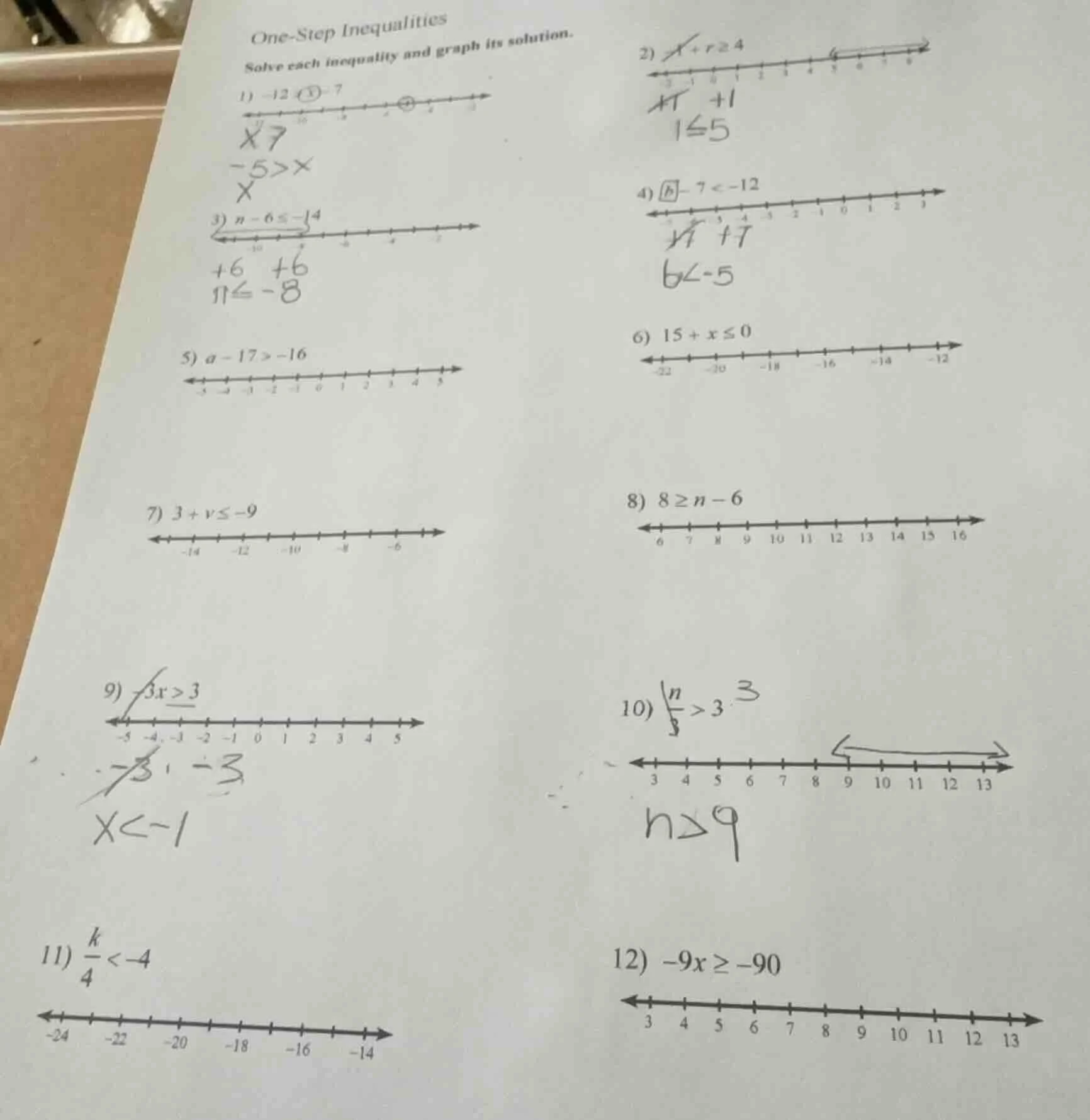
solve each inequality and graph its solution.
- $-12 < x - 7$
- $-1 + r \geq 4$
- $n - 6 \leq -14$
- $b - 7 < -12$
- $a - 17 > -16$
- $15 + x \leq 0$
- $3 + v \leq -9$
- $8 \geq n - 6$
- $-3x \geq 3$
- $\frac{n}{3} > 3$
- $\frac{k}{4} < -4$
- $-9x \geq -90$
Let's solve each one - step inequality:
1. Solve \(- 12\lt x - 7\)
Step 1: Isolate the variable \(x\)
Add 7 to both sides of the inequality. According to the addition property of inequalities, if \(a\lt b\), then \(a + c\lt b + c\) for any real number \(c\).
\(-12 + 7\lt x-7 + 7\)
Step 2: Simplify the inequality
Simplify both sides: \(-5\lt x\) or \(x\gt - 5\)
2. Solve \(1 + r\geq4\)
Step 1: Isolate the variable \(r\)
Subtract 1 from both sides of the inequality. If \(a + b\geq c\), then \(a\geq c - b\) (subtraction property of inequalities).
\(1+r - 1\geq4 - 1\)
Step 2: Simplify the inequality
Simplify both sides: \(r\geq3\)
3. Solve \(n - 6\leq-14\)
Step 1: Isolate the variable \(n\)
Add 6 to both sides of the inequality. Using the addition property of inequalities (\(a - b\leq c\Rightarrow a\leq c + b\))
\(n-6 + 6\leq-14 + 6\)
Step 2: Simplify the inequality
Simplify both sides: \(n\leq - 8\)
4. Solve \(b - 7\lt-12\)
Step 1: Isolate the variable \(b\)
Add 7 to both sides of the inequality. By the addition property of inequalities (\(a - b\lt c\Rightarrow a\lt c + b\))
\(b-7 + 7\lt-12 + 7\)
Step 2: Simplify the inequality
Simplify both sides: \(b\lt - 5\)
5. Solve \(a - 17\gt-16\)
Step 1: Isolate the variable \(a\)
Add 17 to both sides of the inequality. Using the addition property of inequalities (\(a - b\gt c\Rightarrow a\gt c + b\))
\(a-17 + 17\gt-16 + 17\)
Step 2: Simplify the inequality
Simplify both sides: \(a\gt1\)
6. Solve \(15 + x\leq0\)
Step 1: Isolate the variable \(x\)
Subtract 15 from both sides of the inequality. By the subtraction property of inequalities (\(a + b\leq c\Rightarrow a\leq c - b\))
\(15+x - 15\leq0 - 15\)
Step 2: Simplify the inequality
Simplify both sides: \(x\leq - 15\)
7. Solve \(3 + v\leq-9\)
Step 1: Isolate the variable \(v\)
Subtract 3 from both sides of the inequality. Using the subtraction property of inequalities (\(a + b\leq c\Rightarrow a\leq c - b\))
\(3 + v-3\leq-9 - 3\)
Step 2: Simplify the inequality
Simplify both sides: \(v\leq - 12\)
8. Solve \(8\geq n - 6\)
Step 1: Isolate the variable \(n\)
Add 6 to both sides of the inequality. By the addition property of inequalities (\(a\geq b - c\Rightarrow a + c\geq b\))
\(8 + 6\geq n-6 + 6\)
Step 2: Simplify the inequality
Simplify both sides: \(14\geq n\) or \(n\leq14\)
9. Solve \(-3x\geq3\)
Step 1: Isolate the variable \(x\)
Divide both sides of the inequality by - 3. When dividing an inequality by a negative number, the direction of the inequality sign changes. If \(a\gt0\) and \(-ax\geq b\), then \(x\leq-\frac{b}{a}\)
\(\frac{-3x}{-3}\leq\frac{3}{-3}\)
Step 2: Simplify the inequality
Simplify both sides: \(x\leq - 1\)
10. Solve \(\frac{n}{3}\gt3\)
Step 1: Isolate the variable \(n\)
Multiply both sides of the inequality by 3. According to the multiplication property of inequalities, if \(a\gt0\) and \(\frac{x}{a}\gt b\), then \(x\gt ab\)
\(\frac{n}{3}\times3\gt3\times3\)
Step 2: Simplify the inequality
Simplify both sides: \(n\gt9\)
11. Solve \(\frac{k}{4}\lt - 4\)
Step 1: Isolate the variable \(k\)
Multiply both sides of the inequality by 4. Using the multiplication property of inequalities, if \(a\gt0\) and \(\frac{x}{a}\lt b\), then \(x\lt ab\)
\(\frac{k}{4}\times4\lt - 4\times4\)
Step 2: Simplify the inequality
Simplify both sides: \(k\lt - 16\)
12. Solve \(-9x\geq - 90\)
Step 1: Isolate the variable \(x\)
Divide both sides of the inequality by - 9. When dividing an inequality by a negative number, the direction…

Snap & solve any problem in the app
Get step-by-step solutions on Sovi AI
Photo-based solutions with guided steps
Explore more problems and detailed explanations
Let's solve each one - step inequality:
1. Solve \(- 12\lt x - 7\)
Step 1: Isolate the variable \(x\)
Add 7 to both sides of the inequality. According to the addition property of inequalities, if \(a\lt b\), then \(a + c\lt b + c\) for any real number \(c\).
\(-12 + 7\lt x-7 + 7\)
Step 2: Simplify the inequality
Simplify both sides: \(-5\lt x\) or \(x\gt - 5\)
2. Solve \(1 + r\geq4\)
Step 1: Isolate the variable \(r\)
Subtract 1 from both sides of the inequality. If \(a + b\geq c\), then \(a\geq c - b\) (subtraction property of inequalities).
\(1+r - 1\geq4 - 1\)
Step 2: Simplify the inequality
Simplify both sides: \(r\geq3\)
3. Solve \(n - 6\leq-14\)
Step 1: Isolate the variable \(n\)
Add 6 to both sides of the inequality. Using the addition property of inequalities (\(a - b\leq c\Rightarrow a\leq c + b\))
\(n-6 + 6\leq-14 + 6\)
Step 2: Simplify the inequality
Simplify both sides: \(n\leq - 8\)
4. Solve \(b - 7\lt-12\)
Step 1: Isolate the variable \(b\)
Add 7 to both sides of the inequality. By the addition property of inequalities (\(a - b\lt c\Rightarrow a\lt c + b\))
\(b-7 + 7\lt-12 + 7\)
Step 2: Simplify the inequality
Simplify both sides: \(b\lt - 5\)
5. Solve \(a - 17\gt-16\)
Step 1: Isolate the variable \(a\)
Add 17 to both sides of the inequality. Using the addition property of inequalities (\(a - b\gt c\Rightarrow a\gt c + b\))
\(a-17 + 17\gt-16 + 17\)
Step 2: Simplify the inequality
Simplify both sides: \(a\gt1\)
6. Solve \(15 + x\leq0\)
Step 1: Isolate the variable \(x\)
Subtract 15 from both sides of the inequality. By the subtraction property of inequalities (\(a + b\leq c\Rightarrow a\leq c - b\))
\(15+x - 15\leq0 - 15\)
Step 2: Simplify the inequality
Simplify both sides: \(x\leq - 15\)
7. Solve \(3 + v\leq-9\)
Step 1: Isolate the variable \(v\)
Subtract 3 from both sides of the inequality. Using the subtraction property of inequalities (\(a + b\leq c\Rightarrow a\leq c - b\))
\(3 + v-3\leq-9 - 3\)
Step 2: Simplify the inequality
Simplify both sides: \(v\leq - 12\)
8. Solve \(8\geq n - 6\)
Step 1: Isolate the variable \(n\)
Add 6 to both sides of the inequality. By the addition property of inequalities (\(a\geq b - c\Rightarrow a + c\geq b\))
\(8 + 6\geq n-6 + 6\)
Step 2: Simplify the inequality
Simplify both sides: \(14\geq n\) or \(n\leq14\)
9. Solve \(-3x\geq3\)
Step 1: Isolate the variable \(x\)
Divide both sides of the inequality by - 3. When dividing an inequality by a negative number, the direction of the inequality sign changes. If \(a\gt0\) and \(-ax\geq b\), then \(x\leq-\frac{b}{a}\)
\(\frac{-3x}{-3}\leq\frac{3}{-3}\)
Step 2: Simplify the inequality
Simplify both sides: \(x\leq - 1\)
10. Solve \(\frac{n}{3}\gt3\)
Step 1: Isolate the variable \(n\)
Multiply both sides of the inequality by 3. According to the multiplication property of inequalities, if \(a\gt0\) and \(\frac{x}{a}\gt b\), then \(x\gt ab\)
\(\frac{n}{3}\times3\gt3\times3\)
Step 2: Simplify the inequality
Simplify both sides: \(n\gt9\)
11. Solve \(\frac{k}{4}\lt - 4\)
Step 1: Isolate the variable \(k\)
Multiply both sides of the inequality by 4. Using the multiplication property of inequalities, if \(a\gt0\) and \(\frac{x}{a}\lt b\), then \(x\lt ab\)
\(\frac{k}{4}\times4\lt - 4\times4\)
Step 2: Simplify the inequality
Simplify both sides: \(k\lt - 16\)
12. Solve \(-9x\geq - 90\)
Step 1: Isolate the variable \(x\)
Divide both sides of the inequality by - 9. When dividing an inequality by a negative number, the direction of the inequality sign changes. If \(a\gt0\) and \(-ax\geq b\), then \(x\leq-\frac{b}{a}\)
\(\frac{-9x}{-9}\leq\frac{-90}{-9}\)
Step 2: Simplify the inequality
Simplify both sides: \(x\leq10\)
Graphing the solutions:
- For \(x\gt - 5\): Draw an open circle at \(x=-5\) and a line with an arrow pointing to the right.
- For \(r\geq3\): Draw a closed circle at \(r = 3\) and a line with an arrow pointing to the right.
- For \(n\leq - 8\): Draw a closed circle at \(n=-8\) and a line with an arrow pointing to the left.
- For \(b\lt - 5\): Draw an open circle at \(b = - 5\) and a line with an arrow pointing to the left.
- For \(a\gt1\): Draw an open circle at \(a = 1\) and a line with an arrow pointing to the right.
- For \(x\leq - 15\): Draw a closed circle at \(x=-15\) and a line with an arrow pointing to the left.
- For \(v\leq - 12\): Draw a closed circle at \(v=-12\) and a line with an arrow pointing to the left.
- For \(n\leq14\): Draw a closed circle at \(n = 14\) and a line with an arrow pointing to the left.
- For \(x\leq - 1\): Draw a closed circle at \(x=-1\) and a line with an arrow pointing to the left.
- For \(n\gt9\): Draw an open circle at \(n = 9\) and a line with an arrow pointing to the right.
- For \(k\lt - 16\): Draw an open circle at \(k=-16\) and a line with an arrow pointing to the left.
- For \(x\leq10\): Draw a closed circle at \(x = 10\) and a line with an arrow pointing to the left.