QUESTION IMAGE
Question
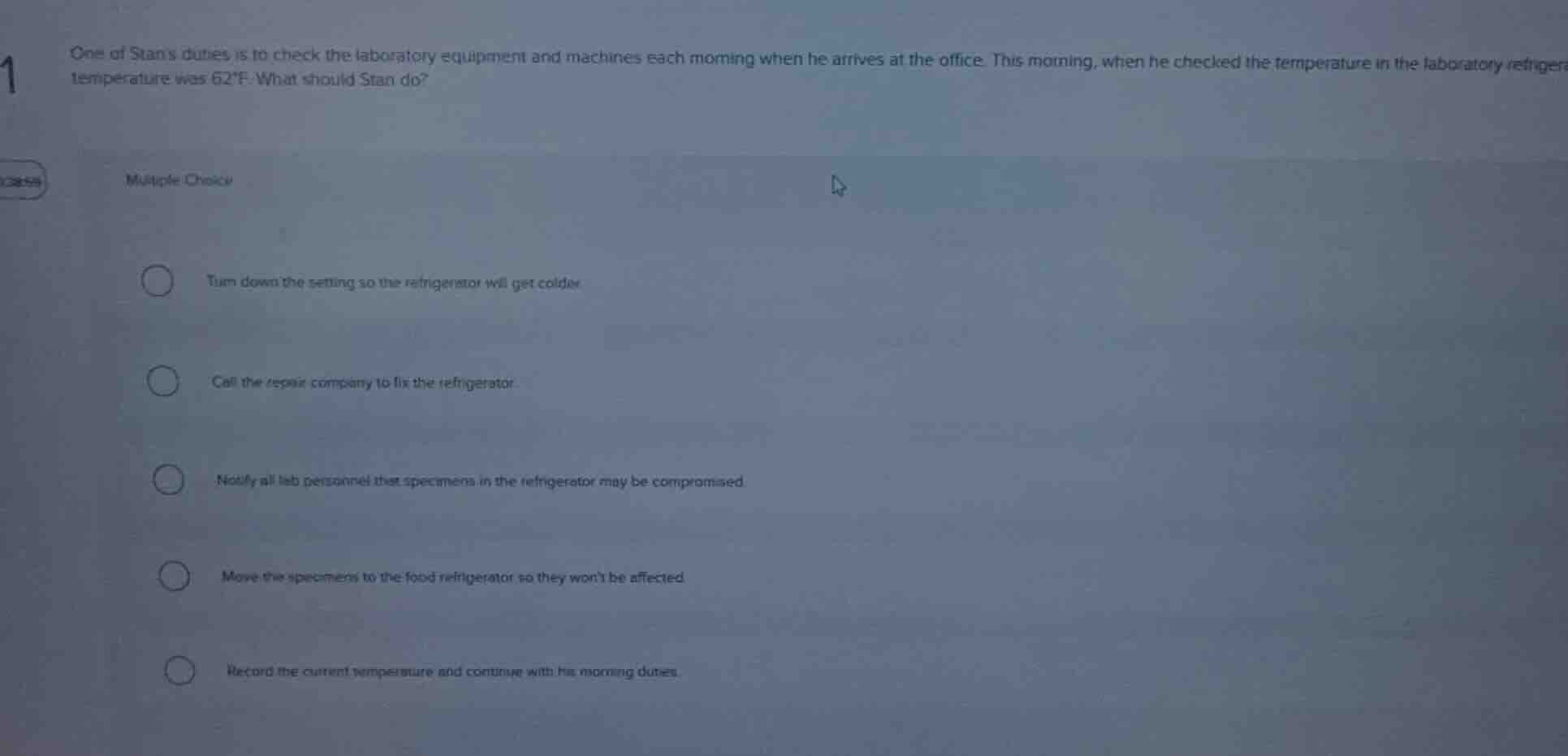
one of stans duties is to check the laboratory equipment and machines each morning when he arrives at the office. this morning, when he checked the temperature in the laboratory refrigerator, the temperature was 62°f. what should stan do?
multiple choice
turn down the setting so the refrigerator will get colder.
call the repair company to fix the refrigerator.
notify all lab personnel that specimens in the refrigerator may be compromised.
move the specimens to the food refrigerator so they wont be affected.
record the current temperature and continue with his morning duties.
Analyze the clinical scenario
The scenario describes a medical assistant, Stan, whose morning duties include checking laboratory equipment. He finds that the laboratory refrigerator temperature is \(62^\circ\text{F}\) (approximately \(16.7^\circ\text{C}\)).
Determine standard laboratory refrigerator temperature
Standard clinical laboratory refrigerators must maintain a temperature range of \(36^\circ\text{F}\) to \(46^\circ\text{F}\) (\(2^\circ\text{C}\) to \(8^\circ\text{C}\)) to preserve the integrity of biological specimens, reagents, and testing kits. A temperature of \(62^\circ\text{F}\) is significantly elevated and falls well outside the safe operating range.
Evaluate the immediate risk
Because the temperature is far too high, any specimens, controls, or reagents stored inside the refrigerator are at immediate risk of degradation or spoilage. This can lead to inaccurate test results, compromising patient care.
Identify the correct protocol
The primary and most urgent responsibility when a storage temperature deviation is detected is to protect patient safety and data integrity. Stan must immediately notify all laboratory personnel so that they are aware that any specimens stored inside may be compromised and that no further testing should be performed using reagents from that unit until they are verified.
Rule out incorrect options
- Turn down the setting: Adjusting the dial does not address the immediate threat to the specimens already inside, and the unit may be broken.
- Call the repair company: While necessary, this is not the immediate first step before alerting staff about compromised specimens.
- Move specimens to the food refrigerator: Storing clinical specimens in a refrigerator used for food or beverages is a severe violation of OSHA regulations.
- Record and continue: Ignoring the deviation and continuing normal duties puts patient specimens and test accuracy at risk.

Snap & solve any problem in the app
Get step-by-step solutions on Sovi AI
Photo-based solutions with guided steps
Explore more problems and detailed explanations
- Turn down the setting so the refrigerator will get colder
- Call the repair company to fix the refrigerator
- Notify all lab personnel that specimens in the refrigerator may be compromised (Correct answer)
- Move the specimens to the food refrigerator so they won't be affected
- Record the current temperature and continue with his morning duties