QUESTION IMAGE
Question
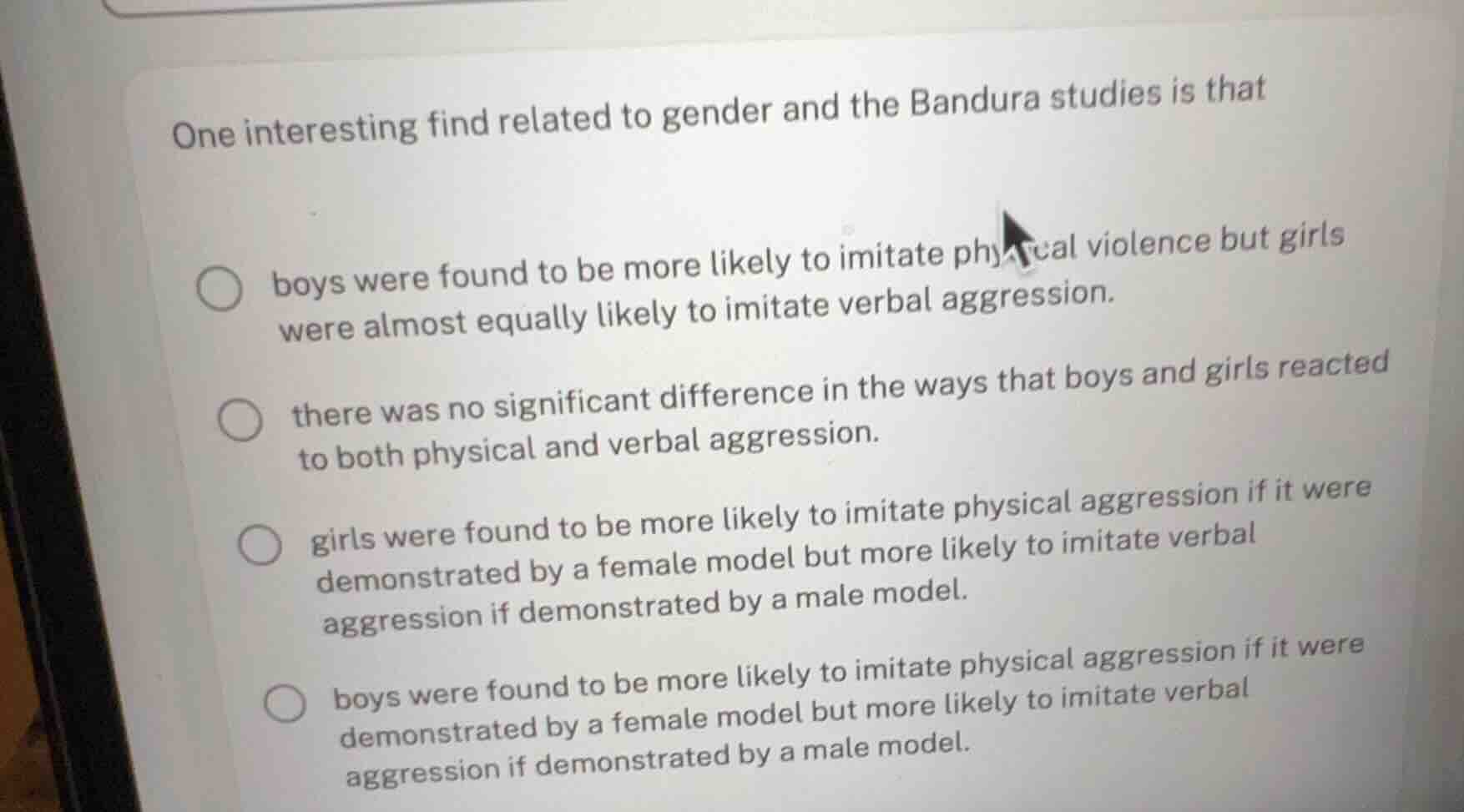
one interesting find related to gender and the bandura studies is that
boys were found to be more likely to imitate physical violence but girls were almost equally likely to imitate verbal aggression.
there was no significant difference in the ways that boys and girls reacted to both physical and verbal aggression.
girls were found to be more likely to imitate physical aggression if it were demonstrated by a female model but more likely to imitate verbal aggression if demonstrated by a male model.
boys were found to be more likely to imitate physical aggression if it were demonstrated by a female model but more likely to imitate verbal aggression if demonstrated by a male model.
<pre_analysis>
{
"quality": "clear",
"question_count": 1,
"skills_matched": [
"direct_cot",
"multiple_choice_formatter",
"explain_then_answer",
"tutor",
"mastery_adaptive_brevity"
],
"needs_drawing": false,
"concepts_used": [
"Bobo Doll Experiment",
"Gender Roles in Imitation",
"Albert Bandura Theory"
],
"new_concepts": [],
"current_concepts": [
"Bobo Doll Experiment",
"Gender Roles in Imitation",
"Albert Bandura Theory"
]
}
</pre_analysis>
<reasoning>
Analyze the question and options
The question asks about an interesting finding related to gender in Albert Bandura's observational learning studies (specifically the famous Bobo doll experiments).
Evaluate the findings on gender differences
Using the Bobo Doll Experiment and Albert Bandura Theory knowledge points:
- Bandura's research analyzed how children imitate physical and verbal aggression.
- A key finding regarding gender was that boys showed significantly more physical aggression than girls.
- However, when looking at verbal aggression, the difference between genders was much smaller, with girls being nearly as likely as boys to imitate verbal aggression.
Using the Gender Roles in Imitation knowledge point:
- Boys were more likely to imitate physical violence overall.
- Girls were almost equally likely to imitate verbal aggression.
- This matches the first option: "boys were found to be more likely to imitate physical violence but girls were almost equally likely to imitate verbal aggression."
- The other options regarding model-gender interactions do not accurately represent this specific general finding regarding physical vs. verbal imitation rates.
</reasoning>
<answer>
<mcq-correct>(A) boys were found to be more likely to imitate physical violence but girls were almost equally likely to imitate verbal aggression.</mcq-correct>
<mcq-option>(B) there was no significant difference in the ways that boys and girls reacted to both physical and verbal aggression.</mcq-option>
<mcq-option>(C) girls were found to be more likely to imitate physical aggression if it were demonstrated by a female model but more likely to imitate verbal aggression if demonstrated by a male model.</mcq-option>
<mcq-option>(D) boys were found to be more likely to imitate physical aggression if it were demonstrated by a female model but more likely to imitate verbal aggression if demonstrated by a male model.</mcq-option>
</answer>
<post_analysis>
{
"subject": "Social Science",
"question_type": "Multiple Choice",
"knowledge_point": [
"Social Science",
"Psychology",
"Observational Learning"
]
}
</post_analysis>
Snap & solve any problem in the app
Get step-by-step solutions on Sovi AI
Photo-based solutions with guided steps
Explore more problems and detailed explanations
<pre_analysis>
{
"quality": "clear",
"question_count": 1,
"skills_matched": [
"direct_cot",
"multiple_choice_formatter",
"explain_then_answer",
"tutor",
"mastery_adaptive_brevity"
],
"needs_drawing": false,
"concepts_used": [
"Bobo Doll Experiment",
"Gender Roles in Imitation",
"Albert Bandura Theory"
],
"new_concepts": [],
"current_concepts": [
"Bobo Doll Experiment",
"Gender Roles in Imitation",
"Albert Bandura Theory"
]
}
</pre_analysis>
<reasoning>
Analyze the question and options
The question asks about an interesting finding related to gender in Albert Bandura's observational learning studies (specifically the famous Bobo doll experiments).
Evaluate the findings on gender differences
Using the Bobo Doll Experiment and Albert Bandura Theory knowledge points:
- Bandura's research analyzed how children imitate physical and verbal aggression.
- A key finding regarding gender was that boys showed significantly more physical aggression than girls.
- However, when looking at verbal aggression, the difference between genders was much smaller, with girls being nearly as likely as boys to imitate verbal aggression.
Using the Gender Roles in Imitation knowledge point:
- Boys were more likely to imitate physical violence overall.
- Girls were almost equally likely to imitate verbal aggression.
- This matches the first option: "boys were found to be more likely to imitate physical violence but girls were almost equally likely to imitate verbal aggression."
- The other options regarding model-gender interactions do not accurately represent this specific general finding regarding physical vs. verbal imitation rates.
</reasoning>
<answer>
<mcq-correct>(A) boys were found to be more likely to imitate physical violence but girls were almost equally likely to imitate verbal aggression.</mcq-correct>
<mcq-option>(B) there was no significant difference in the ways that boys and girls reacted to both physical and verbal aggression.</mcq-option>
<mcq-option>(C) girls were found to be more likely to imitate physical aggression if it were demonstrated by a female model but more likely to imitate verbal aggression if demonstrated by a male model.</mcq-option>
<mcq-option>(D) boys were found to be more likely to imitate physical aggression if it were demonstrated by a female model but more likely to imitate verbal aggression if demonstrated by a male model.</mcq-option>
</answer>
<post_analysis>
{
"subject": "Social Science",
"question_type": "Multiple Choice",
"knowledge_point": [
"Social Science",
"Psychology",
"Observational Learning"
]
}
</post_analysis>