QUESTION IMAGE
Question
objectives
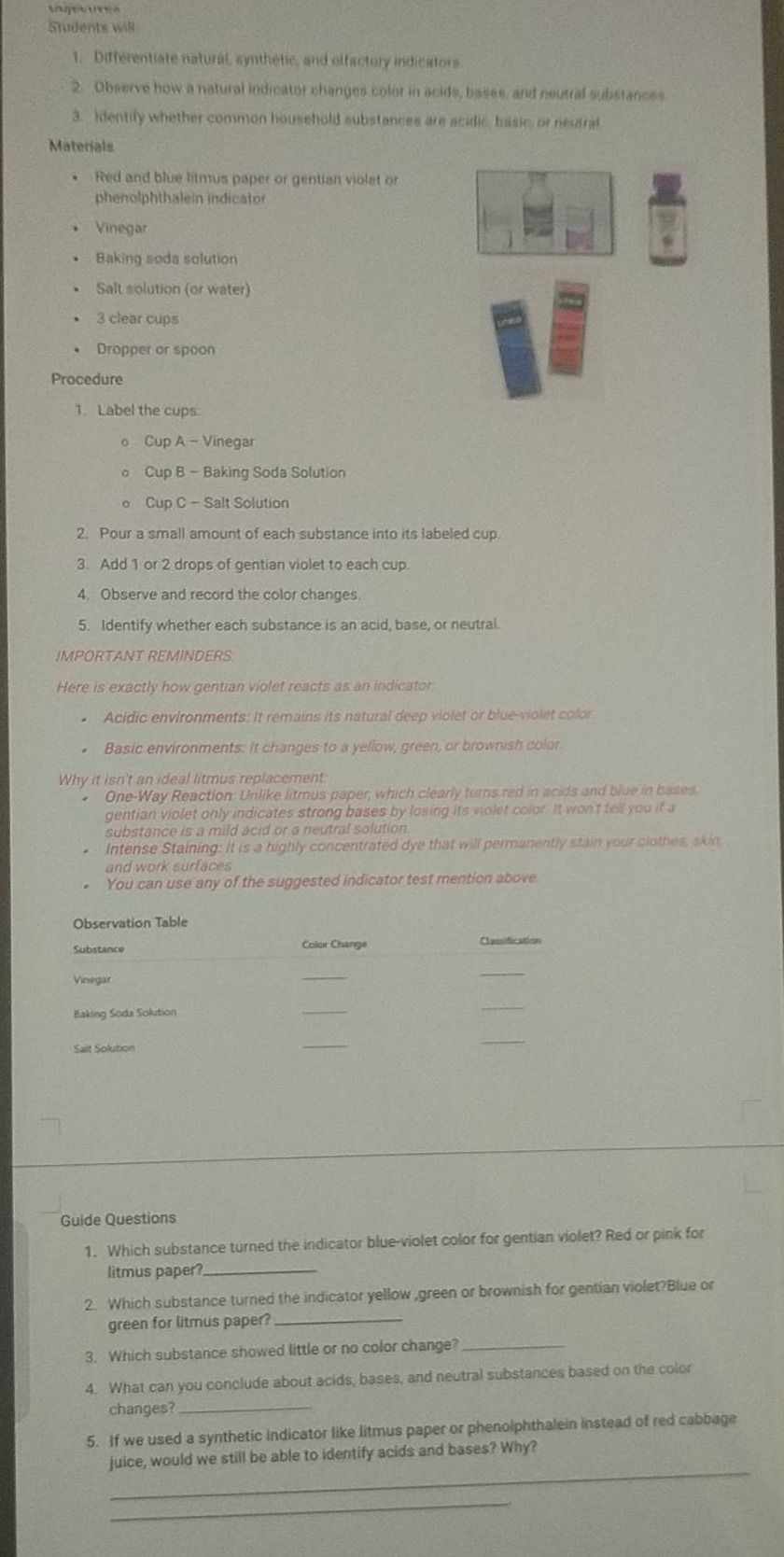
students will
- differentiate natural, synthetic, and olfactory indicators.
- observe how a natural indicator changes color in acids, bases, and neutral substances.
- identify whether common household substances are acidic, basic, or neutral.
materials
- red and blue litmus paper or gentian violet or phenolphthalein indicator
- vinegar
- baking soda solution
- salt solution (or water)
- 3 clear cups
- dropper or spoon
procedure
- label the cups:
- cup a - vinegar
- cup b - baking soda solution
- cup c - salt solution
- pour a small amount of each substance into its labeled cup.
- add 1 or 2 drops of gentian violet to each cup.
- observe and record the color changes.
- identify whether each substance is an acid, base, or neutral.
important reminders:
here is exactly how gentian violet reacts as an indicator:
- acidic environments: it remains its natural deep violet or blue-violet color.
- basic environments: it changes to a yellow, green, or brownish color.
why it isnt an ideal litmus replacement:
- one-way reaction: unlike litmus paper, which clearly turns red in acids and blue in bases, gentian violet only indicates strong bases by losing its violet color. it wont tell you if a substance is a mild acid or a neutral solution.
- intense staining: it is a highly concentrated dye that will permanently stain your clothes, skin, and work surfaces.
- you can use any of the suggested indicator test mention above.
observation table
\
$$\begin{tabular}{|l|l|l|}
\\hline
substance & color change & classification \\\\
\\hline
vinegar & & \\\\
\\hline
baking soda solution & & \\\\
\\hline
salt solution & & \\\\
\\hline
\\end{tabular}$$
guide questions
- which substance turned the indicator blue-violet color for gentian violet? red or pink for litmus paper?
- which substance turned the indicator yellow, green or brownish for gentian violet? blue or green for litmus paper?
- which substance showed little or no color change?
- what can you conclude about acids, bases, and neutral substances based on the color changes?
- if we used a synthetic indicator like litmus paper or phenolphthalein instead of red cabbage juice, would we still be able to identify acids and bases? why?
🆕 New Concept Discovered: Acid-Base Indicators
How substances change color to reveal pH levels.
Step 1: Complete the Observation Table
To answer the guide questions, we first determine the properties, expected color changes, and classifications for each substance using the lab instructions:
- Vinegar is acidic (acetic acid).
- Gentian Violet: Remains deep violet / blue-violet.
- Litmus Paper: Turns red/pink.
- Classification: Acid
- Baking Soda Solution is basic (sodium bicarbonate).
- Gentian Violet: Changes to yellow, green, or brownish.
- Litmus Paper: Turns blue/green.
- Classification: Base
- Salt Solution is neutral (sodium chloride in water).
- Gentian Violet: No significant color change (remains its original violet color).
- Litmus Paper: No color change (red stays red, blue stays blue).
- Classification: Neutral
---
Step 2: Answer Guide Questions 1 & 2
- Question 1: Which substance turned the indicator blue-violet color for gentian violet? Red or pink for litmus paper?
- Reasoning: These color changes indicate an acidic environment. Vinegar is the acidic substance in this experiment.
- Answer: Vinegar
- Question 2: Which substance turned the indicator yellow, green or brownish for gentian violet? Blue or green for litmus paper?
- Reasoning: These color changes indicate a basic environment. Baking soda solution is the basic substance in this experiment.
- Answer: Baking Soda Solution
---
Step 3: Answer Guide Question 3
- Question 3: Which substance showed little or no color change?
- Reasoning: Neutral substances do not trigger the color-changing chemical reactions of these indicators. Salt solution is neutral.
- Answer: Salt Solution
---
Step 4: Answer Guide Question 4
- Question 4: What can you conclude about acids, bases, and neutral substances based on the color changes?
- Reasoning: Indicators change to distinct colors depending on whether they are in contact with an acid or a base, while neutral substances do not cause a characteristic reaction.
- Answer: Different chemical substances (acids, bases, and neutrals) react differently with indicators, causing distinct color changes that allow us to classify them. Acids turn litmus red and keep gentian violet blue-violet; bases turn litmus blue and turn gentian violet yellow/green/brown; neutral substances do not change the indicator's color.
---
Step 5: Answer Guide Question 5
- Question 5: If we used a synthetic indicator like litmus paper or phenolphthalein instead of red cabbage juice, would we still be able to identify acids and bases? Why?
- Reasoning: Synthetic indicators are specifically designed to change colors at precise pH thresholds. Litmus paper turns red in acids and blue in bases. Phenolphthalein turns bright pink in bases and remains colorless in acids.
- Answer: Yes, we would still be able to identify them. Synthetic indicators like litmus paper and phenolphthalein undergo highly predictable, distinct color changes at specific pH levels, making them reliable tools for distinguishing between acidic and basic substances.
---

Snap & solve any problem in the app
Get step-by-step solutions on Sovi AI
Photo-based solutions with guided steps
Explore more problems and detailed explanations
Observation Table Summary
- Vinegar: Blue-violet (Gentian Violet) / Red (Litmus) | Classification: Acid
- Baking Soda Solution: Yellow/Green/Brown (Gentian Violet) / Blue (Litmus) | Classification: Base
- Salt Solution: No change / Violet | Classification: Neutral
Guide Questions Answers
- Vinegar
- Baking Soda Solution
- Salt Solution
- Conclusion: Acids, bases, and neutral substances can be identified and classified because they cause distinct, predictable color changes when mixed with chemical indicators.
- Yes. Synthetic indicators like litmus paper and phenolphthalein are specifically designed to change colors in the presence of acids and bases (e.g., litmus turns red in acids and blue in bases; phenolphthalein turns pink in bases), making them highly effective for identification.