QUESTION IMAGE
Question
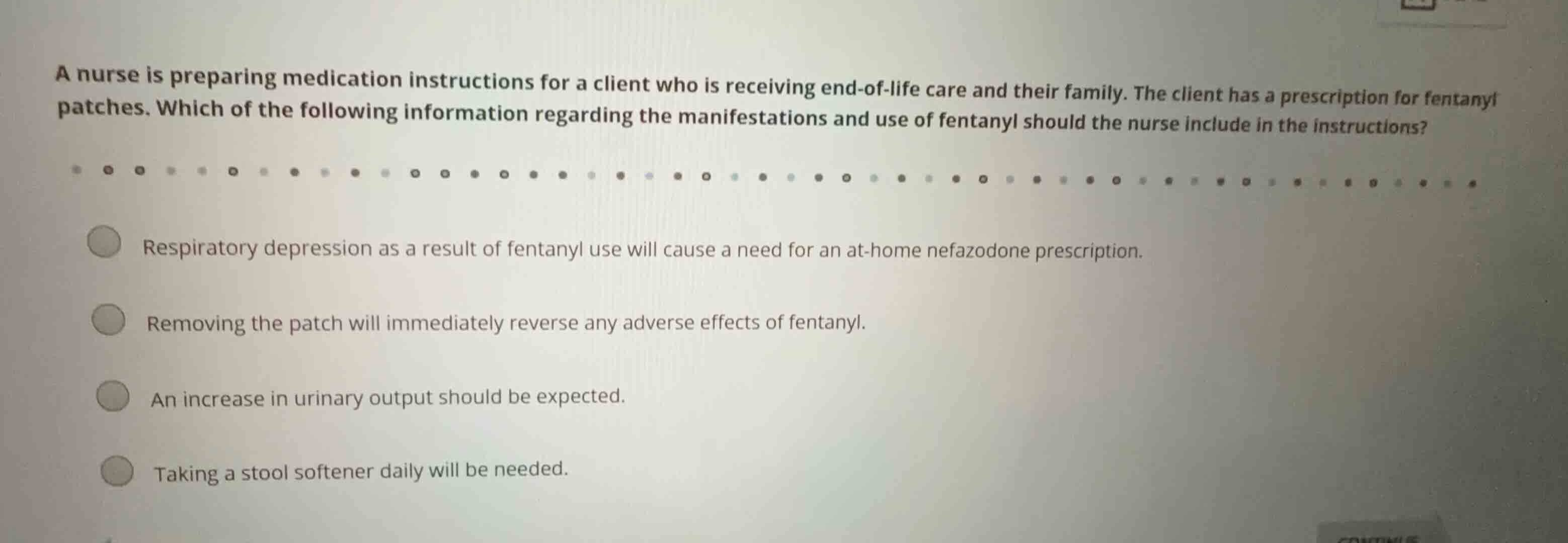
a nurse is preparing medication instructions for a client who is receiving end-of-life care and their family. the client has a prescription for fentanyl patches. which of the following information regarding the manifestations and use of fentanyl should the nurse include in the instructions?
respiratory depression as a result of fentanyl use will cause a need for an at-home nefazodone prescription.
removing the patch will immediately reverse any adverse effects of fentanyl.
an increase in urinary output should be expected.
taking a stool softener daily will be needed.
Analyze the clinical scenario
The scenario involves a client receiving end-of-life care who has been prescribed fentanyl transdermal patches. The nurse is preparing medication instructions for the client and family regarding the manifestations and use of fentanyl.
Evaluate option 1
The first option states that respiratory depression will cause a need for an at-home nefazodone prescription. Nefazodone is an antidepressant, not an opioid antagonist. Severe respiratory depression from opioids is managed with naloxone, not nefazodone. Thus, this option is incorrect.
Evaluate option 2
The second option states that removing the patch will immediately reverse any adverse effects. Transdermal patches create a drug depot in the subcutaneous tissue. Even after the patch is removed, absorption into the systemic circulation continues for many hours, meaning adverse effects (like respiratory depression) will not be immediately reversed. Thus, this option is incorrect.
Evaluate option 3
The third option states that an increase in urinary output should be expected. Opioids typically cause urinary retention rather than an increase in urinary output. Thus, this option is incorrect.
Evaluate option 4
The fourth option states that taking a stool softener daily will be needed. Opioids cause significant constipation by decreasing gastrointestinal motility. Unlike other side effects, tolerance to opioid-induced constipation does not develop over time. Therefore, a prophylactic bowel regimen, including daily stool softeners and/or laxatives, is a standard and necessary instruction for any patient on chronic opioid therapy. This option is correct.

Snap & solve any problem in the app
Get step-by-step solutions on Sovi AI
Photo-based solutions with guided steps
Explore more problems and detailed explanations
- (A) Respiratory depression as a result of fentanyl use will cause a need for an at-home nefazodone prescription.
- (B) Removing the patch will immediately reverse any adverse effects of fentanyl.
- (C) An increase in urinary output should be expected.
- (D) Taking a stool softener daily will be needed. (Correct answer)