QUESTION IMAGE
Question
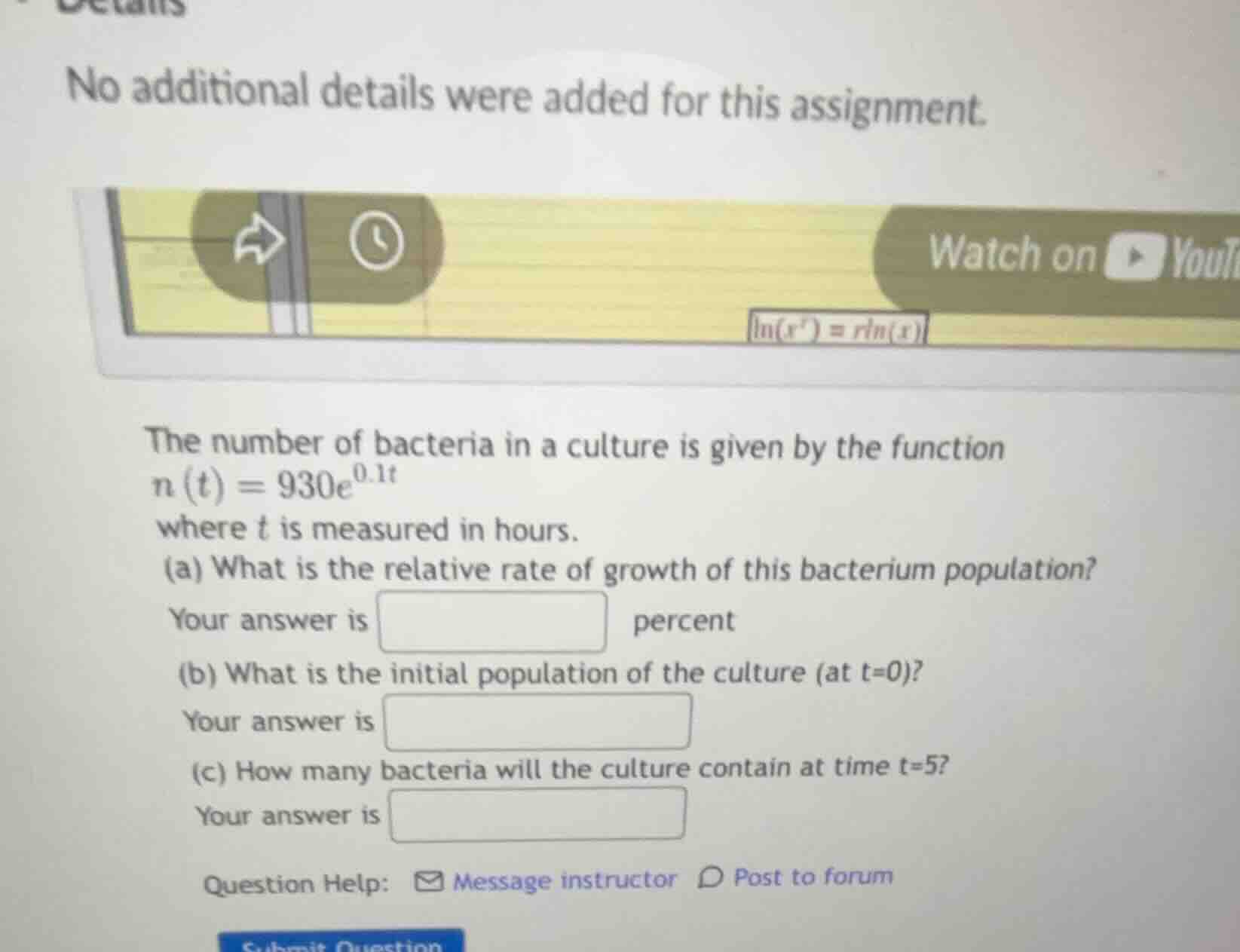
the number of bacteria in a culture is given by the function
\
(t) = 930e^{0.1t}\\
where \\(t\\) is measured in hours.
(a) what is the relative rate of growth of this bacterium population?
your answer is percent
(b) what is the initial population of the culture (at \\(t=0\\))?
your answer is
(c) how many bacteria will the culture contain at time \\(t=5\\)?
your answer is
🆕 New Concept Discovered: Exponential Growth Models
How populations grow continuously over time
Step 1: Identify the relative rate of growth
The exponential growth model is given by the formula:
where:
- \( n_0 \) is the initial population.
- \( r \) is the relative rate of growth (expressed as a decimal).
- \( t \) is the time in hours.
Comparing this to our given function:
The growth rate as a decimal is:
To convert this decimal to a percentage, multiply by \( 100 \):
Step 2: Find the initial population
The initial population occurs at time \( t = 0 \). We can find this by substituting \( t = 0 \) into the function:
Since any non-zero number raised to the power of \( 0 \) is \( 1 \) (\( e^0 = 1 \)):
Step 3: Calculate the population at \( t = 5 \)
To find the population after \( 5 \) hours, substitute \( t = 5 \) into the function:
Using a calculator to find the value of \( e^{0.5} \approx 1.64872 \):
Depending on the rounding instructions of your online homework system, this is typically rounded to the nearest whole bacterium:

Snap & solve any problem in the app
Get step-by-step solutions on Sovi AI
Photo-based solutions with guided steps
Explore more problems and detailed explanations
(a) 10 percent
(b) 930
(c) 1533 (or 1533.31 if decimals are required)