QUESTION IMAGE
Question
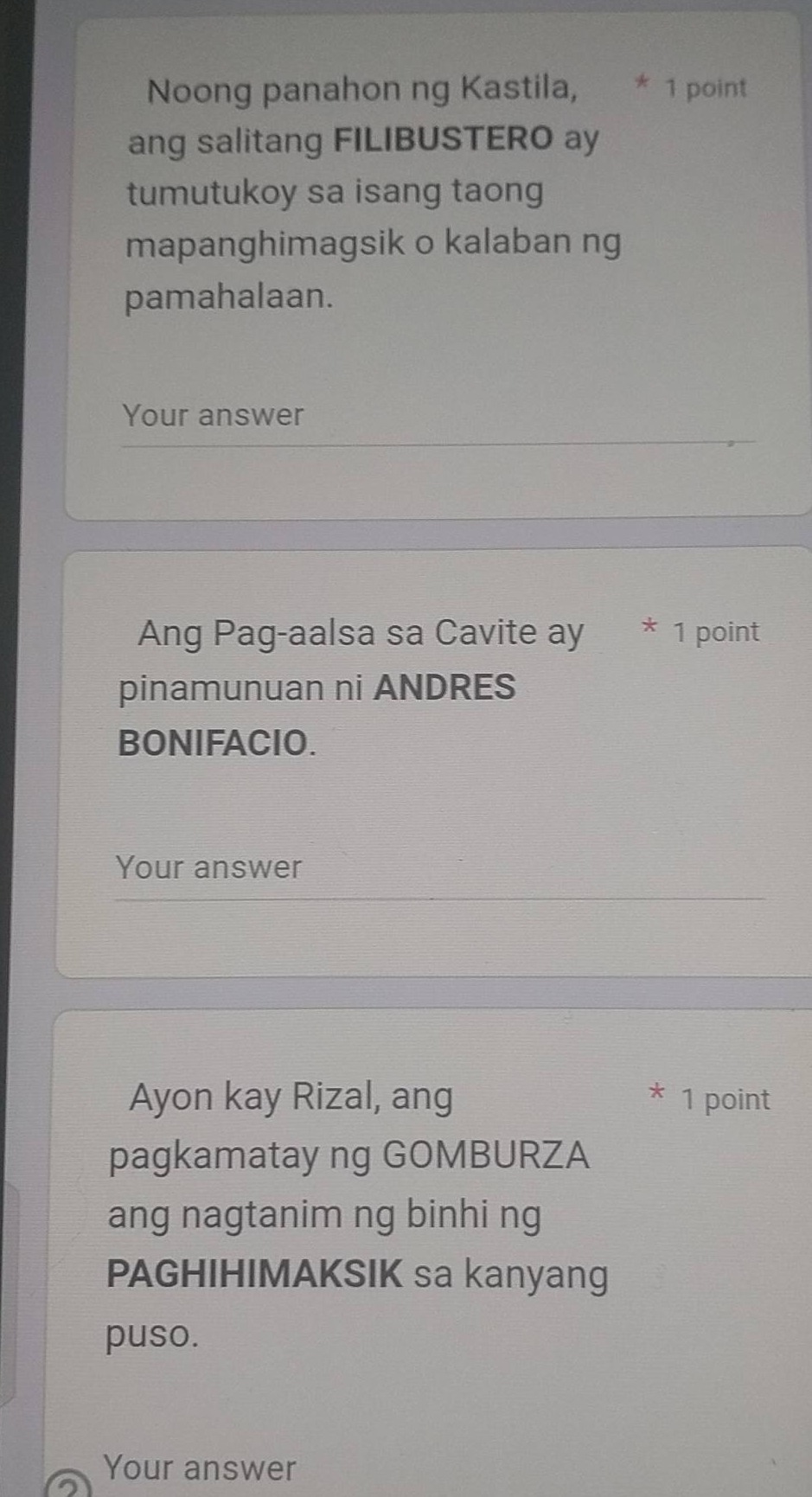
noong panahon ng kastila, ang salitang filibustero ay tumutukoy sa isang taong mapanghimagsik o kalaban ng pamahalaan.
ang pag-aalsa sa cavite ay pinamunuan ni andres bonifacio.
ayon kay rizal, ang pagkamatay ng gomburza ang nagtanim ng binhi ng paghihimaksik sa kanyang puso.
🆕 New Concept Discovered: Historical Fact-Checking (TAMA o MALI)
Evaluating statements for historical accuracy.
Step 1: Analyze the first statement
The first statement is: "Noong panahon ng Kastila, ang salitang FILIBUSTERO ay tumutukoy sa isang taong mapanghimagsik o kalaban ng pamahalaan." (During the Spanish period, the word filibustero referred to a rebellious person or an enemy of the government.)
During the Spanish colonial period in the Philippines, the Spanish authorities used the term filibustero to label reformists, rebels, or anyone who went against the colonial government and the Catholic Church. Therefore, this statement is historically accurate.
Step 2: Analyze the second statement
The second statement is: "Ang Pag-aalsa sa Cavite ay pinamunuan ni ANDRES BONIFACIO." (The Cavite Mutiny was led by Andres Bonifacio.)
The Cavite Mutiny of 1872 (Pag-aalsa sa Cavite) was a local uprising of Filipino military personnel and laborers at the Cavite arsenal. It was led by Sergeant Fernando La Madrid, not by Andres Bonifacio (who later founded the Katipunan in 1892). Therefore, this statement is historically incorrect.
Step 3: Analyze the third statement
The third statement is: "Ayon kay Rizal, ang pagkamatay ng GOMBURZA ang nagtanim ng binhi ng PAGHIHIMAKSIK sa kanyang puso." (According to Rizal, the death of GOMBURZA planted the seed of rebellion/patriotism in his heart.)
In his letters and writings, Jose Rizal explicitly stated that the execution of the three priests (Mariano Gomez, Jose Burgos, and Jacinto Zamora) in 1872 awakened his nationalist sentiments and shaped his life's direction to fight Spanish oppression. Therefore, this statement is historically accurate.

Snap & solve any problem in the app
Get step-by-step solutions on Sovi AI
Photo-based solutions with guided steps
Explore more problems and detailed explanations
- TAMA (or T)
- MALI (or M)
- TAMA (or T)