QUESTION IMAGE
Question
night
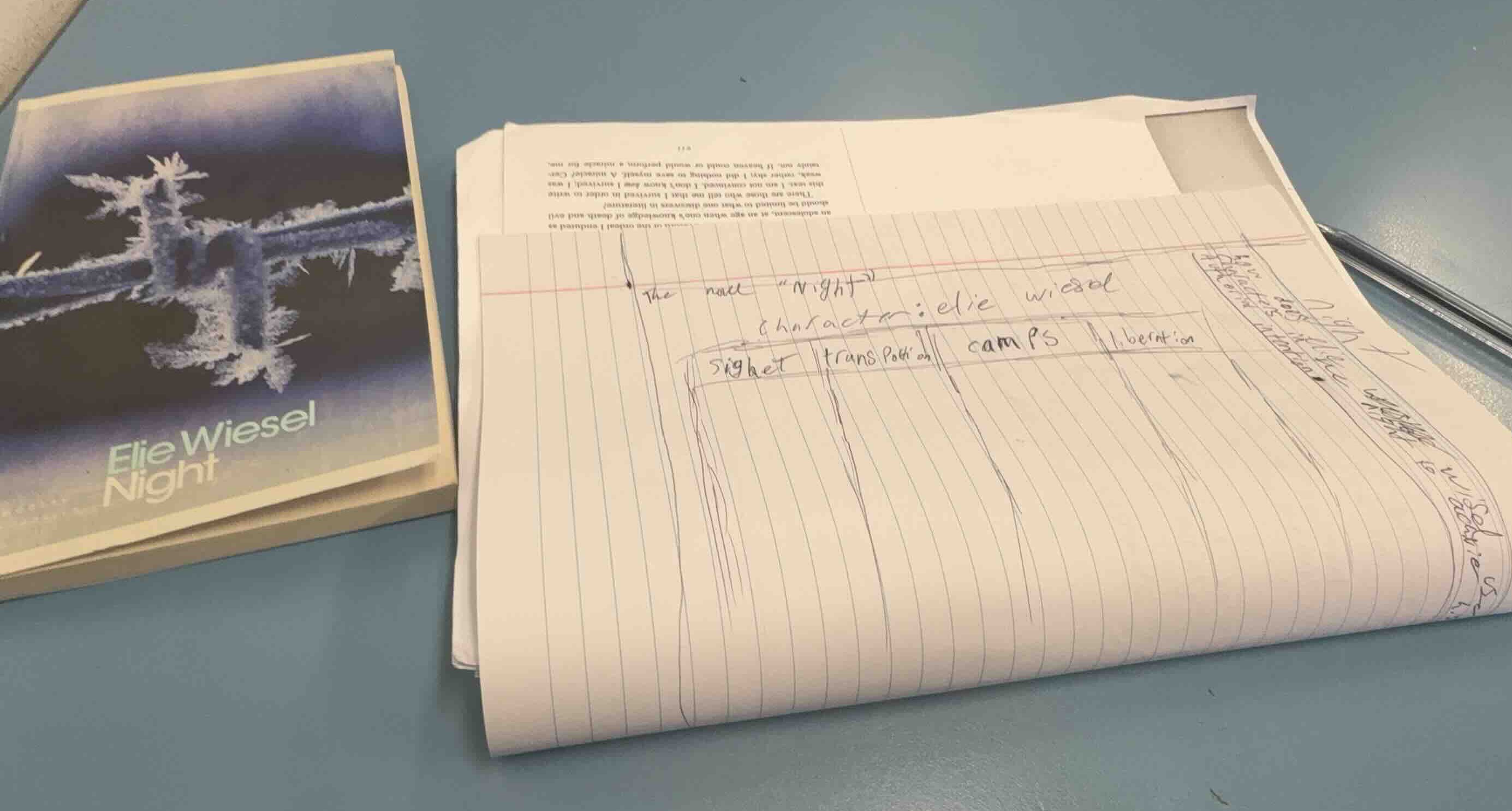
how does elie wiesels character change in elie wiesels
ight\?
pay attention to:
- sighet
- transportation
- camps
- liberation
Identify the handwritten prompt
The handwritten question on the right margin of the notebook paper asks:
"How does Elie Wiesel's character change in 'Night'? Pay attention to factors that affect him."
Analyze the structure of the student's notes
The student has set up a chronological table tracking Elie Wiesel's journey in the memoir Night:
- Sighet: Elie begins as a deeply religious, innocent boy in his hometown.
- Transportation: The dehumanizing journey in the cattle cars, where initial shocks occur.
- Camps: The brutal reality of Auschwitz, Buna, and Buchenwald, where survival becomes paramount.
- Liberation: The final state of Elie when the camps are freed, characterized by emotional numbness.
Trace Elie's character transformation
- Sighet (Innocence & Faith): Elie is deeply spiritual, studying the Talmud and Kabbalah. He has a strong relationship with God and his family.
- Transportation (Loss of Control): The journey strips away his dignity. Witnessing Madame Schächter's hysteria and the cruelty of the officers begins to crack his worldview.
- Camps (Crisis of Faith & Survival Instinct): Upon arrival, witnessing the burning of babies causes Elie to lose his faith in God's justice. His relationship with his father becomes his sole motivation to live, yet the brutal environment forces him to feel resentment when his father is beaten, showing the erosion of his moral compass under extreme suffering.
- Liberation (Emotional Death): By the time he is liberated, his father has died, and Elie is emotionally hollow. Looking in the mirror, he describes seeing a "corpse," symbolizing the death of his former self.
Synthesize the factors affecting him
- Physical Brutality: Starvation, cold, and violence force him to focus purely on physical survival.
- Loss of Family: The systematic separation and death of his mother, sisters, and eventually his father strip away his emotional anchors.
- Religious Disillusionment: The silence of God in the face of absolute evil destroys his childhood faith.

Snap & solve any problem in the app
Get step-by-step solutions on Sovi AI
Photo-based solutions with guided steps
Explore more problems and detailed explanations
In Elie Wiesel's memoir Night, Eliezer undergoes a profound transformation from a deeply religious, innocent boy into an emotionally numb survivor. This change is driven by the extreme trauma, cruelty, and loss he experiences across four distinct stages:
1. Sighet (Innocence and Devout Faith)
- Initial State: At the start of the memoir, Elie is a deeply spiritual teenager in Sighet who spends his days studying Jewish mysticism (Kabbalah) and has absolute faith in God.
- Key Factors: A supportive community, a close-knit family, and religious mentorship from Moishe the Beadle.
2. Transportation (The First Shocks)
- The Shift: During the forced deportation in crowded cattle cars, Elie's sense of security is shattered.
- Key Factors: Dehumanizing conditions, lack of food and water, and witnessing the terror of Madame Schächter's prophetic visions of fire, which foreshadow the horrors to come.
3. The Camps (Crisis of Faith and Moral Struggle)
- The Shift: Upon entering Auschwitz-Birkenau, Elie witnesses the burning of children, which permanently damages his belief in a just God. His focus shifts entirely to physical survival.
- Key Factors:
- Loss of Faith: Elie openly rebels against God, refusing to bless His name during Rosh Hashanah.
- The Father-Son Bond: His relationship with his father, Shlomo, becomes his sole reason to survive. However, the brutal environment forces Elie to feel guilty when he occasionally resents his father's physical weakness, showing how the camps erode natural human empathy.
4. Liberation (Emotional Numbness)
- Final State: Following his father's death and the liberation of Buchenwald, Elie is emotionally hollowed out. He no longer thinks of revenge or his family, only of food.
- Key Factors: The ultimate loss of his father and the cumulative toll of prolonged starvation and grief. When he finally looks in a mirror, he describes seeing a "corpse" staring back, symbolizing that his spiritual and innocent self died in the camps.