QUESTION IMAGE
Question
name:
mr. eaton
civics & public policy
fall 2025
bronxwood preparatory academy
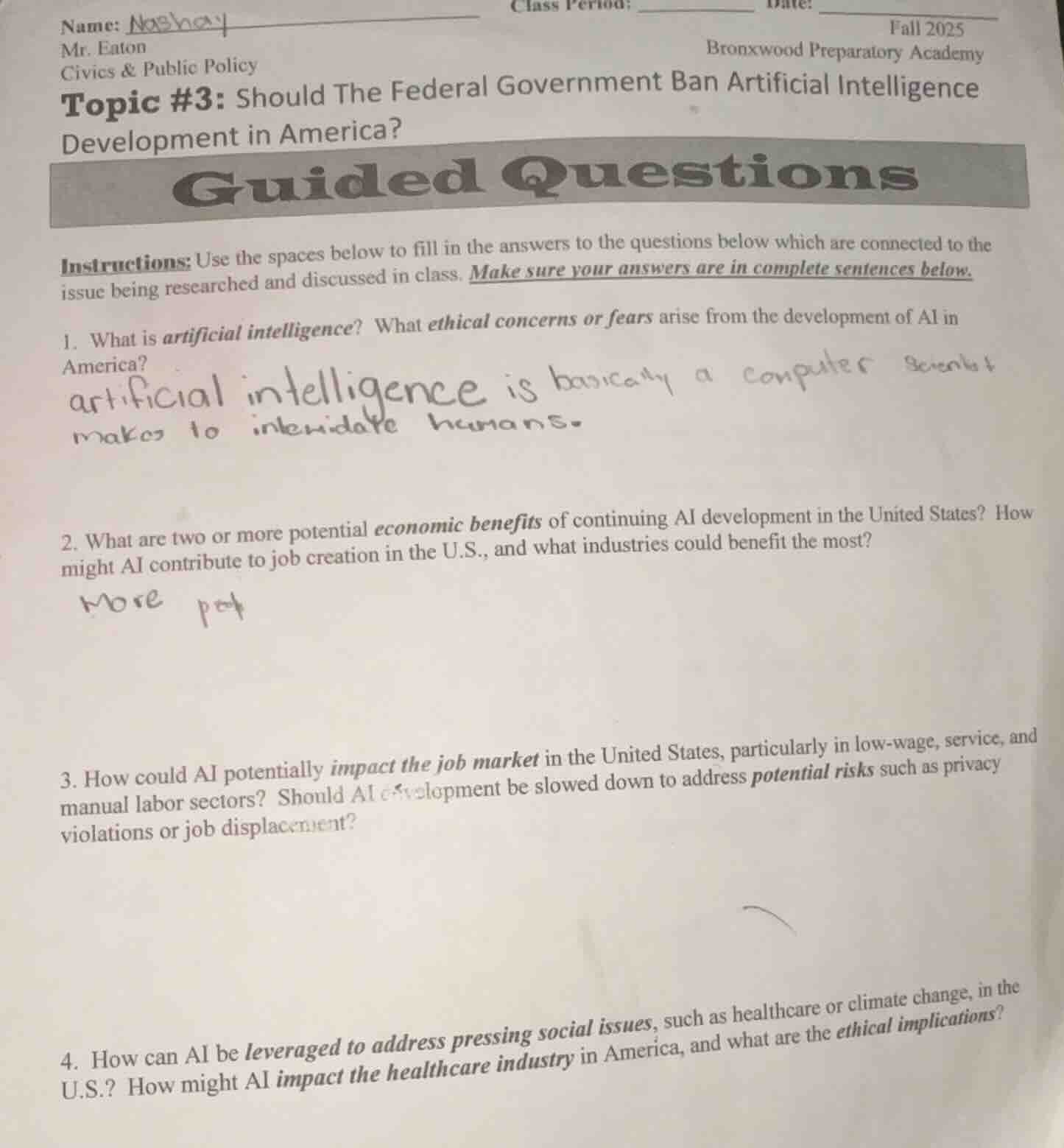
topic #3: should the federal government ban artificial intelligence development in america?
guided questions
instructions: use the spaces below to fill in the answers to the questions below which are connected to the issue being researched and discussed in class. make sure your answers are in complete sentences below.
- what is artificial intelligence? what ethical concerns or fears arise from the development of ai in america?
artificial intelligence is basically a computer senst makes to inkwidate humans.
- what are two or more potential economic benefits of continuing ai development in the united states? how might ai contribute to job creation in the u.s., and what industries could benefit the most?
more peop
- how could ai potentially impact the job market in the united states, particularly in low - wage, service, and manual labor sectors? should ai development be slowed down to address potential risks such as privacy violations or job displacement?
- how can ai be leveraged to address pressing social issues, such as healthcare or climate change, in the u.s.? how might ai impact the healthcare industry in america, and what are the ethical implications?
Brief Explanations
- For question 1: Defines AI clearly and outlines core ethical concerns tied to U.S. development.
- For question 2: Identifies key economic benefits, job creation pathways, and high-impact industries.
- For question 3: Breaks down job market impacts on targeted sectors and evaluates slowing AI development.
- For question 4: Explores AI's role in solving social issues, its healthcare impact, and related ethics.

Snap & solve any problem in the app
Get step-by-step solutions on Sovi AI
Photo-based solutions with guided steps
Explore more problems and detailed explanations
- Artificial intelligence (AI) refers to computer systems and algorithms designed to perform tasks that typically require human intelligence, such as problem-solving, pattern recognition, natural language processing, and decision-making. Key ethical concerns in U.S. AI development include widespread job displacement as AI automates roles, violations of personal privacy through unregulated data collection and analysis, bias and discrimination embedded in AI systems trained on skewed datasets, and the risk of autonomous weapons systems making unaccountable lethal decisions.
- Two major economic benefits of continuing U.S. AI development are increased productivity across industries, as AI automates repetitive tasks and optimizes workflows to reduce costs and output time, and enhanced global competitiveness, as U.S. companies lead in AI innovation to capture market share in the global tech economy. AI can contribute to job creation by spawning new roles in AI training, maintenance, and oversight, as well as supporting growth in adjacent fields like AI cybersecurity and AI-driven content creation. The industries that could benefit the most are healthcare (for diagnostic and treatment optimization), manufacturing (for smart automation), and finance (for fraud detection and algorithmic trading).
- In low-wage, service, and manual labor sectors, AI could automate routine tasks like food service order processing, retail inventory management, and warehouse assembly work, leading to widespread job displacement for workers in these roles. Slowing AI development could help mitigate immediate risks like privacy violations from unregulated data use and sudden job loss, but it would also mean forgoing AI's economic and societal benefits, and could put the U.S. behind global competitors in AI innovation. A more balanced approach, such as implementing targeted regulations for data privacy and worker retraining programs, is more practical than halting development entirely.
- AI can address pressing U.S. social issues by analyzing large datasets to identify patterns in disease spread and optimize public health responses for healthcare, and by modeling climate scenarios to develop more effective mitigation strategies for climate change. In the U.S. healthcare industry, AI can improve diagnostic accuracy by analyzing medical imaging, streamline administrative tasks to reduce costs, and enable personalized treatment plans based on patient data. Ethical implications include risks of biased diagnostic algorithms that fail marginalized patient groups, violations of patient data privacy, and the potential for AI to reduce the human connection between patients and care providers.