QUESTION IMAGE
Question
name ____ date ____
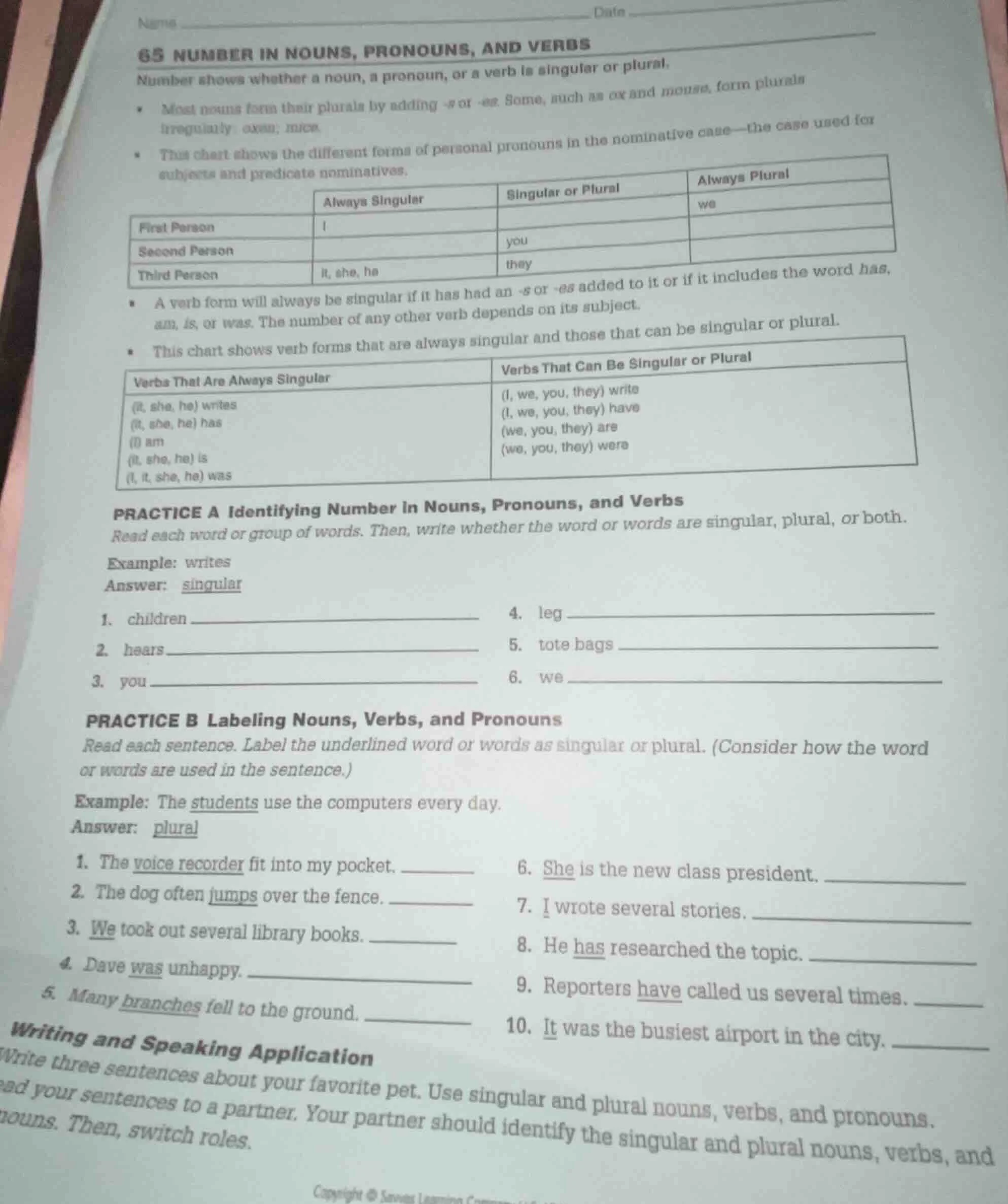
65 number in nouns, pronouns, and verbs
number shows whether a noun, a pronoun, or a verb is singular or plural.
- most nouns form their plurals by adding -s or -es. some, such as ox and mouse, form plurals irregularly: oxen, mice.
- this chart shows the different forms of personal pronouns in the nominative case—the case used for subjects and predicate nominatives.
| always singular | singular or plural | always plural | |
| first person | i | we | |
| second person | you | ||
| third person | it, she, he | they |
- a verb form will always be singular if it has had an -s or -es added to it or if it includes the word has, am, is, or was. the number of any other verb depends on its subject.
- this chart shows verb forms that are always singular and those that can be singular or plural.
| verbs that are always singular | verbs that can be singular or plural |
| (it, she, he) writes<br>(it, she, he) has<br>(i) am<br>(it, she, he) is<br>(i, it, she, he) was | (i, we, you, they) write<br>(i, we, you, they) have<br>(we, you, they) are<br>(we, you, they) were |
practice a identifying number in nouns, pronouns, and verbs
read each word or group of words. then, write whether the word or words are singular, plural, or both.
example: writes
answer: singular
- children ____ 4. leg ____
- hears ____ 5. tote bags ____
- you ____ 6. we ____
practice b labeling nouns, verbs, and pronouns
read each sentence. label the underlined word or words as singular or plural. (consider how the word or words are used in the sentence.)
example: the students use the computers every day.
answer: plural
- the voice recorder fit into my pocket. ____ 6. she is the new class president. ____
- the dog often jumps over the fence. ____ 7. i wrote several stories. ____
- we took out several library books. ____ 8. he has researched the topic. ____
- dave was unhappy. ____ 9. reporters have called us several times. ____
- many branches fell to the ground. ____ 10. it was the busiest airport in the city. ____
writing and speaking application
write three sentences about your favorite pet. use singular and plural nouns, verbs, and pronouns. read your sentences to a partner. your partner should identify the singular and plural nouns, verbs, and pronouns. then, switch roles.
copyright © savvas learning company llc
For Practice A, we use the rules: plural nouns often end in -s/-es (irregular plurals like "children" are plural), verbs with -s/-es are singular, "you" can be singular/plural, singular nouns have no plural ending, and "we" is always plural.
For Practice B, we analyze each word's use: singular nouns have no plural marker, verbs with -s are singular, "we" is plural, "was" pairs with singular subjects, plural nouns end in -es, singular pronouns refer to one person, "has" is singular, "have" is plural, and "it" is singular.

Snap & solve any problem in the app
Get step-by-step solutions on Sovi AI
Photo-based solutions with guided steps
Explore more problems and detailed explanations
Practice A
- children - plural
- hears - singular
- you - both
- leg - singular
- tote bags - plural
- we - plural
Practice B
- voice recorder - singular
- jumps - singular
- We - plural
- was - singular
- branches - plural
- She - singular
- I - singular
- has - singular
- have - plural
- It - singular
Writing and Speaking Application (Sample Sentences)
- My fluffy cat (singular noun) chases (singular verb) its (singular pronoun) toy mouse (singular noun) around the living room every afternoon.
- Our playful dogs (plural noun) love (plural verb) to fetch their (plural pronoun) colorful balls (plural noun) in the backyard.
- I (singular pronoun) brush my cat's (singular possessive pronoun) soft fur (singular noun) and we (plural pronoun) play (plural verb) with her favorite feather wands (plural noun) before bedtime.