QUESTION IMAGE
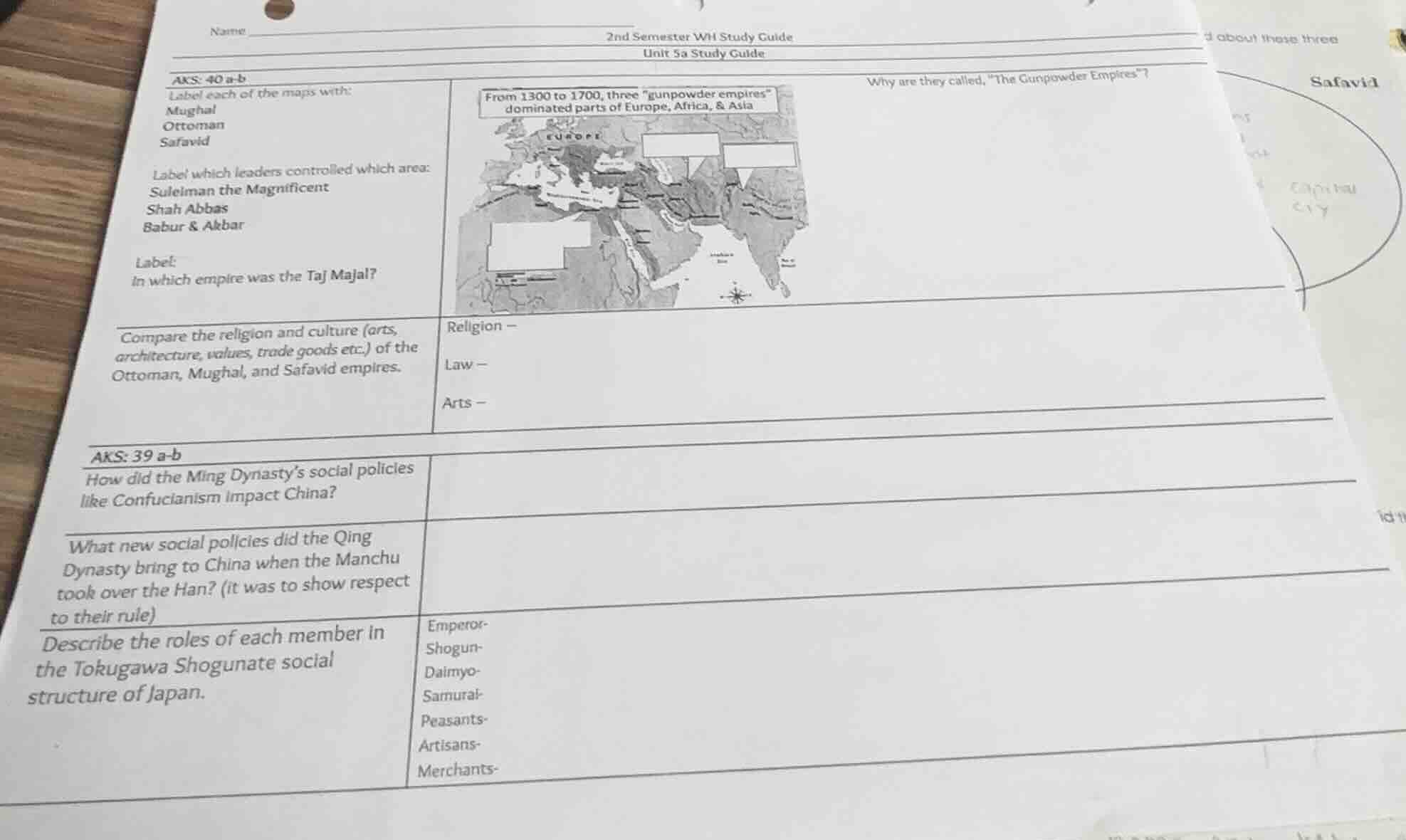
Question
name
2nd semester wh study guide
unit 5a study guide
aks: 40 a-b
label each of the maps with:
mughal
ottoman
safavid
label which leaders controlled which area:
sulelman the magnificent
shah abbas
babur & akbar
label:
in which empire was the taj majal?
from 1300 to 1700, three \gunpowder empires\ dominated parts of europe, africa, & asia
why are they called, \the gunpowder empires\?
compare the religion and culture (arts, architecture, values, trade goods etc.) of the ottoman, mughal, and safavid empires.
religion -
law -
arts -
aks: 39 a-b
how did the ming dynasty’s social policies like confucianism impact china?
what new social policies did the qing dynasty bring to china when the manchu took over the han? (it was to show respect to their rule)
describe the roles of each member in the tokugawa shogunate social structure of japan.
emperor-
shogun-
daimyo-
samurai-
peasants-
artisans-
merchants-
1. Label the maps with Mughal, Ottoman, Safavid
- Ottoman: The Ottoman Empire was centered in modern - day Turkey, with territories in Southeast Europe, Western Asia, and North Africa. So the western - most empire on the map (around the Balkans, Anatolia) is Ottoman.
- Safavid: The Safavid Empire was in modern - day Iran and parts of the Caucasus. It is the empire in the middle - eastern part, centered on Persia.
- Mughal: The Mughal Empire was in the Indian subcontinent. So the empire in the southern - eastern part (covering India) is Mughal.
2. Label which leaders controlled which area
- Suleiman the Magnificent: He was the ruler of the Ottoman Empire. So he controlled the Ottoman - labeled area.
- Shah Abbas: He was the ruler of the Safavid Empire. So he controlled the Safavid - labeled area.
- Babur & Akbar: They were rulers of the Mughal Empire. So they controlled the Mughal - labeled area.
3. In which empire was the Taj Mahal?
The Taj Mahal was built during the Mughal Empire. So the answer is the Mughal Empire.
4. Why are they called “The Gunpowder Empires”?
These three empires (Ottoman, Safavid, Mughal) were called “gunpowder empires” because they made extensive use of gunpowder - based weapons (such as cannons and firearms) in their military conquests and to maintain their power. This technology gave them a significant military advantage, helping them to expand and control large territories.
5. Compare the religion and culture of the Ottoman, Mughal, and Safavid empires
- Religion:
- Ottoman: Mostly Sunni Islam.
- Safavid: Mostly Shia Islam.
- Mughal: Initially Sunni Islam, but there was a lot of religious tolerance (Akbar even tried to create a syncretic religion, Din - i - Ilahi).
- Law:
- Ottoman: Based on Sharia law (Islamic law) with some secular legal elements for non - Muslims.
- Safavid: Based on Sharia law, with a strong influence of Shia religious scholars.
- Mughal: Initially based on Islamic law, but with increasing religious tolerance, there was more flexibility, especially under Akbar who tried to integrate Hindu customs into the legal system for Hindu subjects.
- Arts:
- Ottoman: Architecture (like the Blue Mosque), calligraphy, and miniature paintings.
- Safavid: Intricate tile work (in mosques), carpet weaving, and miniature paintings (with a distinct Persian style).
- Mughal: Architecture (Taj Mahal, Red Fort), miniature paintings (often depicting court life and nature), and literature (Persian and Urdu poetry).
6. How did the Ming Dynasty’s social policies like Confucianism impact China?
Confucianism in the Ming Dynasty emphasized social hierarchy (emperor > scholar - gentry > peasants > artisans > merchants), respect for elders, and filial piety. It was used to maintain social order, as the scholar - gentry class (who were well - versed in Confucian teachings) helped in governing. The civil service exams were based on Confucian classics, which promoted a merit - based (to some extent) system for government jobs and also reinforced Confucian values throughout society.
7. What new social policies did the Qing Dynasty bring to China when the Manchu took over the Han?
One of the policies was the requirement for Han Chinese men to shave the front of their heads and wear the Manchu - style queue (a long braid at the back). This was a symbolic act to show submission to Manchu rule. Also, the Qing tried to maintain a strict social hierarchy, with the Manchu elite at the top, and they promoted Confucianism (similar to the Ming)…

Snap & solve any problem in the app
Get step-by-step solutions on Sovi AI
Photo-based solutions with guided steps
Explore more problems and detailed explanations
s (Summarized for specific questions):
- Map labeling (Ottoman, Safavid, Mughal): Western - Ottoman, Middle - Safavid, Eastern - Mughal.
- Leader - area: Suleiman - Ottoman; Shah Abbas - Safavid; Babur & Akbar - Mughal.
- Taj Mahal empire: Mughal Empire.
- Gunpowder Empires reason: Used gunpowder weapons for conquest/power.
- Tokugawa roles: Emperor (ceremonial), Shogun (real power), Daimyo (feudal lords), Samurai (warriors), Peasants (farmers), Artisans (craftsmen), Merchants (traders, low status).