QUESTION IMAGE
Question
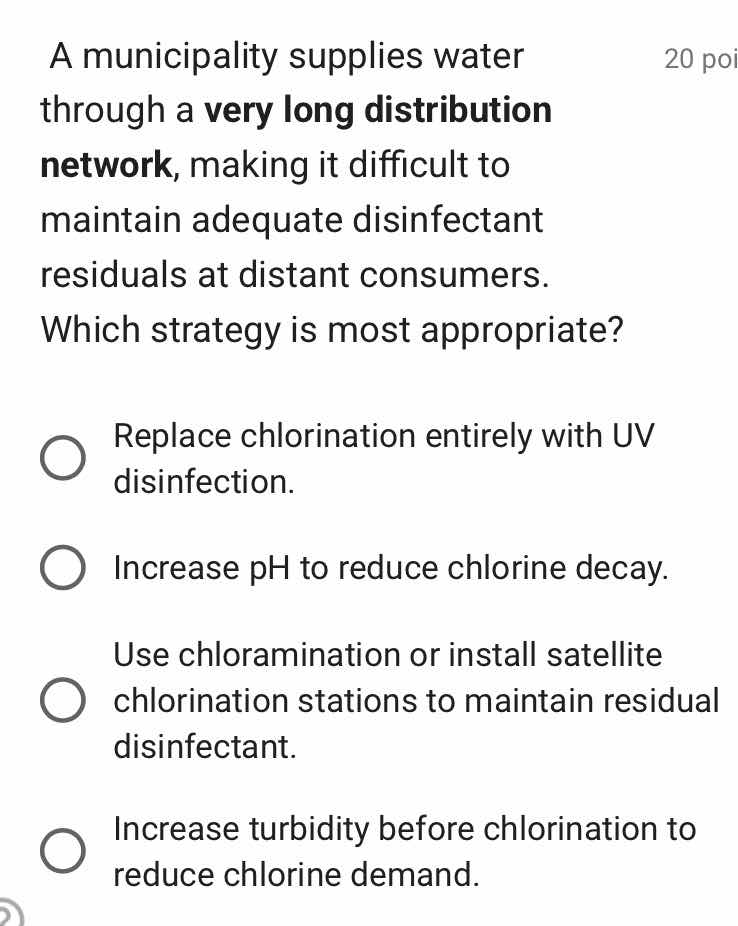
a municipality supplies water through a very long distribution network, making it difficult to maintain adequate disinfectant residuals at distant consumers.
which strategy is most appropriate?
replace chlorination entirely with uv disinfection.
increase ph to reduce chlorine decay.
use chloramination or install satellite chlorination stations to maintain residual disinfectant.
increase turbidity before chlorination to reduce chlorine demand.
Analyze the problem of long distribution networks
A very long distribution network increases water residence time, leading to the decay of free chlorine residuals before reaching distant consumers.
Evaluate the proposed strategies
- Replacing chlorination with UV is ineffective because UV provides no secondary residual protection in the distribution system.
- Increasing pH alters chlorine speciation (reducing hypochlorous acid concentration) and does not reliably prevent decay over very long distances.
- Increasing turbidity increases chlorine demand rather than reducing it, which accelerates decay.
- Using chloramination (which forms more stable monochloramines) or installing satellite chlorination stations along the network directly addresses residual decay over long distances.

Snap & solve any problem in the app
Get step-by-step solutions on Sovi AI
Photo-based solutions with guided steps
Explore more problems and detailed explanations
- Replace chlorination entirely with UV disinfection.
- Increase pH to reduce chlorine decay.
- Use chloramination or install satellite chlorination stations to maintain residual disinfectant. (Correct answer)
- Increase turbidity before chlorination to reduce chlorine demand.