QUESTION IMAGE
Question
multiplying and dividing rational expressions: practice
question 3 of 5
select the correct step and value in the work.
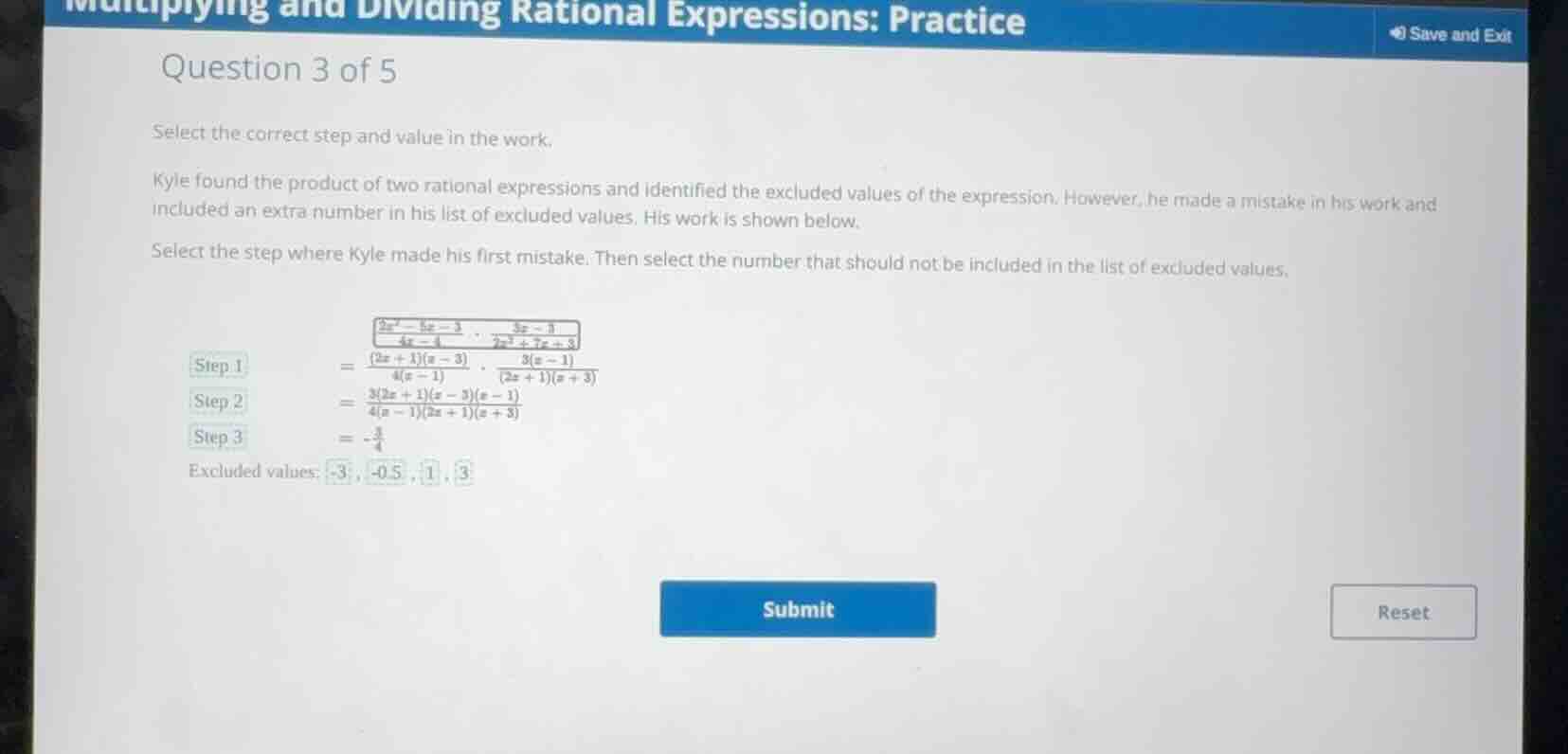
kyle found the product of two rational expressions and identified the excluded values of the expression. however, he made a mistake in his work and included an extra number in his list of excluded values. his work is shown below.
select the step where kyle made his first mistake. then select the number that should not be included in the list of excluded values.
\\ \frac{2x^2 - 5x - 3}{4x - 4} \cdot \frac{3x - 3}{2x^2 + 7x + 3} \\
step 1: \\( = \frac{(2x + 1)(x - 3)}{4(x - 1)} \cdot \frac{3(x - 1)}{(2x + 1)(x + 3)} \\)
step 2: \\( = \frac{3(2x + 1)(x - 3)(x - 1)}{4(x - 1)(2x + 1)(x + 3)} \\)
step 3: \\( = \frac{3}{4} \\)
excluded values: -3, -0.5, 1, 3
Analyze the original expression and Step 1
Using the Simplifying Rational Expressions knowledge point
Factoring each polynomial:
- \(2x^2 - 5x - 3 = (2x + 1)(x - 3)\)
- \(4x - 4 = 4(x - 1)\)
- \(3x - 3 = 3(x - 1)\)
- \(2x^2 + 7x + 3 = (2x + 1)(x + 3)\)
Substituting these factored forms:
This matches Step 1 exactly. Thus, Step 1 is correct.
Analyze Step 2 and Step 3
Using the Simplifying Rational Expressions knowledge point
This is the correct product of the numerators and denominators. Thus, Step 2 is correct.
Simplifying by canceling common factors \((2x + 1)\) and \((x - 1)\):
Kyle's Step 3 shows:
This is incorrect because \(\frac{x - 3}{x + 3}
eq -1\). Thus, Kyle made his first mistake in Step 3.
Determine the correct excluded values
The excluded values are the values of \(x\) that make any denominator in the original expression or intermediate steps equal to zero.
The denominators are:
- \(4(x - 1) = 0 \implies x = 1\)
- \(2x^2 + 7x + 3 = (2x + 1)(x + 3) = 0 \implies x = -0.5\) or \(x = -3\)
Thus, the set of excluded values is \(\{-3, -0.5, 1\}\).
Kyle's list of excluded values is \(\{-3, -0.5, 1, 3\}\).
The number \(3\) makes the numerator \(x - 3\) equal to zero, not the denominator. Therefore, \(3\) should not be included in the list of excluded values.

Snap & solve any problem in the app
Get step-by-step solutions on Sovi AI
Photo-based solutions with guided steps
Explore more problems and detailed explanations
- First mistake: Step 3
- Number that should not be included: 3