QUESTION IMAGE
Question
multiple select question
select all that apply
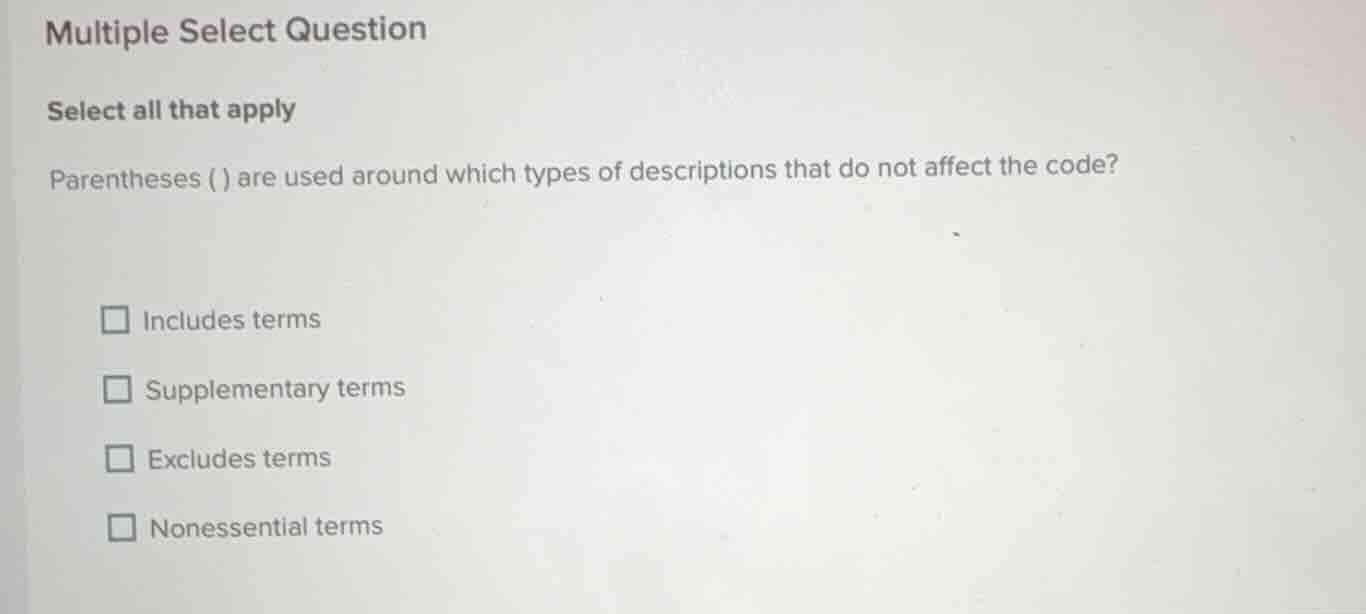
parentheses () are used around which types of descriptions that do not affect the code?
includes terms
supplementary terms
excludes terms
nonessential modifiers
Identify the punctuation rule
In medical coding (specifically ICD-10-CM), parentheses ( ) are used in both the Alphabetic Index and Tabular List to enclose supplementary words that may be present or absent in the statement of a disease or procedure without affecting the code number to which it is assigned. These terms are referred to as nonessential modifiers or supplementary terms.
Evaluate the given options
- Includes terms: Incorrect. Includes notes are preceded by the word "Includes" and are not defined by parentheses.
- Supplementary terms: Correct. Parentheses enclose supplementary words (also known as nonessential modifiers) that do not affect the code selection.
- Excludes terms: Incorrect. Excludes notes (Excludes1 and Excludes2) are boxed or listed under specific headings, not enclosed in parentheses to denote nonessential modifiers.
- Nonessential terms: Correct. These are officially called "nonessential modifiers" or nonessential terms because their presence or absence does not alter the code assignment.
Therefore, the correct options to select are "Supplementary terms" and "Nonessential terms".

Snap & solve any problem in the app
Get step-by-step solutions on Sovi AI
Photo-based solutions with guided steps
Explore more problems and detailed explanations
- Includes terms
- Supplementary terms (Correct answer)
- Excludes terms
- Nonessential terms (Correct answer)