QUESTION IMAGE
Question
multiple choice practice test
directions: answer the question below.
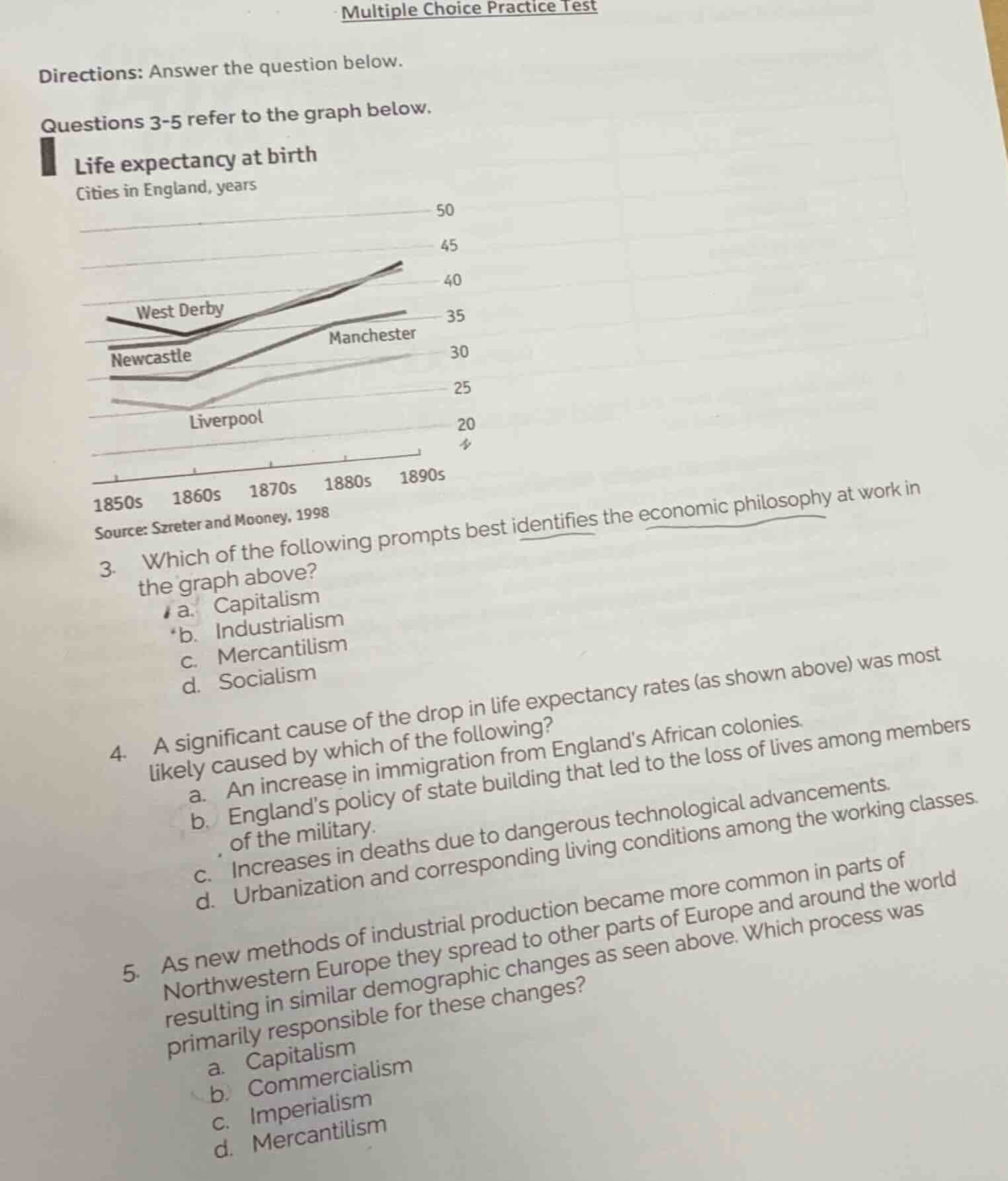
questions 3-5 refer to the graph below.
life expectancy at birth
cities in england, years
source: szreter and mooney, 1998
- which of the following prompts best identifies the economic philosophy at work in
the graph above?
a. capitalism
*b. industrialism
c. mercantilism
d. socialism
- a significant cause of the drop in life expectancy rates (as shown above) was most
likely caused by which of the following?
a. an increase in immigration from england’s african colonies.
b. england’s policy of state building that led to the loss of lives among members
of the military.
c. increases in deaths due to dangerous technological advancements.
d. urbanization and corresponding living conditions among the working classes.
- as new methods of industrial production became more common in parts of
northwestern europe they spread to other parts of europe and around the world
resulting in similar demographic changes as seen above. which process was
primarily responsible for these changes?
a. capitalism
b. commercialism
c. imperialism
d. mercantilism
Question 3
To determine the economic philosophy, we analyze the context. The graph shows life expectancy in English cities during industrialization. Capitalism (a) focuses on private ownership and market, but the graph's context of industrial growth and its social impacts (like urbanization, working - class conditions) ties more to Industrialism (b)? Wait, no—wait, actually, the time period (1850s - 1890s) is industrial revolution era. But the options: Capitalism is the economic system driving industrialization. Wait, no, let's re - evaluate. The question is about economic philosophy. Capitalism is the economic system where private individuals own capital, driving industrial growth. Industrialism is more about the process of industrialization. Mercantilism is about trade and colonies, Socialism about public ownership. The industrial revolution was driven by capitalism, but the graph's life expectancy changes (with drops likely due to industrial - era urban working conditions) are under the economic system of Capitalism? Wait, no, maybe I'm mixing. Wait, the correct answer here: during the industrial revolution, the economic philosophy at work was Capitalism (a), as it was the system that fueled industrial growth, with private capital investment. Or maybe Industrialism? Wait, no, economic philosophy: Capitalism is an economic system (philosophy) that emphasizes private ownership and free markets, which drove industrialization. So the best answer is a. Capitalism.
We need to find the cause of the drop in life expectancy. Option a: Immigration from African colonies is not a major cause of life expectancy drop in English cities. Option b: State - building and military deaths don't directly affect city life expectancy. Option c: Dangerous tech advancements? No, the main issue in industrial cities was urbanization - related poor living conditions (overcrowding, unsanitary conditions, long working hours in factories) for the working class. Option d: Urbanization led to overcrowded, unsanitary living conditions in cities, which caused increased deaths and lower life expectancy. So the correct answer is d.
We need to find the process responsible for the spread of industrial production and demographic changes. Option a: Capitalism is the economic system that drives industrial production (private investment, profit - motive), which led to the spread of industrial methods. Commercialism is about trade, Imperialism about colonies, Mercantilism about trade and colonies. Capitalism (a) was the driving force behind the spread of industrial production, as it provided the profit - driven incentive for businesses to expand and spread industrial methods. So the correct answer is a.

Snap & solve any problem in the app
Get step-by-step solutions on Sovi AI
Photo-based solutions with guided steps
Explore more problems and detailed explanations
a. Capitalism