QUESTION IMAGE
Question
mrs. pedlar
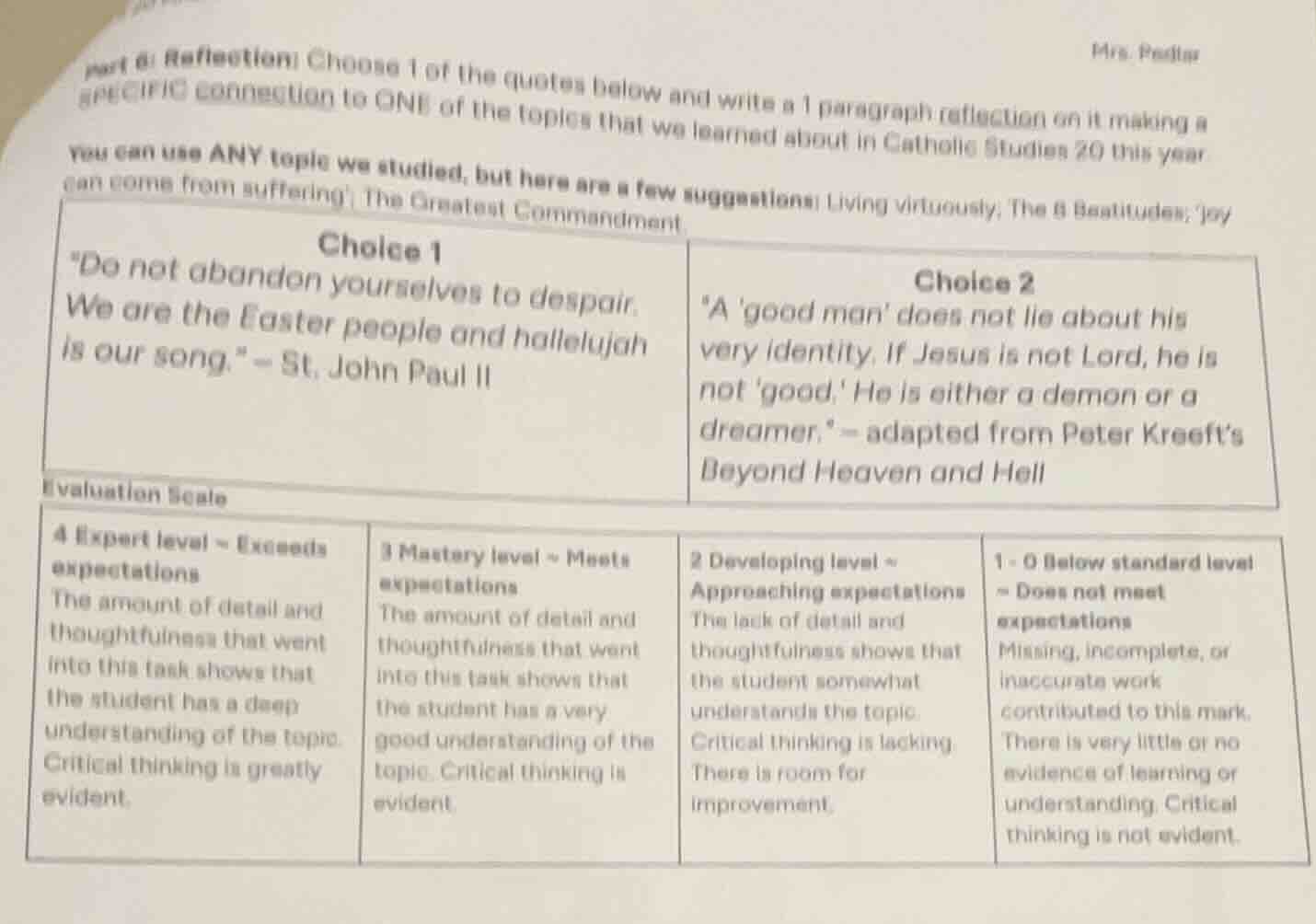
part 6: reflection: choose 1 of the quotes below and write a 1 paragraph reflection on it making a specific connection to one of the topics that we learned about in catholic studies 20 this year.
you can use any topic we studied, but here are a few suggestions: living virtuously; the 8 beatitudes; joy can come from suffering; the greatest commandment.
choice 1
\do not abandon yourselves to despair. we are the easter people and hallelujah is our song.\ - st. john paul ii
choice 2
\a good man does not lie about his very identity. if jesus is not lord, he is not good. he is either a demon or a dreamer.\ - adapted from peter kreefts beyond heaven and hell
evaluation scale
4 expert level - exceeds expectations
the amount of detail and thoughtfulness that went into this task shows that the student has a deep understanding of the topic. critical thinking is greatly evident.
3 mastery level - meets expectations
the amount of detail and thoughtfulness that went into this task shows that the student has a very good understanding of the topic. critical thinking is evident.
2 developing level - approaching expectations
the lack of detail and thoughtfulness shows that the student somewhat understands the topic. critical thinking is lacking. there is room for improvement.
1 - 0 below standard level - does not meet expectations
missing, incomplete, or inaccurate work contributed to this mark. there is very little or no evidence of learning or understanding. critical thinking is not evident.
Analyze the prompt and select a quote
The prompt asks to choose one of the two provided quotes and write a one-paragraph reflection connecting it to a topic studied in Catholic Studies 20.
- Choice 1: "Do not abandon yourselves to despair. We are the Easter people and hallelujah is our song." — St. John Paul II.
- Choice 2: "'A good man' does not lie about his very identity. If Jesus is not Lord, he is not 'good.' He is either a demon or a dreamer." — adapted from Peter Kreeft's Beyond Heaven and Hell.
We will select Choice 1, which directly connects to the theology of Pope John Paul II and can be beautifully linked to The Beatitudes (specifically, finding hope and joy amidst suffering).
Connect the quote to Catholic Studies topics
St. John Paul II's quote emphasizes hope, resurrection, and joy ("Easter people") over despair. This connects deeply with The Beatitudes, which teach that those who mourn, are poor in spirit, or suffer persecution are blessed and will find ultimate joy in God's kingdom. The "Easter" identity represents the transition from the suffering of Good Friday to the joy of the Resurrection, mirroring how the Beatitudes reframe earthly suffering through the lens of eternal hope.
Draft the reflection paragraph
We will construct a thoughtful, high-school-level reflection paragraph that:
- Identifies the chosen quote (Choice 1 by St. John Paul II).
- Connects it explicitly to the theological framework of the Beatitudes.
- Explains how being "Easter people" means living out the hope of the Resurrection even during times of personal or societal suffering.
- Demonstrates critical thinking and depth, aiming for the "Expert level" on the provided evaluation scale.

Snap & solve any problem in the app
Get step-by-step solutions on Sovi AI
Photo-based solutions with guided steps
Explore more problems and detailed explanations
Here is a complete, high-quality reflection paragraph based on Choice 1:
St. John Paul II’s powerful reminder, "Do not abandon yourselves to despair. We are the Easter people and hallelujah is our song," beautifully encapsulates the transformative hope at the heart of The Beatitudes. In Catholic Studies, we learn that the Beatitudes are not merely passive ideals, but a radical call to find divine blessing and joy even in the midst of earthly suffering, mourning, and persecution. To live as "Easter people" means to look at the hardships of our world not as final defeats, but through the lens of Christ's Resurrection. Just as the sorrow of Good Friday was answered by the joy of Easter Sunday, the Beatitudes promise that those who hunger, thirst for justice, and weep will ultimately be satisfied and comforted. By anchoring our identity in this resurrection hope, we are empowered to reject despair and actively bring Christ's light, joy, and peace to a hurting world.