QUESTION IMAGE
Question
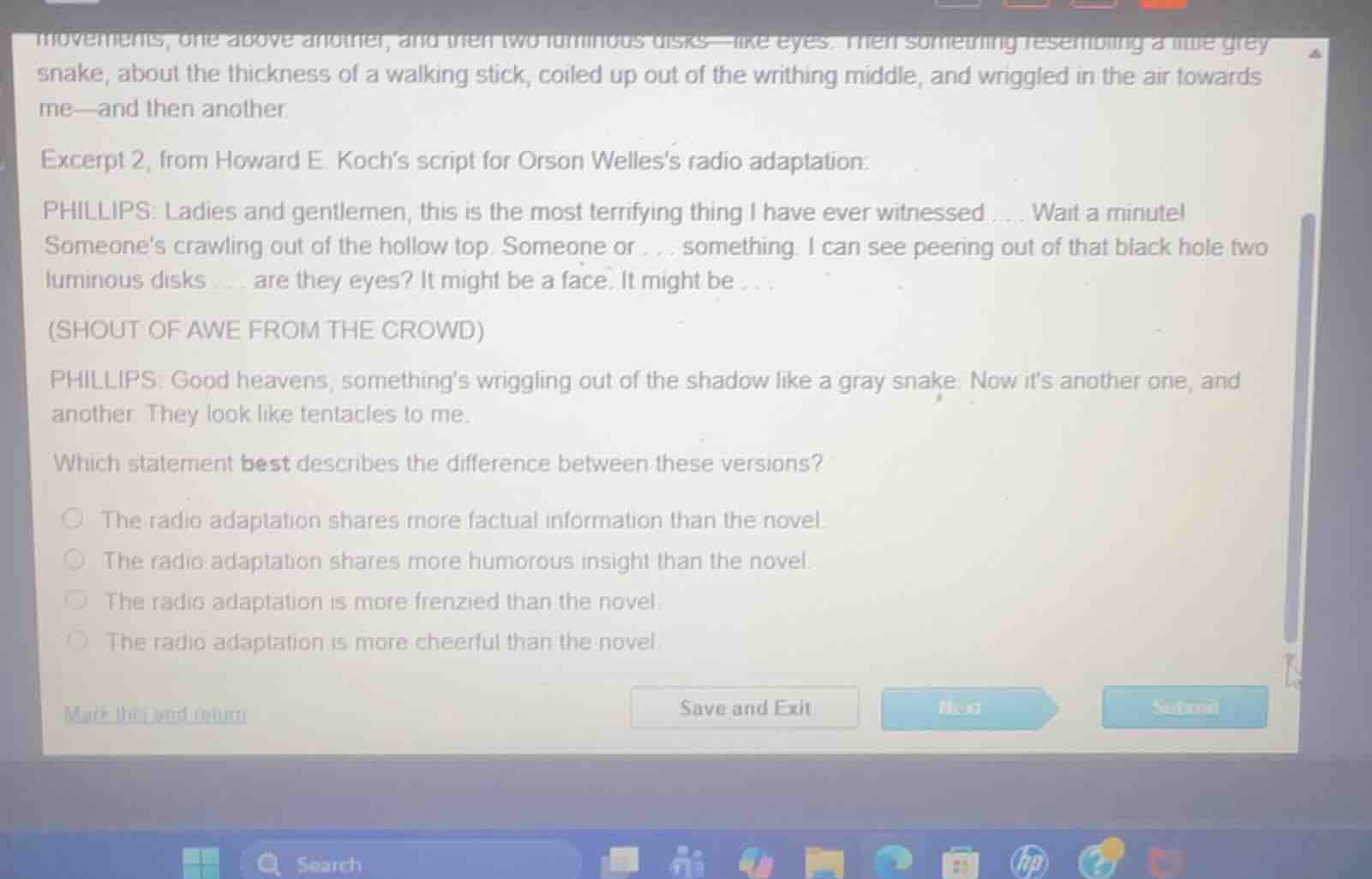
movements, one above another, and then two luminous disks-like eyes. then something resembling a little grey snake, about the thickness of a walking stick, coiled up out of the writhing middle, and wriggled in the air towards me-and then another.
excerpt 2, from howard e. kochs script for orson welless radio adaptation:
phillips: ladies and gentlemen, this is the most terrifying thing i have ever witnessed.... wait a minute! someones crawling out of the hollow top. someone or... something. i can see peering out of that black hole two luminous disks... are they eyes? it might be a face. it might be...
(shout of awe from the crowd)
phillips: good heavens, somethings wriggling out of the shadow like a gray snake. now its another one, and another. they look like tentacles to me.
which statement best describes the difference between these versions?
- the radio adaptation shares more factual information than the novel.
- the radio adaptation shares more humorous insight than the novel.
- the radio adaptation is more frenzied than the novel.
- the radio adaptation is more cheerful than the novel.
Analyze the first excerpt
Using the Tone and Mood Analysis knowledge point, Excerpt 1 (from H.G. Wells's novel The War of the Worlds) describes the alien's emergence with a deliberate, observational, and suspenseful tone. The narrator recounts the movements systematically ("one above another," "then two luminous disks," "then something resembling a little grey snake").
Analyze the second excerpt
Using the Media Adaptation Analysis and Tone and Mood Analysis knowledge points, Excerpt 2 (from Howard E. Koch's radio script) uses urgent, fragmented dialogue, exclamation points, and sound cues ("Wait a minute!", "Someone or... something.", "(SHOUT OF AWE FROM THE CROWD)", "Good heavens"). This creates an immediate, chaotic, and highly panicked atmosphere.
Compare the two versions
Using the Media Adaptation Analysis knowledge point, the radio adaptation translates the written description into a live broadcast format. The speaker's interrupted speech patterns and the crowd's reaction make the radio version feel significantly more frantic, urgent, and panicked compared to the novel's retrospective narration.
Evaluate the given options
- Option 1 ("shares more factual information") is incorrect because both describe the same fictional event.
- Option 2 ("shares more humorous insight") is incorrect because the scene is terrifying, not funny.
- Option 3 ("is more frenzied than the novel") is correct because the dialogue and exclamation marks convey panic.
- Option 4 ("is more cheerful") is incorrect because the mood is fearful and tense.

Snap & solve any problem in the app
Get step-by-step solutions on Sovi AI
Photo-based solutions with guided steps
Explore more problems and detailed explanations
- (A) The radio adaptation shares more factual information than the novel.
- (B) The radio adaptation shares more humorous insight than the novel.
- (C) The radio adaptation is more frenzied than the novel. (Correct answer)
- (D) The radio adaptation is more cheerful than the novel.