QUESTION IMAGE
Question
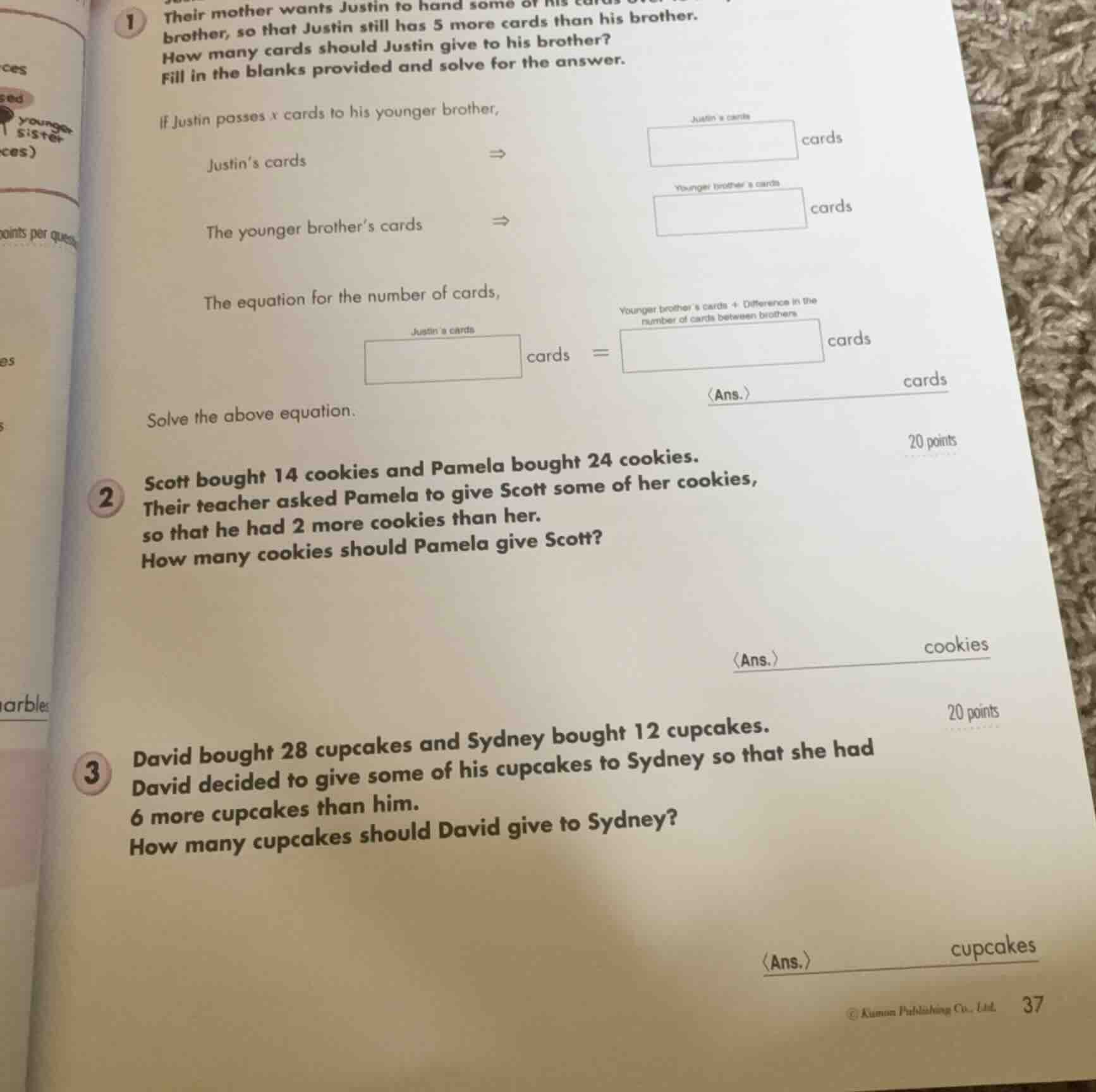
- their mother wants justin to hand some of his cards over to his brother, so that justin still has 5 more cards than his brother. how many cards should justin give to his brother?
fill in the blanks provided and solve for the answer.
if justin passes \\(x\\) cards to his younger brother,
justins cards \\(\
ightarrow\\) justins cards cards
the younger brothers cards \\(\
ightarrow\\) younger brothers cards cards
the equation for the number of cards,
justins cards cards = younger brothers cards + difference in the number of cards between brothers cards
solve the above equation.
\\(\langle\text{ans.}\
angle\\) ______ cards
- scott bought 14 cookies and pamela bought 24 cookies. their teacher asked pamela to give scott some of her cookies, so that he had 2 more cookies than her. how many cookies should pamela give scott?
\\(\langle\text{ans.}\
angle\\) ______ cookies
- david bought 28 cupcakes and sydney bought 12 cupcakes. david decided to give some of his cupcakes to sydney so that she had 6 more cupcakes than him. how many cupcakes should david give to sydney?
\\(\langle\text{ans.}\
angle\\) ______ cupcakes
Set up expressions for Question 1
Using the Algebraic Word Problems knowledge point, let Justin's initial number of cards be \(J\) and his younger brother's initial number of cards be \(B\). We are given that Justin has 5 more cards than his brother after some transfer, or initially. Let's read the problem carefully: "Their mother wants Justin to hand some of his cards over to his younger brother, so that Justin still has 5 more cards than his brother. How many cards should Justin give to his brother?"
Let \(J\) be Justin's initial cards and \(B\) be the younger brother's initial cards.
If Justin passes \(x\) cards to his younger brother:
- Justin's new number of cards is \(J - x\).
- The younger brother's new number of cards is \(B + x\).
We want Justin to still have 5 more cards than his brother:
Since the problem asks to fill in the blanks using the labels:
- Justin's cards \(\Rightarrow J - x\)
- Younger brother's cards \(\Rightarrow B + x\)
- The equation: \(\text{Justin's cards} = \text{Younger brother's cards} + \text{Difference in the number of cards between brothers}\)
Solving for \(x\) in terms of the initial difference \(J - B\):
However, looking at the top of the page (which is partially cut off), it likely specified the initial numbers of cards or their initial difference. Let's look at the context of the next questions to find the pattern.
In Question 2: Scott has 14, Pamela has 24. Pamela gives Scott \(y\) cookies so Scott has 2 more than Pamela.
Initial total: \(14 + 24 = 38\).
Let Pamela give \(y\) cookies.
Pamela's cookies: \(24 - y\).
Scott's cookies: \(14 + y\).
We want Scott to have 2 more than Pamela:
Let's check: if Pamela gives 6 cookies, Pamela has \(24 - 6 = 18\), Scott has \(14 + 6 = 20\). Indeed, \(20 - 18 = 2\).
In Question 3: David has 28, Sydney has 12. David gives Sydney \(z\) cupcakes so Sydney has 6 more than David.
David's cupcakes: \(28 - z\).
Sydney's cupcakes: \(12 + z\).
We want Sydney to have 6 more than David:
Let's check: if David gives 11 cupcakes, David has \(28 - 11 = 17\), Sydney has \(12 + 11 = 23\). Indeed, \(23 - 17 = 6\).
Now let's re-examine Question 1. The top of the page shows a circled "1" with text: "Their mother wants Justin to hand some of his cards over to his younger brother, so that Justin still has 5 more cards than his brother."
The line above it is cut off, but we can see the end of the words: "...ces" and "...sed" on the left margin.
Wait, let's look at the left margin of Question 1:
"younger sister... ces)"
This suggests the initial numbers of cards were given in a previous part or at the very start of the problem.
Let's look at the visible text: "Their mother wants Justin to hand some of his cards over to his younger brother, so that Justin still has 5 more…

Snap & solve any problem in the app
Get step-by-step solutions on Sovi AI
Photo-based solutions with guided steps
Explore more problems and detailed explanations
Question 1
If Justin initially has \(J\) cards and his brother has \(B\) cards, and Justin gives \(x\) cards to his brother:
- Justin's cards \(\Rightarrow\) <blank>\(J - x\)</blank> cards
- The younger brother's cards \(\Rightarrow\) <blank>\(B + x\)</blank> cards
- The equation: <blank>\(J - x\)</blank> cards = <blank>\(B + x + 5\)</blank> cards
- Answer: <blank>\(\frac{J - B - 5}{2}\)</blank> cards
(Note: Please substitute your worksheet's initial values for \(J\) and \(B\) into these expressions to get your final numerical answer.)
Question 2
- Answer: <blank>6</blank> cookies
Question 3
- Answer: <blank>11</blank> cupcakes