QUESTION IMAGE
Question
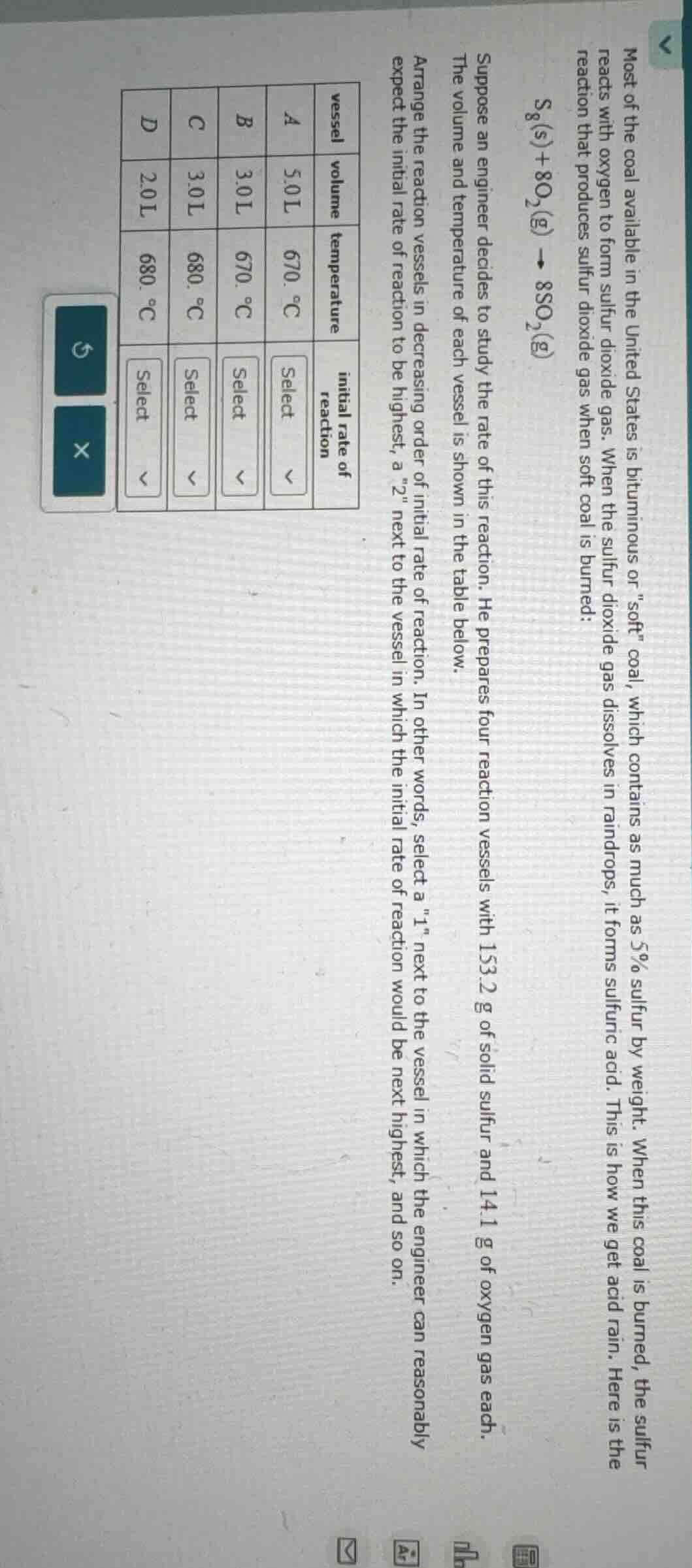
most of the coal available in the united states is bituminous or \soft\ coal, which contains as much as \\(5\\%\\) sulfur by weight. when this coal is burned, the sulfur reacts with oxygen to form sulfur dioxide gas. when the sulfur dioxide gas dissolves in raindrops, it forms sulfuric acid. this is how we get acid rain. here is the reaction that produces sulfur dioxide gas when soft coal is burned:
\\\text{s}_8(\text{s}) + 8\text{o}_2(\text{g}) \
ightarrow 8\text{so}_2(\text{g})\\
suppose an engineer decides to study the rate of this reaction. he prepares four reaction vessels with \\(153.2\text{ g}\\) of solid sulfur and \\(14.1\text{ g}\\) of oxygen gas each. the volume and temperature of each vessel is shown in the table below.
arrange the reaction vessels in decreasing order of initial rate of reaction. in other words, select a \1\ next to the vessel in which the engineer can reasonably expect the initial rate of reaction to be highest, a \2\ next to the vessel in which the initial rate of reaction would be next highest, and so on.
| vessel | volume | temperature | initial rate of reaction |
|---|---|---|---|
| b | \\(3.0\text{ l}\\) | \\(670. \\,^{\circ}\text{c}\\) | select |
| c | \\(3.0\text{ l}\\) | \\(680. \\,^{\circ}\text{c}\\) | select |
| d | \\(2.0\text{ l}\\) | \\(680. \\,^{\circ}\text{c}\\) | select |
🆕 New Concept Discovered: Factors Affecting Reaction Rates
How temperature and reactant concentration influence how fast a reaction occurs.
Step 1: Identify the factors that affect the reaction rate
The rate of a chemical reaction depends on temperature and the concentration of the reactants.
- Temperature: Higher temperatures increase the kinetic energy of the molecules, leading to more frequent and energetic collisions, which increases the reaction rate.
- Concentration of Reactants: For gases, a smaller volume for a fixed mass of reactant means a higher concentration (or partial pressure), leading to more frequent collisions and a faster reaction rate.
The reaction is:
Since each vessel contains the same mass of reactants (\(153.2\text{ g}\) of solid sulfur and \(14.1\text{ g}\) of oxygen gas), the concentration of the gaseous reactant (\(\text{O}_2\)) is determined by the volume of the vessel. A smaller volume results in a higher concentration of \(\text{O}_2\).
---
Step 2: Compare vessels by temperature
Let's group the vessels by temperature first, as temperature generally has a highly significant effect on reaction rates:
- Higher temperature (\(680\text{ }^{\circ}\text{C}\)): Vessels C and D
- Lower temperature (\(670\text{ }^{\circ}\text{C}\)): Vessels A and B
Vessels at \(680\text{ }^{\circ}\text{C}\) (C and D) will have higher initial rates than vessels at \(670\text{ }^{\circ}\text{C}\) (A and B).
---
Step 3: Compare vessels by volume (concentration) within each temperature group
Now, we compare the volumes within each temperature group. A smaller volume means a higher concentration of \(\text{O}_2\) gas, which increases the rate.
- Within the \(680\text{ }^{\circ}\text{C}\) group (C and D):
- Vessel D: \(2.0\text{ L}\) (smaller volume \(
ightarrow\) higher concentration \(
ightarrow\) faster rate)
- Vessel C: \(3.0\text{ L}\) (larger volume \(
ightarrow\) lower concentration \(
ightarrow\) slower rate)
- Therefore: Rate of D > Rate of C
- Within the \(670\text{ }^{\circ}\text{C}\) group (A and B):
- Vessel B: \(3.0\text{ L}\) (smaller volume \(
ightarrow\) higher concentration \(
ightarrow\) faster rate)
- Vessel A: \(5.0\text{ L}\) (larger volume \(
ightarrow\) lower concentration \(
ightarrow\) slower rate)
- Therefore: Rate of B > Rate of A
---
Step 4: Determine the final ranking
Combining our findings from fastest to slowest:
- Vessel D (Highest rate: \(680\text{ }^{\circ}\text{C}\), \(2.0\text{ L}\)) \(
ightarrow\) 1
- Vessel C (\(680\text{ }^{\circ}\text{C}\), \(3.0\text{ L}\)) \(
ightarrow\) 2
- Vessel B (\(670\text{ }^{\circ}\text{C}\), \(3.0\text{ L}\)) \(
ightarrow\) 3
- Vessel A (Lowest rate: \(670\text{ }^{\circ}\text{C}\), \(5.0\text{ L}\)) \(
ightarrow\) 4

Snap & solve any problem in the app
Get step-by-step solutions on Sovi AI
Photo-based solutions with guided steps
Explore more problems and detailed explanations
- Vessel A: 4 (lowest rate)
- Vessel B: 3
- Vessel C: 2
- Vessel D: 1 (highest rate)