QUESTION IMAGE
Question
5.8 more work with discriminants
rational when there is a perfect square under the radical. example: √4
irrational when there is not a perfect square under the radical. example: √2
equal example: x = 1; x = 1
unequal example: x = 2; x = -3
imaginary when there is a negative under the radical. example: √(-3)
do now: calculate the value of each discriminant below.
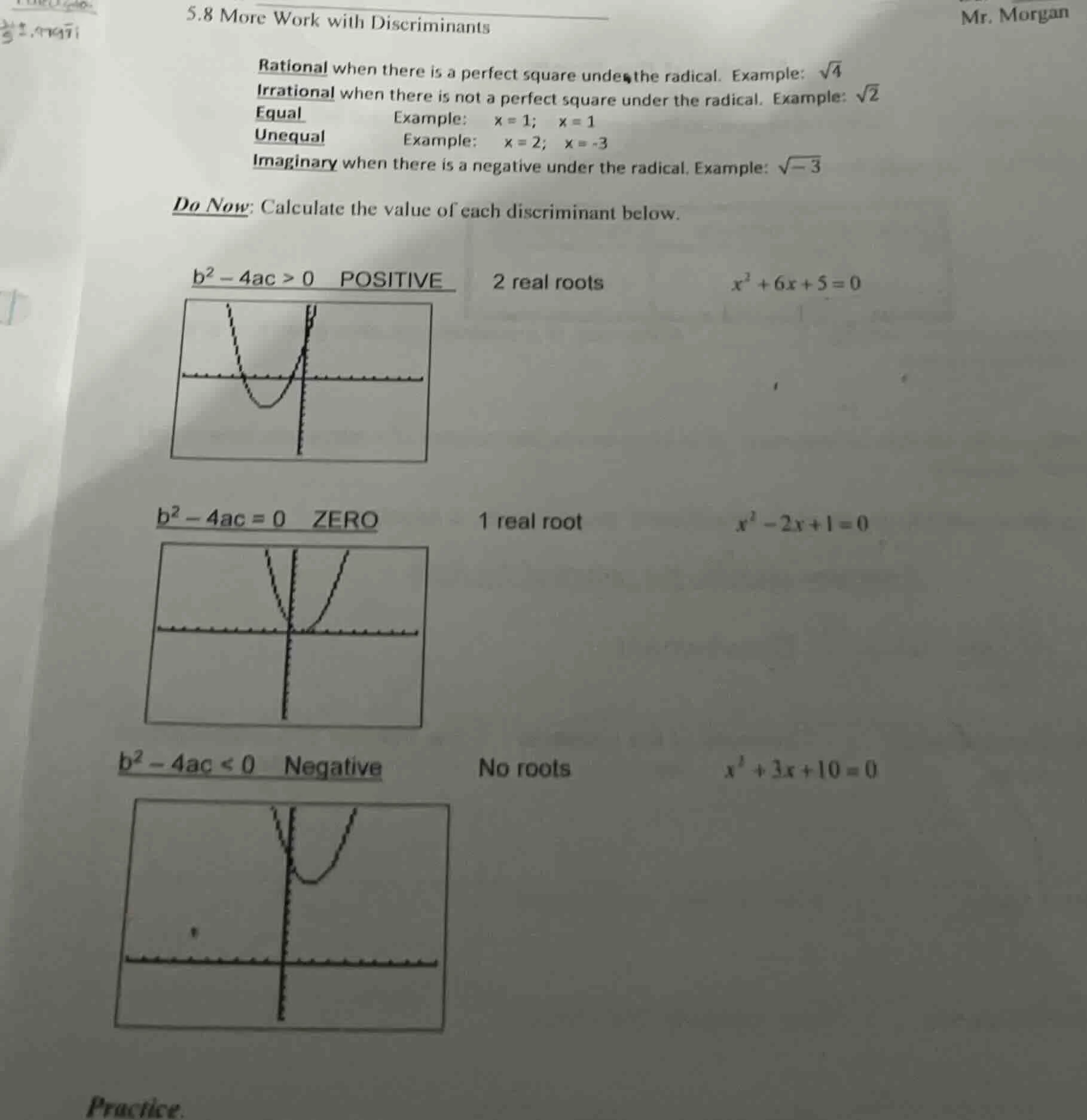
b² - 4ac > 0 positive 2 real roots x² + 6x + 5 = 0
graph of parabola intersecting x - axis at two points
b² - 4ac = 0 zero 1 real root x² - 2x + 1 = 0
graph of parabola touching x - axis at one point
b² - 4ac < 0 negative no roots x² + 3x + 10 = 0
graph of parabola not intersecting x - axis
practice:
Step1: Identify a,b,c for first equation
For $x^2 + 6x + 5 = 0$, $a=1$, $b=6$, $c=5$
Step2: Calculate first discriminant
$\Delta = b^2 - 4ac = 6^2 - 4(1)(5) = 36 - 20 = 16$
Step3: Identify a,b,c for second equation
For $x^2 - 2x + 1 = 0$, $a=1$, $b=-2$, $c=1$
Step4: Calculate second discriminant
$\Delta = b^2 - 4ac = (-2)^2 - 4(1)(1) = 4 - 4 = 0$
Step5: Identify a,b,c for third equation
For $x^2 + 3x + 10 = 0$, $a=1$, $b=3$, $c=10$
Step6: Calculate third discriminant
$\Delta = b^2 - 4ac = 3^2 - 4(1)(10) = 9 - 40 = -31$

Snap & solve any problem in the app
Get step-by-step solutions on Sovi AI
Photo-based solutions with guided steps
Explore more problems and detailed explanations
- For $x^2 + 6x + 5 = 0$: $16$
- For $x^2 - 2x + 1 = 0$: $0$
- For $x^2 + 3x + 10 = 0$: $-31$