QUESTION IMAGE
Question
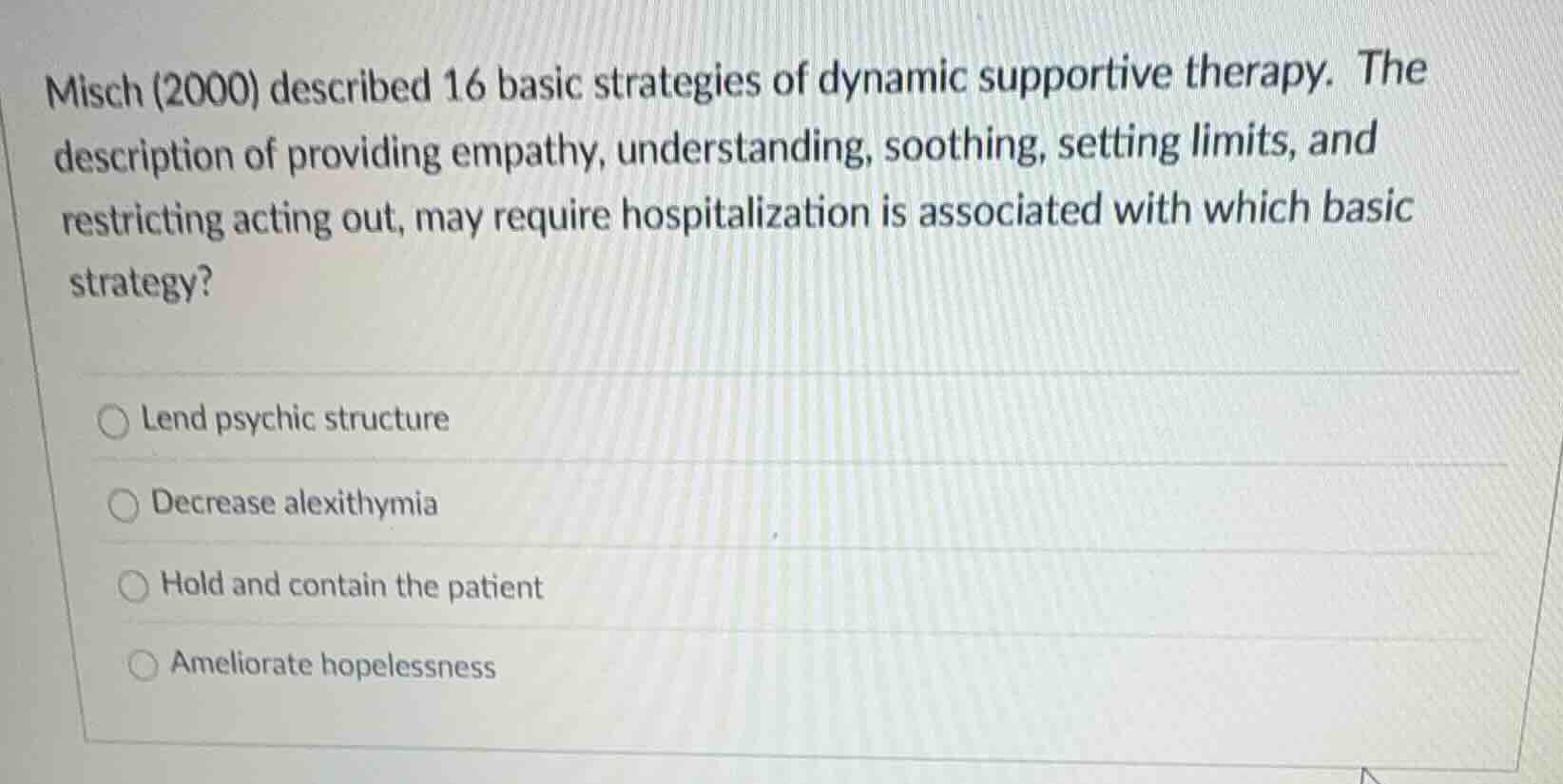
misch (2000) described 16 basic strategies of dynamic supportive therapy. the description of providing empathy, understanding, soothing, setting limits, and restricting acting out, may require hospitalization is associated with which basic strategy?
lend psychic structure
decrease alexithymia
hold and contain the patient
ameliorate hopelessness
🆕 New Concept Discovered: Dynamic Supportive Therapy Strategies
Understanding core techniques used to stabilize and support vulnerable patients.
Step 1: Analyze the question prompt
The question asks us to identify which of Misch's (2000) 16 basic strategies of dynamic supportive therapy is described by:
- Providing empathy, understanding, and soothing
- Setting limits and restricting acting out (which may require hospitalization)
Step 2: Evaluate the options against the description
- Lend psychic structure: This strategy involves the therapist acting as an auxiliary ego for the patient (e.g., helping with reality testing, impulse control, and judgment) when the patient's own ego functions are compromised. While it involves limit-setting, it is distinct from the specific holding environment concept.
- Decrease alexithymia: This refers to helping patients identify, label, and express emotions rather than experiencing them purely as physical sensations or acting them out.
- Hold and contain the patient: In psychodynamic theory (originating from D.W. Winnicott and Wilfred Bion), "holding" and "containing" refer to the therapist's ability to provide a safe psychological space. This space is characterized by empathy, understanding, and soothing (holding), alongside active containment of destructive impulses through limit-setting, behavioral boundaries, or even physical hospitalization when acting out becomes dangerous.
- Ameliorate hopelessness: This strategy focuses specifically on restoring hope, self-esteem, and a sense of agency in depressed or demoralized patients.
Step 3: Match the definition to the correct strategy
The combination of emotional soothing (holding) and active boundary/limit-setting to prevent dangerous acting out (containing) directly defines the strategy of Hold and contain the patient.

Snap & solve any problem in the app
Get step-by-step solutions on Sovi AI
Photo-based solutions with guided steps
Explore more problems and detailed explanations
Hold and contain the patient