QUESTION IMAGE
Question
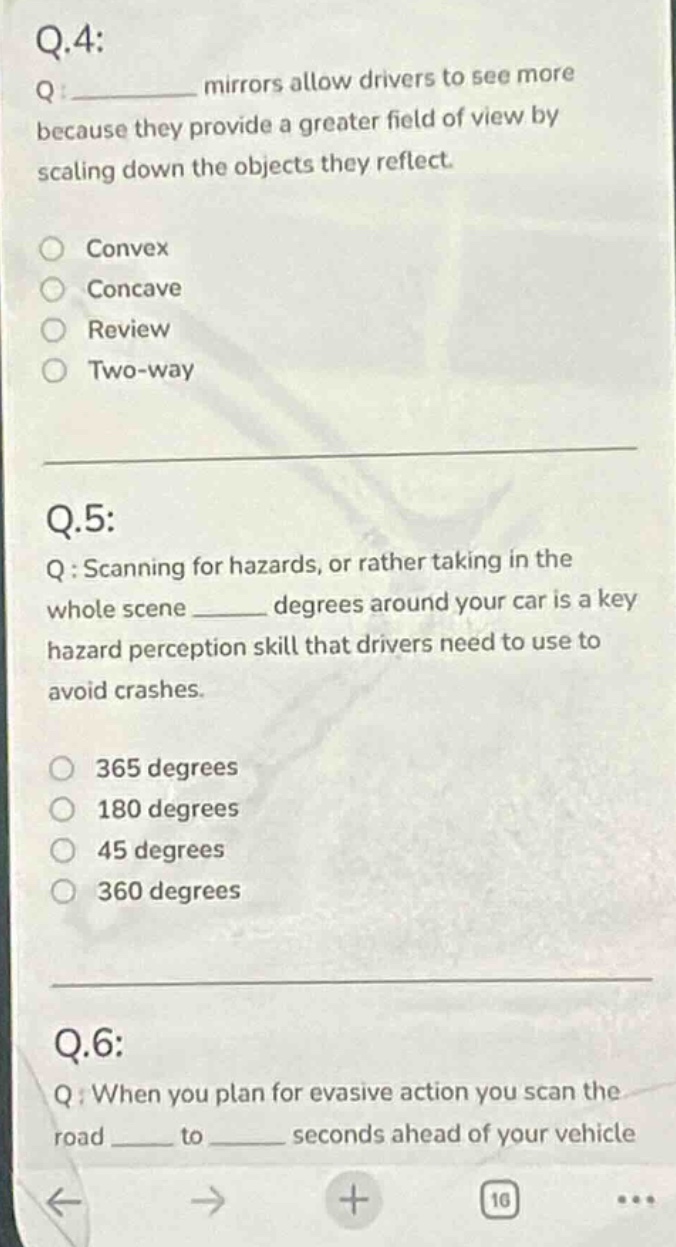
q.4:
q: ________ mirrors allow drivers to see more because they provide a greater field of view by scaling down the objects they reflect.
convex
concave
review
two-way
q.5:
q: scanning for hazards, or rather taking in the whole scene ________ degrees around your car is a key hazard perception skill that drivers need to use to avoid crashes.
365 degrees
180 degrees
45 degrees
360 degrees
q.6:
q: when you plan for evasive action you scan the road ______ to ______ seconds ahead of your vehicle
🆕 New Concept Discovered: Defensive Driving and Hazard Perception
Understanding spatial awareness and vehicle safety tools.
Step 1: Analyze Q.4 (Mirror Types)
The question asks which type of mirror provides a wider field of view by shrinking (scaling down) the image of the objects reflected.
- Convex mirrors curve outward. This shape diverges light rays, which makes reflected objects appear smaller than they actually are, allowing a much wider area (field of view) to fit into the mirror. This is why passenger-side mirrors on cars are convex.
- Concave mirrors curve inward and typically magnify close objects, which narrows the field of view.
- Review and Two-way are not types of optical curved mirrors that scale down images for a wider field of view.
Therefore, the correct option is Convex.
---
Step 2: Analyze Q.5 (Scanning Range)
The question asks about the coverage area in degrees required when scanning for hazards to take in the "whole scene" around your vehicle.
- A complete circle around your vehicle represents a full rotation of \( 360^\circ \).
- To avoid crashes, a driver must maintain situational awareness in all directions (front, sides, and rear using mirrors and shoulder checks).
Therefore, the correct option is 360 degrees.
---
Step 3: Analyze Q.6 (Evasive Action Scanning Time)
The question asks for the standard defensive driving visual lead time (in seconds) needed to plan for evasive action.
- In standard defensive driving courses, drivers are taught to look 12 to 15 seconds ahead of their vehicle. This distance provides enough time to identify potential hazards and plan an alternative path or evasive action if needed.
---

Snap & solve any problem in the app
Get step-by-step solutions on Sovi AI
Photo-based solutions with guided steps
Explore more problems and detailed explanations
- Q.4: Convex
- Q.5: 360 degrees
- Q.6: 12 to 15