QUESTION IMAGE
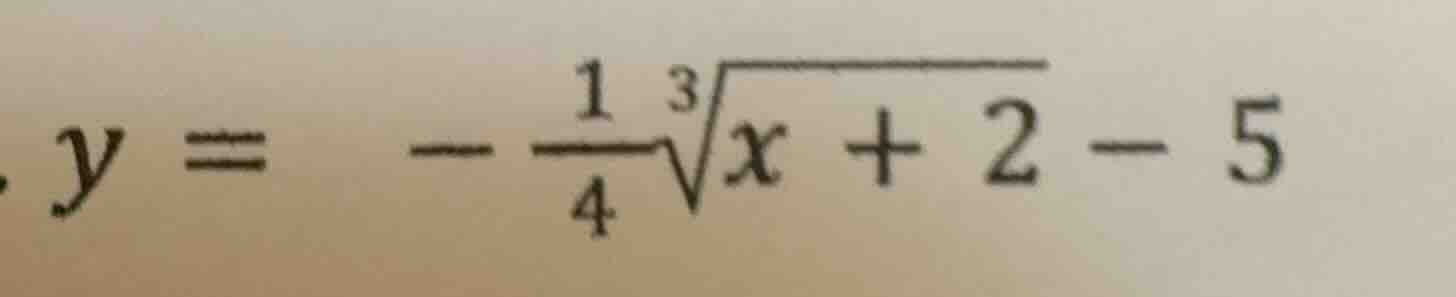
Question
\\y = -\frac{1}{4}\sqrt3{x + 2} - 5\\
⚡ Using what you learned: combining transformations
Step 1: Identify the parent function
The parent function is the cube root function:
$$ y = \sqrt[3]{x} $$
Step 2: Identify horizontal translation
The term inside the radical is \( x + 2 \).
$$ x \to x + 2 $$
This shifts the graph left by \( 2 \) units.
Step 3: Identify vertical and horizontal reflections and scaling
The factor multiplying the radical is \( -\frac{1}{4} \).
- The negative sign reflects the graph vertically across the \( x \)-axis.
- The factor of \( \frac{1}{4} \) vertically compresses the graph by a factor of \( \frac{1}{4} \).
Step 4: Identify vertical translation
The constant term outside the radical is \( -5 \).
This shifts the graph down by \( 5 \) units.

Snap & solve any problem in the app
Get step-by-step solutions on Sovi AI
Photo-based solutions with guided steps
Explore more problems and detailed explanations
The function \( y = -\frac{1}{4}\sqrt[3]{x + 2} - 5 \) is obtained by transforming the parent function \( y = \sqrt[3]{x} \) through the following steps:
- Horizontal Shift: Left by \( 2 \) units.
- Reflection: Vertically across the \( x \)-axis.
- Vertical Compression: By a factor of \( \frac{1}{4} \).
- Vertical Shift: Down by \( 5 \) units.