QUESTION IMAGE
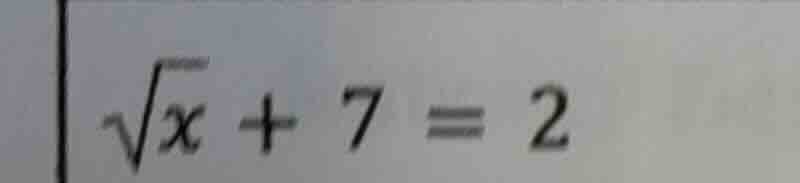
Question
\\\sqrt{x} + 7 = 2\\
🆕 New Concept Discovered: Solving Radical Equations
Isolate the root, square both sides, and check for extraneous solutions.
Step 1: Isolate the radical term
To solve for \(x\), we first want to get the square root term \(\sqrt{x}\) by itself on one side of the equation. We do this by subtracting \(7\) from both sides:
Step 2: Analyze the equation
A principal square root, \(\sqrt{x}\), represents the non-negative square root of a number. By definition, it can never produce a negative value:
Since our equation states that \(\sqrt{x} = -5\), and a square root cannot equal a negative number, there is no real number \(x\) that satisfies this equation.
Step 3: Verify by squaring (optional check)
If we proceed by squaring both sides to eliminate the radical:
Now, we must substitute \(x = 25\) back into the original equation to check for extraneous solutions:
Since \(x = 25\) does not satisfy the original equation, it is an extraneous solution. Therefore, the equation has no solution.

Snap & solve any problem in the app
Get step-by-step solutions on Sovi AI
Photo-based solutions with guided steps
Explore more problems and detailed explanations
No solution (or no real solution)