Sovi.AI - AI Math Tutor

Scan to solve math questions

QUESTION IMAGE

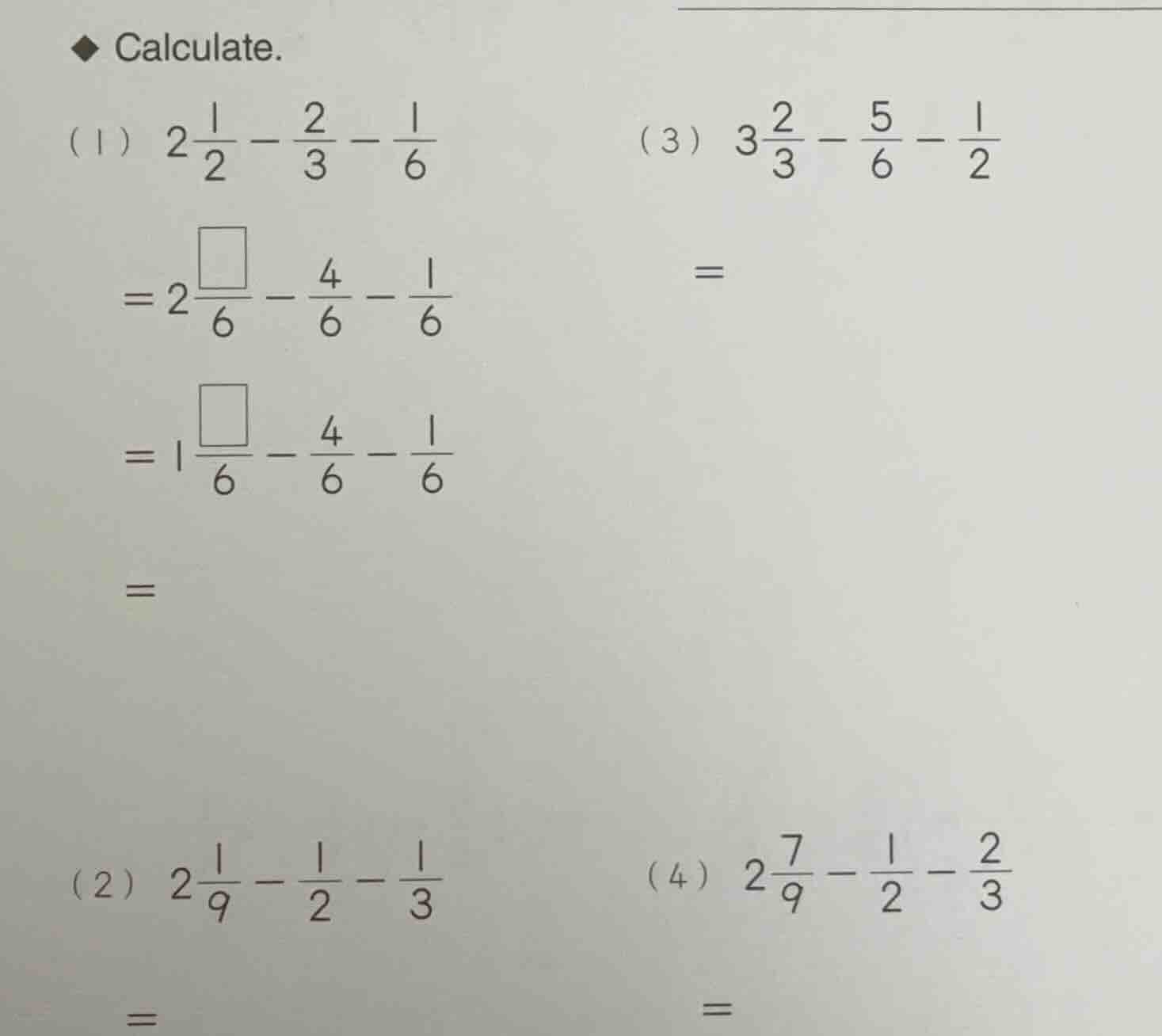
calculate. (1) \\(2\\frac{1}{2} - \\frac{2}{3} - \\frac{1}{6}\\) \\(= 2…
13,467 Learners found this answer helpful

Question

calculate.

(1) \\(2\frac{1}{2} - \frac{2}{3} - \frac{1}{6}\\)
\\(= 2\frac{\box}{6} - \frac{4}{6} - \frac{1}{6}\\)
\\(= 1\frac{\box}{6} - \frac{4}{6} - \frac{1}{6}\\)
\\(=\\)

(2) \\(2\frac{1}{9} - \frac{1}{2} - \frac{1}{3}\\)
\\(=\\)

(3) \\(3\frac{2}{3} - \frac{5}{6} - \frac{1}{2}\\)
\\(=\\)

(4) \\(2\frac{7}{9} - \frac{1}{2} - \frac{2}{3}\\)
\\(=\\)

Explanation:

Response

<pre_analysis>
{
"quality": "clear",
"question_count": 4,
"skills_matched": [
"step_cot",
"table_formatter",
"explain_then_answer",
"tutor"
],
"needs_drawing": false,
"concepts_used": [],
"new_concepts": [
"Fraction Subtraction",
"Mixed Numbers",
"Common Denominator"
],
"current_concepts": [
"Fraction Subtraction",
"Mixed Numbers",
"Common Denominator"
]
}
</pre_analysis>

<reasoning>

Find common denominators

To subtract fractions, find the least common multiple of the denominators for each problem.

  • For (1): Denominators are 2, 3, 6. The least common multiple is 6.
  • For (2): Denominators are 9, 2, 3. The least common multiple is 18.
  • For (3): Denominators are 3, 6, 2. The least common multiple is 6.
  • For (4): Denominators are 9, 2, 3. The least common multiple is 18.

Solve Question (1)

Convert fractions to have denominator 6 and fill in the blanks:
\[
2\frac{1}{2} - \frac{2}{3} - \frac{1}{6} = 2\frac{3}{6} - \frac{4}{6} - \frac{1}{6}
\]
The first blank box contains \(3\).
Since \(\frac{3}{6} < \frac{4}{6}\), borrow 1 from the whole number 2:
\[
2\frac{3}{6} = 1\frac{9}{6}
\]
The second blank box contains \(9\).
Subtract the fractions:
\[
1\frac{9}{6} - \frac{4}{6} - \frac{1}{6} = 1\frac{4}{6} = 1\frac{2}{3}
\]

Solve Question (2)

Convert to a common denominator of 18:
\[
2\frac{1}{9} - \frac{1}{2} - \frac{1}{3} = 2\frac{2}{18} - \frac{9}{18} - \frac{6}{18}
\]
Borrow 1 from the whole number 2:
\[
1\frac{20}{18} - \frac{9}{18} - \frac{6}{18} = 1\frac{5}{18}
\]

Solve Question (3)

Convert to a common denominator of 6:
\[
3\frac{2}{3} - \frac{5}{6} - \frac{1}{2} = 3\frac{4}{6} - \frac{5}{6} - \frac{3}{6}
\]
Borrow 1 from the whole number 3:
\[
2\frac{10}{6} - \frac{5}{6} - \frac{3}{6} = 2\frac{2}{6} = 2\frac{1}{3}
\]

Solve Question (4)

Convert to a common denominator of 18:
\[
2\frac{7}{9} - \frac{1}{2} - \frac{2}{3} = 2\frac{14}{18} - \frac{9}{18} - \frac{12}{18}
\]
Subtract step-by-step:
\[
2\frac{14}{18} - \frac{9}{18} = 2\frac{5}{18}
\]
Borrow 1 from the whole number 2:
\[
1\frac{23}{18} - \frac{12}{18} = 1\frac{11}{18}
\]
</reasoning>

<answer>

No.Answer
(2)\(1\frac{5}{18}\)
(3)\(2\frac{1}{3}\)
(4)\(1\frac{11}{18}\)

</answer>

<post_analysis>
{
"subject": "Mathematics",
"question_type": "Multi-part",
"knowledge_point": [
"Mathematics",
"Arithmetic",
"Fraction Operations"
]
}
</post_analysis>

Answer:

<pre_analysis>
{
"quality": "clear",
"question_count": 4,
"skills_matched": [
"step_cot",
"table_formatter",
"explain_then_answer",
"tutor"
],
"needs_drawing": false,
"concepts_used": [],
"new_concepts": [
"Fraction Subtraction",
"Mixed Numbers",
"Common Denominator"
],
"current_concepts": [
"Fraction Subtraction",
"Mixed Numbers",
"Common Denominator"
]
}
</pre_analysis>

<reasoning>

Find common denominators

To subtract fractions, find the least common multiple of the denominators for each problem.

  • For (1): Denominators are 2, 3, 6. The least common multiple is 6.
  • For (2): Denominators are 9, 2, 3. The least common multiple is 18.
  • For (3): Denominators are 3, 6, 2. The least common multiple is 6.
  • For (4): Denominators are 9, 2, 3. The least common multiple is 18.

Solve Question (1)

Convert fractions to have denominator 6 and fill in the blanks:
\[
2\frac{1}{2} - \frac{2}{3} - \frac{1}{6} = 2\frac{3}{6} - \frac{4}{6} - \frac{1}{6}
\]
The first blank box contains \(3\).
Since \(\frac{3}{6} < \frac{4}{6}\), borrow 1 from the whole number 2:
\[
2\frac{3}{6} = 1\frac{9}{6}
\]
The second blank box contains \(9\).
Subtract the fractions:
\[
1\frac{9}{6} - \frac{4}{6} - \frac{1}{6} = 1\frac{4}{6} = 1\frac{2}{3}
\]

Solve Question (2)

Convert to a common denominator of 18:
\[
2\frac{1}{9} - \frac{1}{2} - \frac{1}{3} = 2\frac{2}{18} - \frac{9}{18} - \frac{6}{18}
\]
Borrow 1 from the whole number 2:
\[
1\frac{20}{18} - \frac{9}{18} - \frac{6}{18} = 1\frac{5}{18}
\]

Solve Question (3)

Convert to a common denominator of 6:
\[
3\frac{2}{3} - \frac{5}{6} - \frac{1}{2} = 3\frac{4}{6} - \frac{5}{6} - \frac{3}{6}
\]
Borrow 1 from the whole number 3:
\[
2\frac{10}{6} - \frac{5}{6} - \frac{3}{6} = 2\frac{2}{6} = 2\frac{1}{3}
\]

Solve Question (4)

Convert to a common denominator of 18:
\[
2\frac{7}{9} - \frac{1}{2} - \frac{2}{3} = 2\frac{14}{18} - \frac{9}{18} - \frac{12}{18}
\]
Subtract step-by-step:
\[
2\frac{14}{18} - \frac{9}{18} = 2\frac{5}{18}
\]
Borrow 1 from the whole number 2:
\[
1\frac{23}{18} - \frac{12}{18} = 1\frac{11}{18}
\]
</reasoning>

<answer>

No.Answer
(2)\(1\frac{5}{18}\)
(3)\(2\frac{1}{3}\)
(4)\(1\frac{11}{18}\)

</answer>

<post_analysis>
{
"subject": "Mathematics",
"question_type": "Multi-part",
"knowledge_point": [
"Mathematics",
"Arithmetic",
"Fraction Operations"
]
}
</post_analysis>