QUESTION IMAGE
Question
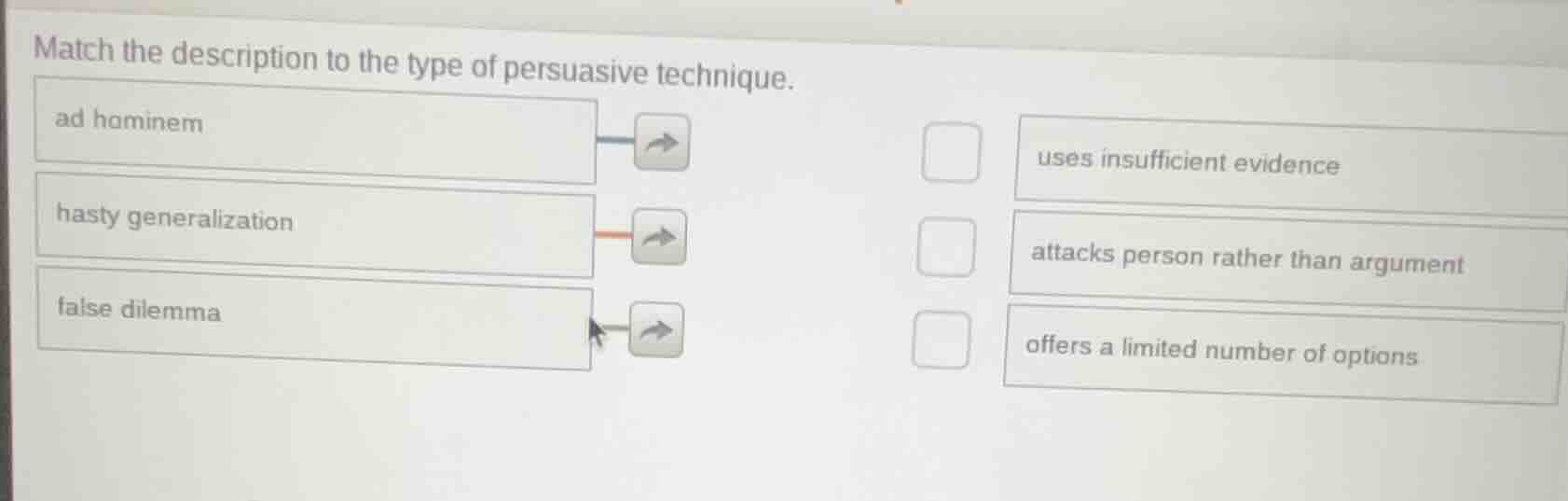
match the description to the type of persuasive technique.
ad hominem
hasty generalization
false dilemma
uses insufficient evidence
attacks person rather than argument
offers a limited number of options
<pre_analysis>
{
"quality": "clear",
"question_count": 1,
"skills_matched": [
"direct_cot",
"explain_then_answer",
"tutor"
],
"needs_drawing": false,
"concepts_used": [
"Persuasive Techniques"
],
"new_concepts": [
"Logical Fallacies",
"Ad Hominem",
"Hasty Generalization"
],
"current_concepts": [
"Persuasive Techniques",
"Logical Fallacies",
"Ad Hominem",
"Hasty Generalization",
"False Dilemma"
]
}
</pre_analysis>
<reasoning>
Analyze the persuasive techniques
We need to match each logical fallacy on the left to its correct description on the right. This involves applying our understanding of Persuasive Techniques and logical fallacies.
Define ad hominem
The term "ad hominem" is Latin for "to the person." This fallacy occurs when an arguer attacks the character, motive, or other attribute of the person making the argument rather than addressing the substance of the argument itself.
- Match: "attacks person rather than argument"
Define hasty generalization
A "hasty generalization" occurs when a person draws a broad conclusion based on a sample size that is too small or biased, rather than looking at sufficient evidence.
- Match: "uses insufficient evidence"
Define false dilemma
A "false dilemma" (or black-and-white fallacy) presents a choice between two mutually exclusive options when, in fact, there are other viable alternatives available.
- Match: "offers a limited number of options"
</reasoning>
<answer>
| Persuasive Technique | Description |
|---|---|
| hasty generalization | uses insufficient evidence |
| false dilemma | offers a limited number of options |
</answer>
<post_analysis>
{
"subject": "Others",
"question_type": "Free Response",
"knowledge_point": [
"Others",
"English Language Arts",
"Logical Fallacies"
]
}
</post_analysis>
Snap & solve any problem in the app
Get step-by-step solutions on Sovi AI
Photo-based solutions with guided steps
Explore more problems and detailed explanations
<pre_analysis>
{
"quality": "clear",
"question_count": 1,
"skills_matched": [
"direct_cot",
"explain_then_answer",
"tutor"
],
"needs_drawing": false,
"concepts_used": [
"Persuasive Techniques"
],
"new_concepts": [
"Logical Fallacies",
"Ad Hominem",
"Hasty Generalization"
],
"current_concepts": [
"Persuasive Techniques",
"Logical Fallacies",
"Ad Hominem",
"Hasty Generalization",
"False Dilemma"
]
}
</pre_analysis>
<reasoning>
Analyze the persuasive techniques
We need to match each logical fallacy on the left to its correct description on the right. This involves applying our understanding of Persuasive Techniques and logical fallacies.
Define ad hominem
The term "ad hominem" is Latin for "to the person." This fallacy occurs when an arguer attacks the character, motive, or other attribute of the person making the argument rather than addressing the substance of the argument itself.
- Match: "attacks person rather than argument"
Define hasty generalization
A "hasty generalization" occurs when a person draws a broad conclusion based on a sample size that is too small or biased, rather than looking at sufficient evidence.
- Match: "uses insufficient evidence"
Define false dilemma
A "false dilemma" (or black-and-white fallacy) presents a choice between two mutually exclusive options when, in fact, there are other viable alternatives available.
- Match: "offers a limited number of options"
</reasoning>
<answer>
| Persuasive Technique | Description |
|---|---|
| hasty generalization | uses insufficient evidence |
| false dilemma | offers a limited number of options |
</answer>
<post_analysis>
{
"subject": "Others",
"question_type": "Free Response",
"knowledge_point": [
"Others",
"English Language Arts",
"Logical Fallacies"
]
}
</post_analysis>