QUESTION IMAGE
Question
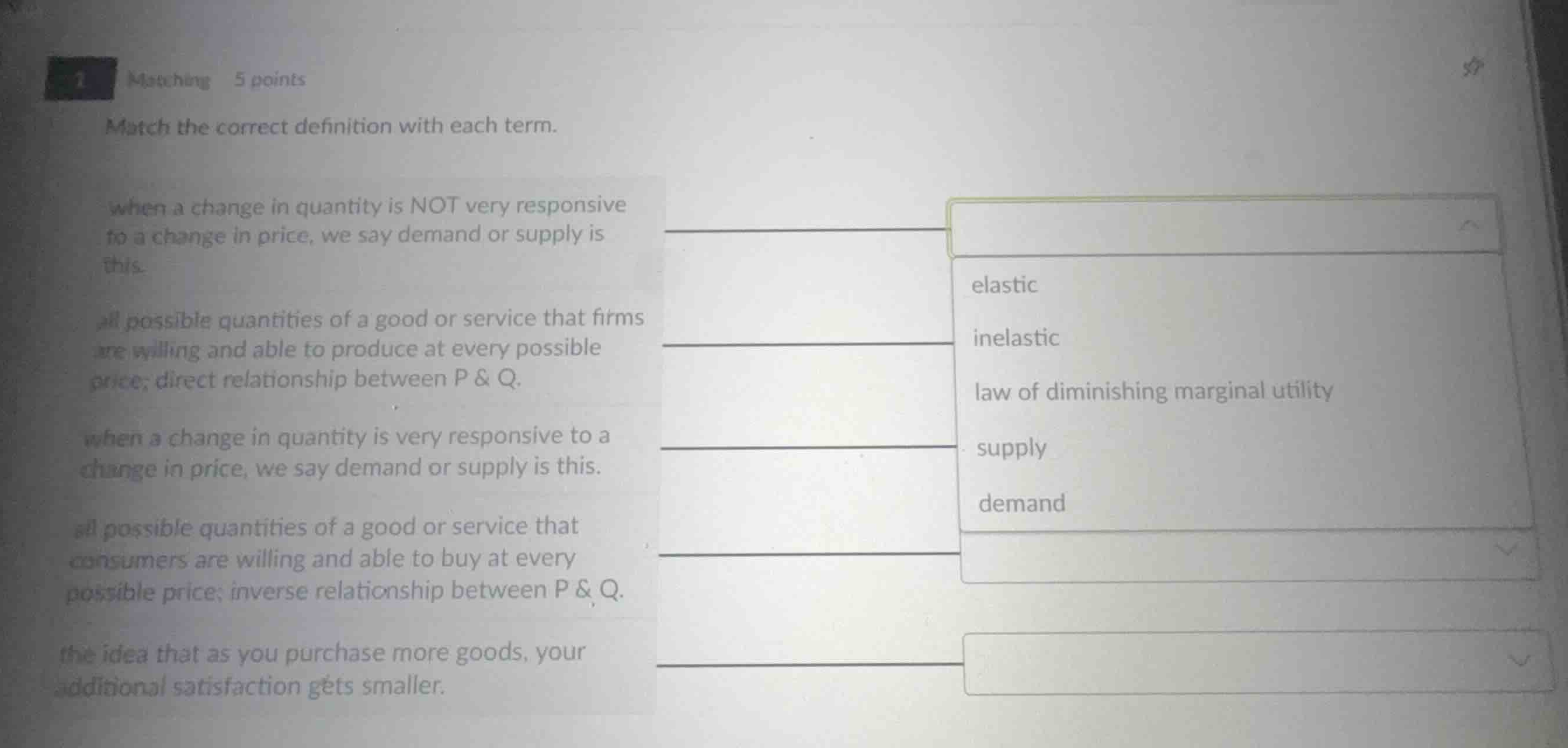
match the correct definition with each term.
when a change in quantity is not very responsive to a change in price, we say demand or supply is this.
all possible quantities of a good or service that firms are willing and able to produce at every possible price; direct relationship between p & q.
when a change in quantity is very responsive to a change in price, we say demand or supply is this.
all possible quantities of a good or service that consumers are willing and able to buy at every possible price; inverse relationship between p & q.
the idea that as you purchase more goods, your additional satisfaction gets smaller.
terms:
elastic
inelastic
law of diminishing marginal utility
supply
demand
Define responsiveness to price changes
We analyze the first and third definitions. When quantity is not very responsive to price changes, it is inelastic. When quantity is highly responsive, it is elastic. This relates directly to Price Elasticity of Demand.
Identify the definition of supply
The second definition describes the quantities firms are willing and able to produce at every price, showing a direct relationship. This is the definition of supply.
Identify the definition of demand
The fourth definition describes the quantities consumers are willing and able to buy at every price, showing an inverse relationship. This is the definition of demand.
Identify diminishing marginal utility
The fifth definition describes how additional satisfaction decreases as more of a good is consumed. This is the law of diminishing marginal utility.

Snap & solve any problem in the app
Get step-by-step solutions on Sovi AI
Photo-based solutions with guided steps
Explore more problems and detailed explanations
| No. | Definition | Term |
|---|---|---|
| 2 | all possible quantities of a good or service that firms are willing and able to produce at every possible price; direct relationship between P & Q. | supply |
| 3 | when a change in quantity is very responsive to a change in price, we say demand or supply is this. | elastic |
| 4 | all possible quantities of a good or service that consumers are willing and able to buy at every possible price; inverse relationship between P & Q. | demand |
| 5 | the idea that as you purchase more goods, your additional satisfaction gets smaller. | law of diminishing marginal utility |