Sovi.AI - AI Math Tutor

Scan to solve math questions

QUESTION IMAGE

make up a true proportion out of each set of four numbers. is it possib…
24,952 Learners found this answer helpful

Question

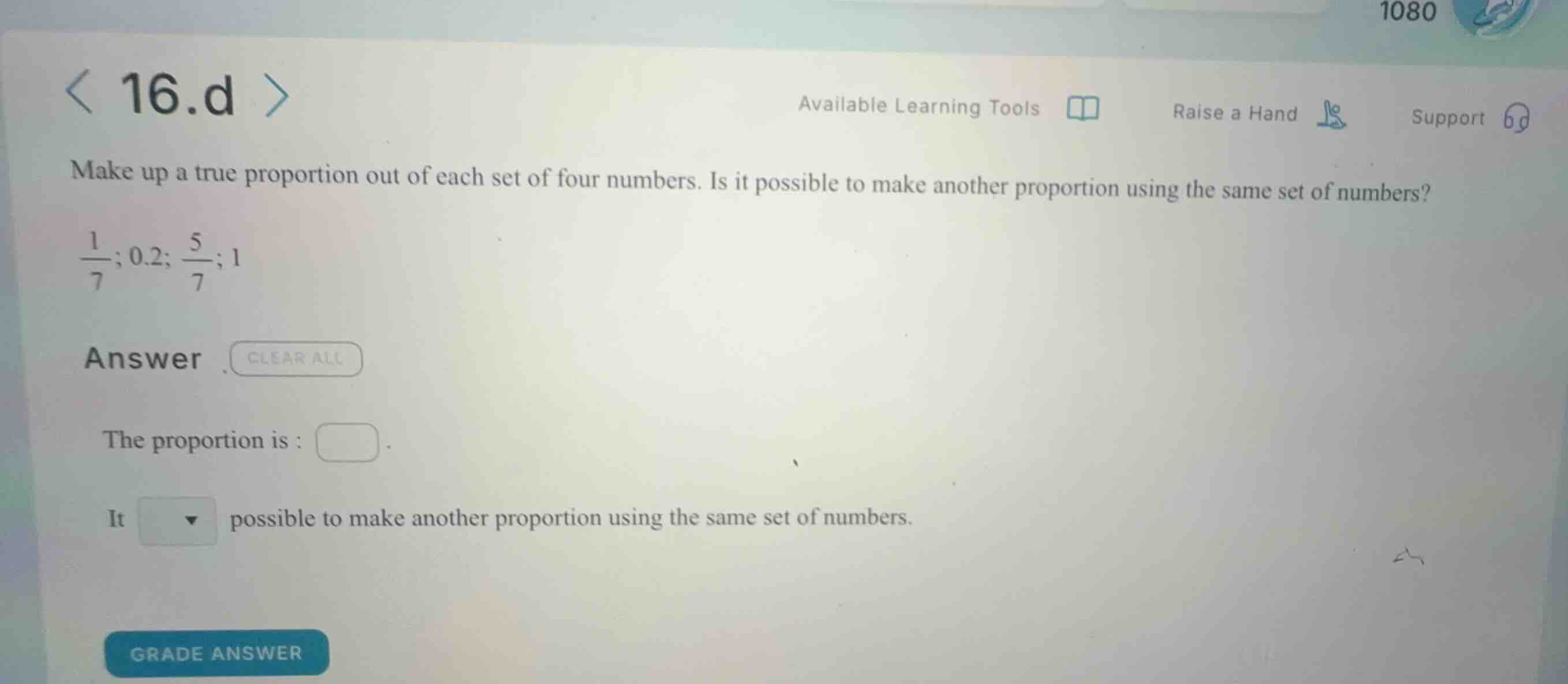
make up a true proportion out of each set of four numbers. is it possible to make another proportion using the same set of numbers?

\\(\frac{1}{7}; 0.2; \frac{5}{7}; 1\\)

answer

the proportion is: .

it v possible to make another proportion using the same set of numbers.

Explanation:

Response

<pre_analysis>
{
"quality": "clear",
"question_count": 1,
"skills_matched": [
"step_cot",
"blank_filling_formatter",
"explain_then_answer",
"quick"
],
"needs_drawing": false,
"concepts_used": [
"Proportions"
],
"new_concepts": [],
"current_concepts": [
"Proportions",
"Ratios"
]
}
</pre_analysis>

<reasoning>

Convert numbers to fractions

\[
0.2 = \frac{1}{5}
\]
The set of numbers is:
\[
\frac{1}{7}, \frac{1}{5}, \frac{5}{7}, 1
\]

Find a true proportion

\[
\frac{1}{7} \cdot 1 = \frac{1}{7}
\]
\[
\frac{1}{5} \cdot \frac{5}{7} = \frac{1}{7}
\]
Since the products of the extremes and means are equal:
\[
\frac{1/7}{1/5} = \frac{5/7}{1} \implies \frac{1}{7} : 0.2 = \frac{5}{7} : 1
\]

Determine if other proportions are possible

Using the same product relation \(ad = bc\), we can rearrange the terms:
\[
\frac{1}{7} : \frac{5}{7} = 0.2 : 1
\]
Thus, it is possible to make another proportion.
</reasoning>

<answer>
Make up a true proportion out of each set of four numbers. Is it possible to make another proportion using the same set of numbers?

\(\frac{1}{7}; 0.2; \frac{5}{7}; 1\)

The proportion is: <blank>\(\frac{1}{7} : 0.2 = \frac{5}{7} : 1\)</blank>.

It <blank>is</blank> possible to make another proportion using the same set of numbers.
</answer>

<post_analysis>
{
"subject": "Mathematics",
"question_type": "Fill-in-the-blank",
"knowledge_point": [
"Mathematics",
"Algebra",
"Proportions"
]
}
</post_analysis>

Answer:

<pre_analysis>
{
"quality": "clear",
"question_count": 1,
"skills_matched": [
"step_cot",
"blank_filling_formatter",
"explain_then_answer",
"quick"
],
"needs_drawing": false,
"concepts_used": [
"Proportions"
],
"new_concepts": [],
"current_concepts": [
"Proportions",
"Ratios"
]
}
</pre_analysis>

<reasoning>

Convert numbers to fractions

\[
0.2 = \frac{1}{5}
\]
The set of numbers is:
\[
\frac{1}{7}, \frac{1}{5}, \frac{5}{7}, 1
\]

Find a true proportion

\[
\frac{1}{7} \cdot 1 = \frac{1}{7}
\]
\[
\frac{1}{5} \cdot \frac{5}{7} = \frac{1}{7}
\]
Since the products of the extremes and means are equal:
\[
\frac{1/7}{1/5} = \frac{5/7}{1} \implies \frac{1}{7} : 0.2 = \frac{5}{7} : 1
\]

Determine if other proportions are possible

Using the same product relation \(ad = bc\), we can rearrange the terms:
\[
\frac{1}{7} : \frac{5}{7} = 0.2 : 1
\]
Thus, it is possible to make another proportion.
</reasoning>

<answer>
Make up a true proportion out of each set of four numbers. Is it possible to make another proportion using the same set of numbers?

\(\frac{1}{7}; 0.2; \frac{5}{7}; 1\)

The proportion is: <blank>\(\frac{1}{7} : 0.2 = \frac{5}{7} : 1\)</blank>.

It <blank>is</blank> possible to make another proportion using the same set of numbers.
</answer>

<post_analysis>
{
"subject": "Mathematics",
"question_type": "Fill-in-the-blank",
"knowledge_point": [
"Mathematics",
"Algebra",
"Proportions"
]
}
</post_analysis>