QUESTION IMAGE
Question
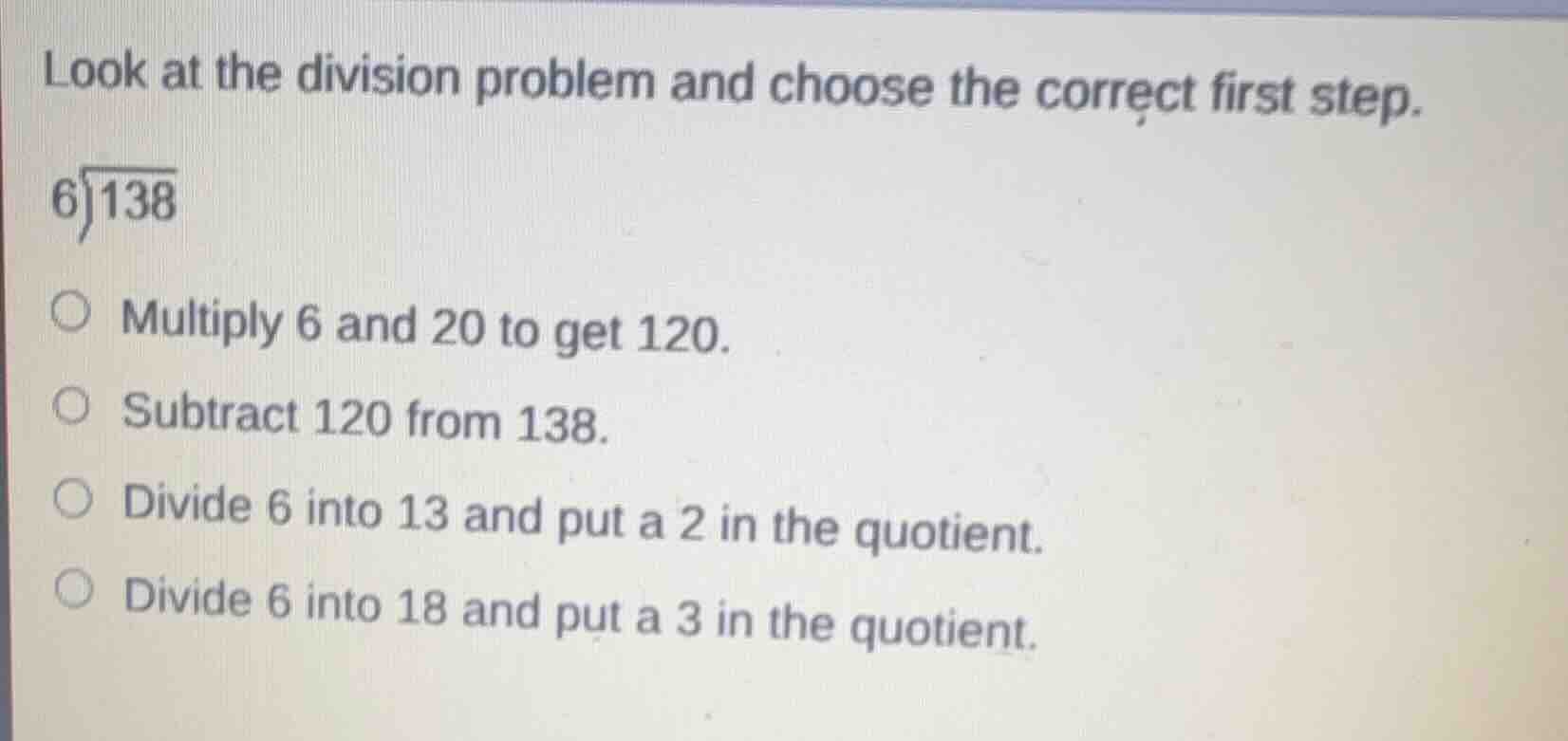
look at the division problem and choose the correct first step.
(6 \overline{) 138})
- multiply 6 and 20 to get 120.
- subtract 120 from 138.
- divide 6 into 13 and put a 2 in the quotient.
- divide 6 into 18 and put a 3 in the quotient.
Analyze the division problem
We are given the long division problem \(138 \div 6\). Here, \(6\) is the divisor and \(138\) is the dividend.
Determine the first step of long division
Using the Division Vocabulary concept, we begin long division by looking at the leftmost digits of the dividend.
- The first digit is \(1\). Since \(6\) cannot divide into \(1\), we look at the first two digits, which make \(13\).
- We determine how many times \(6\) goes into \(13\). Since \(6 \times 2 = 12\) and \(6 \times 3 = 18\), \(6\) goes into \(13\) exactly \(2\) times with a remainder.
- Therefore, the correct first step is to divide \(6\) into \(13\) and place a \(2\) in the quotient above the \(3\).
Evaluate the given options
- "Multiply 6 and 20 to get 120": This is an estimation or partial quotients strategy, but not the standard first step shown in the options.
- "Subtract 120 from 138": This is a later step if using partial quotients.
- "Divide 6 into 13 and put a 2 in the quotient": This matches our standard long division first step.
- "Divide 6 into 18 and put a 3 in the quotient": This ignores the place value of the tens digit.

Snap & solve any problem in the app
Get step-by-step solutions on Sovi AI
Photo-based solutions with guided steps
Explore more problems and detailed explanations
- Multiply 6 and 20 to get 120.
- Subtract 120 from 138.
- Divide 6 into 13 and put a 2 in the quotient. (Correct answer)
- Divide 6 into 18 and put a 3 in the quotient.