QUESTION IMAGE
Question
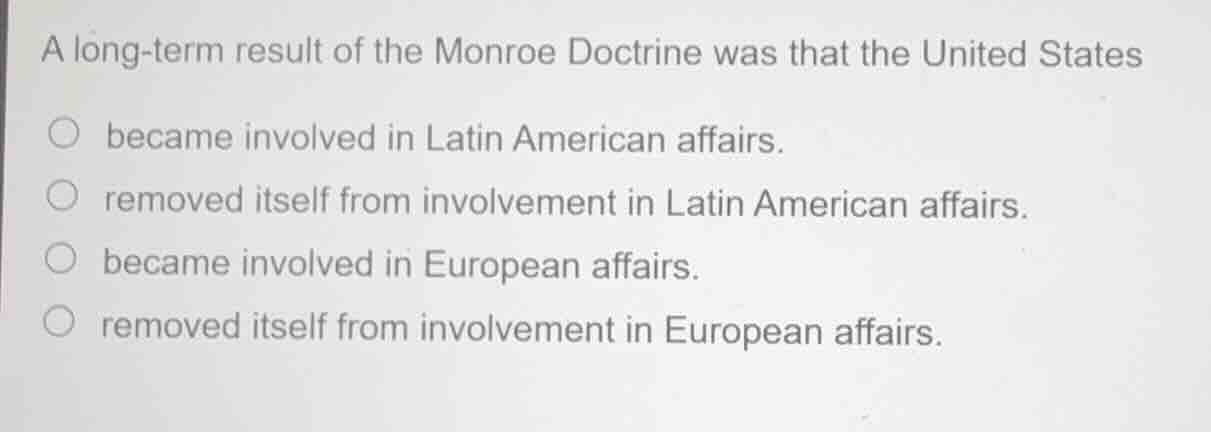
a long-term result of the monroe doctrine was that the united states
became involved in latin american affairs.
removed itself from involvement in latin american affairs.
became involved in european affairs.
removed itself from involvement in european affairs.
<pre_analysis>
{
"quality": "clear",
"question_count": 1,
"skills_matched": [
"direct_cot",
"multiple_choice_formatter",
"explain_then_answer",
"quick"
],
"needs_drawing": false,
"concepts_used": [
"Monroe Doctrine",
"US Foreign Policy"
],
"new_concepts": [],
"current_concepts": [
"Monroe Doctrine",
"US Foreign Policy",
"Monroe Doctrine Context"
]
}
</pre_analysis>
<reasoning>
Analyze the core purpose of the Monroe Doctrine
The Monroe Doctrine (1823) declared that the Western Hemisphere was closed to further European colonization and that any European intervention in the political affairs of the Americas would be viewed as a hostile act against the United States.
Evaluate the long-term geopolitical consequences
By establishing the Western Hemisphere as its sphere of influence, the United States increasingly intervened in the political and economic affairs of Latin American nations to protect its interests, especially in the late 19th and early 20th centuries (e.g., through the Roosevelt Corollary).
Assess the given multiple-choice options
- Option 1: "became involved in Latin American affairs" directly aligns with the historical outcome of the doctrine serving as a justification for U.S. intervention in the region.
- Option 2 is incorrect because the U.S. increased, rather than removed, its involvement.
- Options 3 and 4 are incorrect because the doctrine aimed to keep Europe out of the Americas, while the U.S. generally maintained its policy of avoiding European political entanglements during this era.
</reasoning>
<answer>
<mcq-correct>became involved in Latin American affairs.</mcq-correct>
<mcq-option>removed itself from involvement in Latin American affairs.</mcq-option>
<mcq-option>became involved in European affairs.</mcq-option>
<mcq-option>removed itself from involvement in European affairs.</mcq-option>
</answer>
<post_analysis>
{
"subject": "Social Science",
"question_type": "Multiple Choice",
"knowledge_point": [
"Social Science",
"U.S. History",
"Monroe Doctrine"
]
}
</post_analysis>
Snap & solve any problem in the app
Get step-by-step solutions on Sovi AI
Photo-based solutions with guided steps
Explore more problems and detailed explanations
<pre_analysis>
{
"quality": "clear",
"question_count": 1,
"skills_matched": [
"direct_cot",
"multiple_choice_formatter",
"explain_then_answer",
"quick"
],
"needs_drawing": false,
"concepts_used": [
"Monroe Doctrine",
"US Foreign Policy"
],
"new_concepts": [],
"current_concepts": [
"Monroe Doctrine",
"US Foreign Policy",
"Monroe Doctrine Context"
]
}
</pre_analysis>
<reasoning>
Analyze the core purpose of the Monroe Doctrine
The Monroe Doctrine (1823) declared that the Western Hemisphere was closed to further European colonization and that any European intervention in the political affairs of the Americas would be viewed as a hostile act against the United States.
Evaluate the long-term geopolitical consequences
By establishing the Western Hemisphere as its sphere of influence, the United States increasingly intervened in the political and economic affairs of Latin American nations to protect its interests, especially in the late 19th and early 20th centuries (e.g., through the Roosevelt Corollary).
Assess the given multiple-choice options
- Option 1: "became involved in Latin American affairs" directly aligns with the historical outcome of the doctrine serving as a justification for U.S. intervention in the region.
- Option 2 is incorrect because the U.S. increased, rather than removed, its involvement.
- Options 3 and 4 are incorrect because the doctrine aimed to keep Europe out of the Americas, while the U.S. generally maintained its policy of avoiding European political entanglements during this era.
</reasoning>
<answer>
<mcq-correct>became involved in Latin American affairs.</mcq-correct>
<mcq-option>removed itself from involvement in Latin American affairs.</mcq-option>
<mcq-option>became involved in European affairs.</mcq-option>
<mcq-option>removed itself from involvement in European affairs.</mcq-option>
</answer>
<post_analysis>
{
"subject": "Social Science",
"question_type": "Multiple Choice",
"knowledge_point": [
"Social Science",
"U.S. History",
"Monroe Doctrine"
]
}
</post_analysis>