QUESTION IMAGE
Question
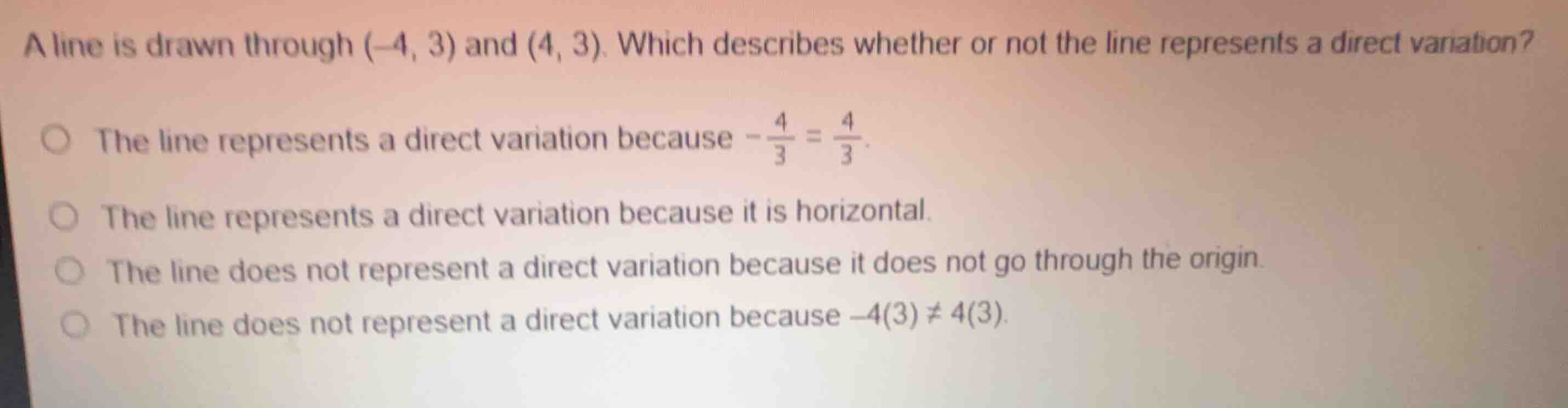
a line is drawn through \\((-4, 3)\\) and \\((4, 3)\\). which describes whether or not the line represents a direct variation?
- the line represents a direct variation because \\(-\frac{4}{3} = \frac{4}{3}\\).
- the line represents a direct variation because it is horizontal.
- the line does not represent a direct variation because it does not go through the origin.
- the line does not represent a direct variation because \\(-4(3) \
eq 4(3)\\).
Determine the equation of the line
$$
LATEXBLOCK0
$$
Check the direct variation condition
$$
LATEXBLOCK1
$$
Match with the correct option
$$
\text{The line does not represent a direct variation because it does not go through the origin.}
$$

Snap & solve any problem in the app
Get step-by-step solutions on Sovi AI
Photo-based solutions with guided steps
Explore more problems and detailed explanations
- The line represents a direct variation because \(-\frac{4}{3} = \frac{4}{3}\).
- The line represents a direct variation because it is horizontal.
- The line does not represent a direct variation because it does not go through the origin. (Correct answer)
- The line does not represent a direct variation because \(-4(3)
eq 4(3)\).