QUESTION IMAGE
Question
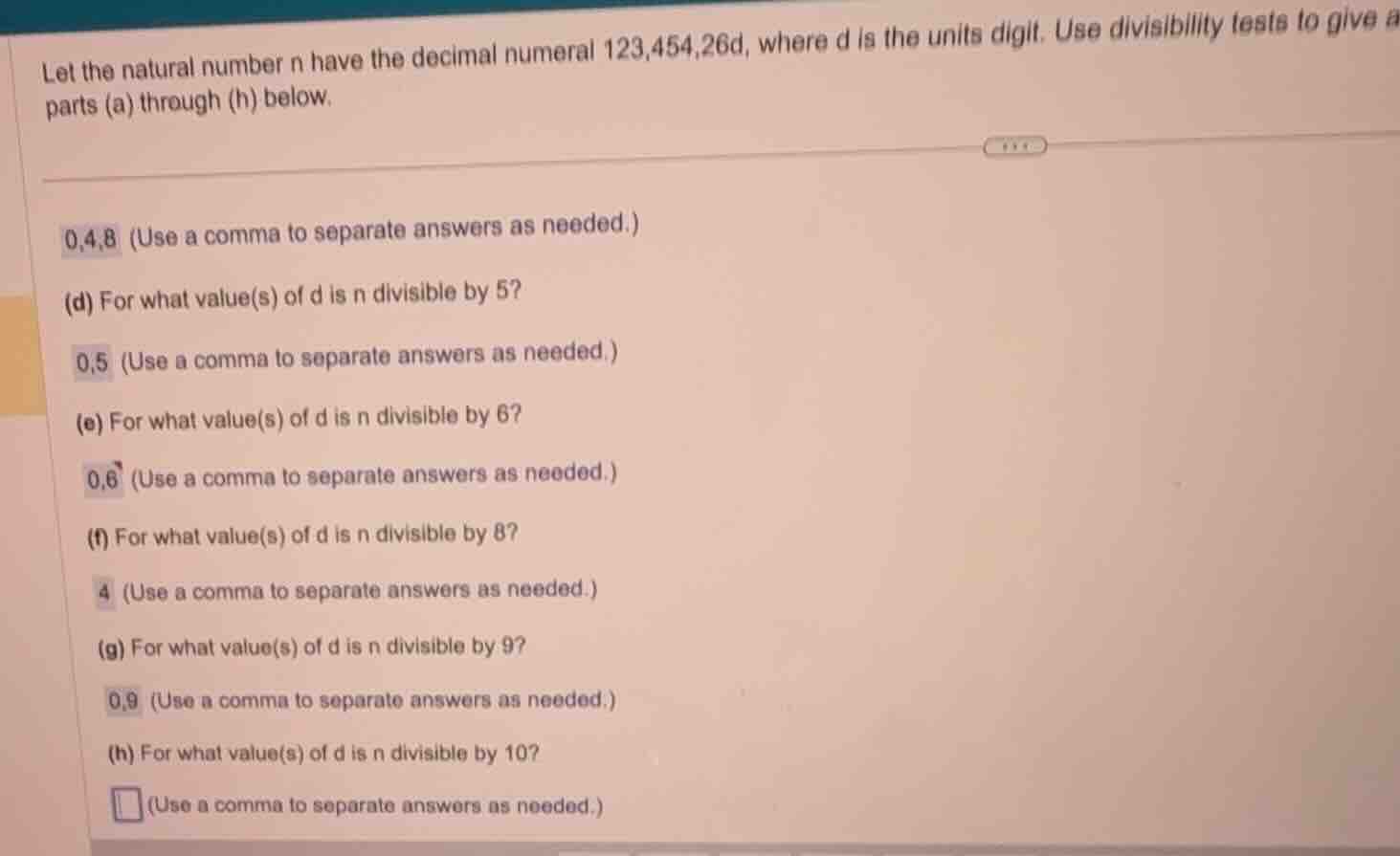
let the natural number n have the decimal numeral 123,454,26d, where d is the units digit. use divisibility tests to give a parts (a) through (h) below.
0,4,8 (use a comma to separate answers as needed.)
(d) for what value(s) of d is n divisible by 5?
0,5 (use a comma to separate answers as needed.)
(e) for what value(s) of d is n divisible by 6?
0,6 (use a comma to separate answers as needed.)
(f) for what value(s) of d is n divisible by 8?
4 (use a comma to separate answers as needed.)
(g) for what value(s) of d is n divisible by 9?
0,9 (use a comma to separate answers as needed.)
(h) for what value(s) of d is n divisible by 10?
(use a comma to separate answers as needed.)
Analyze the number and divisibility by 5
The natural number is \(n = 123,454,26d\).
Using the Divisibility Rules concept, a number is divisible by 5 if and only if its units digit \(d\) is either 0 or 5.
Thus, the values of \(d\) for divisibility by 5 are 0, 5.
Analyze divisibility by 6
Using the Divisibility Rules concept, a number is divisible by 6 if it is divisible by both 2 and 3.
For divisibility by 2, \(d\) must be even: \(d \in \{0, 2, 4, 6, 8\}\).
For divisibility by 3, the sum of the digits must be divisible by 3.
The sum of the digits is:
Since 27 is divisible by 3, \(27 + d\) is divisible by 3 if \(d\) is divisible by 3: \(d \in \{0, 3, 6, 9\}\).
Intersecting the two sets:
Thus, the values of \(d\) for divisibility by 6 are 0, 6.
Analyze divisibility by 8
Using the Divisibility Rules concept, a number is divisible by 8 if the number formed by its last three digits is divisible by 8.
The last three digits form the number \(26d\), which is \(260 + d\).
We divide 260 by 8:
So, \(26d = 8 \times 32 + (4 + d)\).
For \(26d\) to be divisible by 8, \(4 + d\) must be divisible by 8.
Since \(d\) is a single digit (\(0 \le d \le 9\)):
Thus, the value of \(d\) for divisibility by 8 is 4.
Analyze divisibility by 9
Using the Divisibility Rules concept, a number is divisible by 9 if the sum of its digits is divisible by 9.
The sum of the digits is \(27 + d\).
Since 27 is divisible by 9, \(27 + d\) is divisible by 9 if \(d\) is divisible by 9.
Since \(d\) is a single digit, \(d\) can be 0 or 9.
Thus, the values of \(d\) for divisibility by 9 are 0, 9.
Analyze divisibility by 10
Using the Divisibility Rules concept, a number is divisible by 10 if and only if its units digit \(d\) is 0.
Thus, the value of \(d\) for divisibility by 10 is 0.

Snap & solve any problem in the app
Get step-by-step solutions on Sovi AI
Photo-based solutions with guided steps
Explore more problems and detailed explanations
Question d
0,5
Question e
0,6
Question f
4
Question g
0,9
Question h
0