QUESTION IMAGE
Question
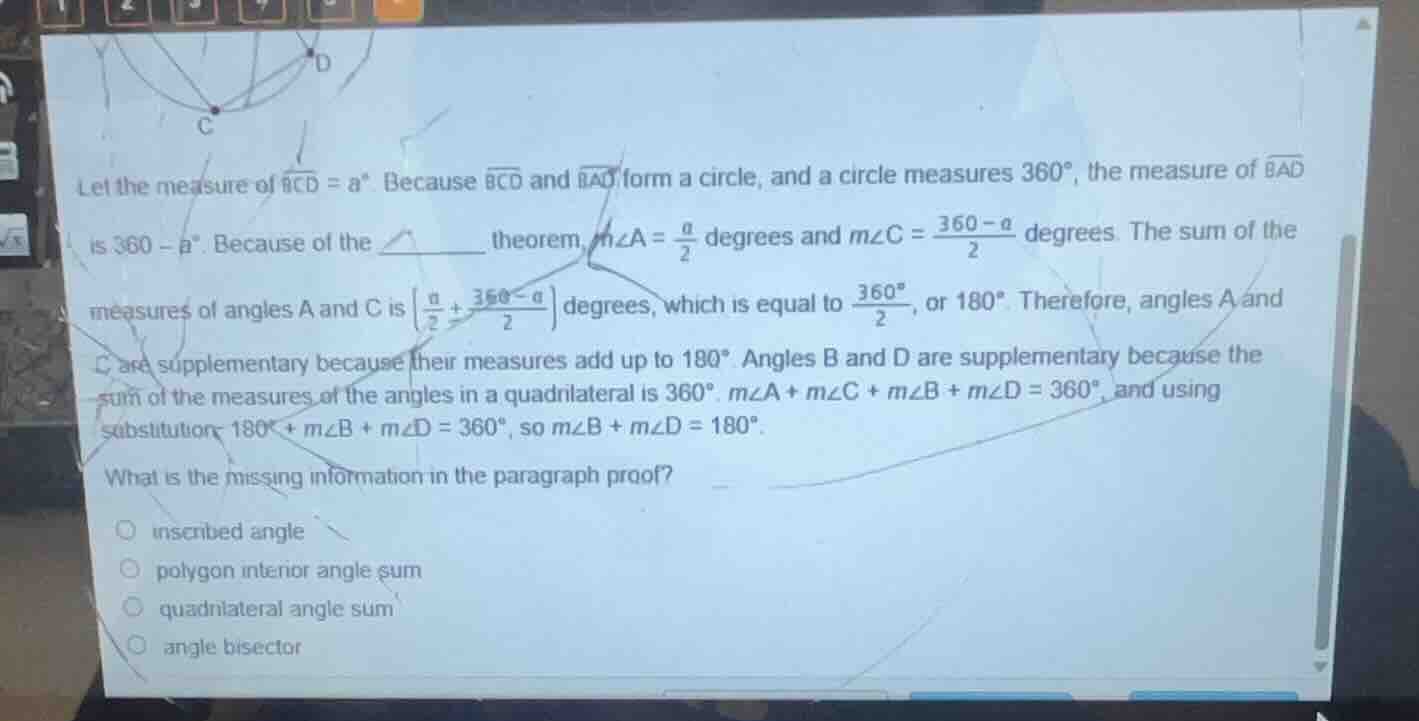
let the measure of \\(\widehat{bcd} = a^{\circ}\\). because \\(\widehat{bcd}\\) and \\(\widehat{bad}\\) form a circle, and a circle measures \\(360^{\circ}\\), the measure of \\(\widehat{bad}\\) is \\(360 - a^{\circ}\\). because of the ______ theorem, \\(m\angle a = \frac{a}{2}\\) degrees and \\(m\angle c = \frac{360 - a}{2}\\) degrees. the sum of the measures of angles a and c is \\(\left(\frac{a}{2} + \frac{360 - a}{2}\
ight)\\) degrees, which is equal to \\(\frac{360^{\circ}}{2}\\), or \\(180^{\circ}\\). therefore, angles a and c are supplementary because their measures add up to \\(180^{\circ}\\). angles b and d are supplementary because the sum of the measures of the angles in a quadrilateral is \\(360^{\circ}\\). \\(m\angle a + m\angle c + m\angle b + m\angle d = 360^{\circ}\\), and using substitution, \\(180^{\circ} + m\angle b + m\angle d = 360^{\circ}\\), so \\(m\angle b + m\angle d = 180^{\circ}\\).
what is the missing information in the paragraph proof?
- inscribed angle
- polygon interior angle sum
- quadrilateral angle sum
- angle bisector
Identify the missing theorem in the proof
The proof states: "Because of the ______ theorem, \(m\angle A = \frac{a}{2}\) degrees and \(m\angle C = \frac{360-a}{2}\) degrees."
Analyze the relationship between the angles and arcs
- Angle \(A\) is an inscribed angle that intercepts the arc \(\widehat{BCD}\), which has a measure of \(a^\circ\).
- Angle \(C\) is an inscribed angle that intercepts the arc \(\widehat{BAD}\), which has a measure of \((360-a)^\circ\).
- The theorem stating that the measure of an inscribed angle is half the measure of its intercepted arc is the inscribed angle theorem.
Match with the given options
- "inscribed angle" matches the blank.

Snap & solve any problem in the app
Get step-by-step solutions on Sovi AI
Photo-based solutions with guided steps
Explore more problems and detailed explanations
- inscribed angle (Correct answer)
- polygon interior angle sum
- quadrilateral angle sum
- angle bisector