QUESTION IMAGE
Question
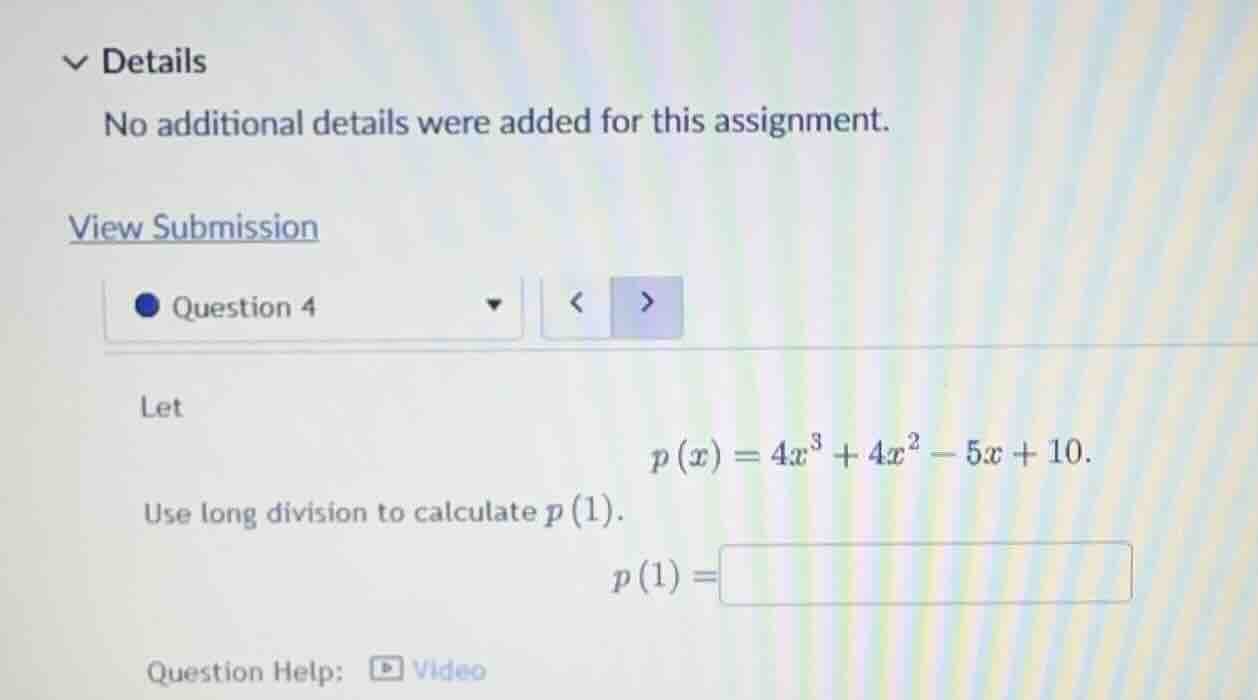
let
\\ p(x) = 4x^3 + 4x^2 - 5x + 10. \\
use long division to calculate \\( p(1) \\).
\\ p(1) = \\
Step1: Apply the Remainder Theorem
Divide \(p(x)\) by \(x - 1\) to find the remainder.
$$\frac{4x^3 + 4x^2 - 5x + 10}{x - 1}$$
Step2: Divide the first term
Divide \(4x^3\) by \(x\) to get \(4x^2\).
$$4x^2(x - 1) = 4x^3 - 4x^2$$
Step3: Subtract and bring down
Subtract \(4x^3 - 4x^2\) from \(4x^3 + 4x^2\).
$$(4x^3 + 4x^2) - (4x^3 - 4x^2) = 8x^2$$
Step4: Divide the next term
Divide \(8x^2\) by \(x\) to get \(8x\).
$$8x(x - 1) = 8x^2 - 8x$$
Step5: Subtract and bring down
Subtract \(8x^2 - 8x\) from \(8x^2 - 5x\).
$$(8x^2 - 5x) - (8x^2 - 8x) = 3x$$
Step6: Divide the final term
Divide \(3x\) by \(x\) to get \(3\).
$$3(x - 1) = 3x - 3$$
Step7: Find the final remainder
Subtract \(3x - 3\) from \(3x + 10\).
$$(3x + 10) - (3x - 3) = 13$$

Snap & solve any problem in the app
Get step-by-step solutions on Sovi AI
Photo-based solutions with guided steps
Explore more problems and detailed explanations
\(p(1) = 13\)