QUESTION IMAGE
Question
lesson 3 rsg
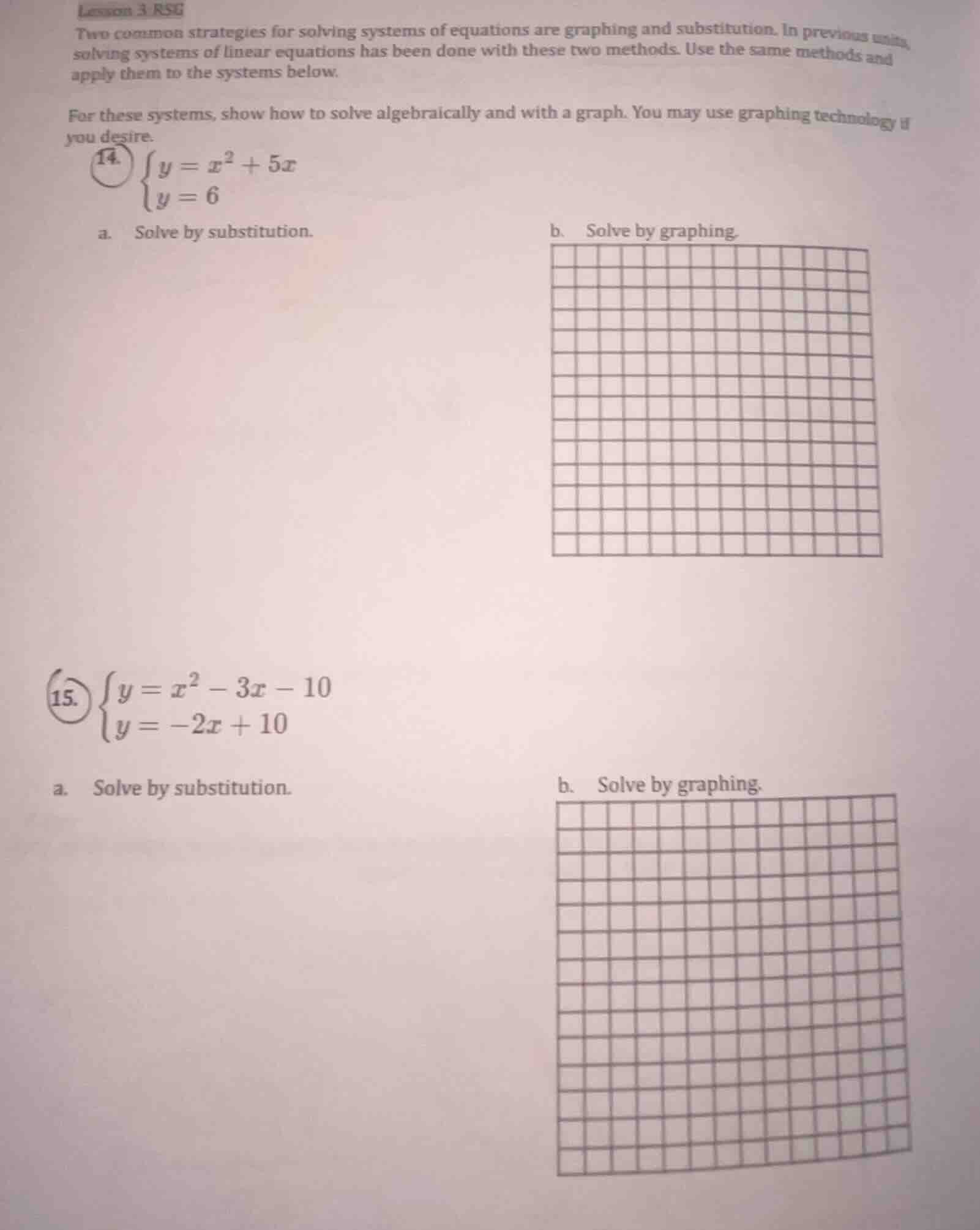
two common strategies for solving systems of equations are graphing and substitution. in previous units, solving systems of linear equations has been done with these two methods. use the same methods and apply them to the systems below.
for these systems, show how to solve algebraically and with a graph. you may use graphing technology if you desire.
- \\(\
\\)
a. solve by substitution.
b. solve by graphing.
\\(\
\\)
a. solve by substitution.
b. solve by graphing.
Problem 14
Part a: Solve by substitution
Step 1: Substitute \( y = 6 \) into the first equation
We have the system \(
\). Substitute \( y = 6 \) into \( y=x^2 + 5x \), we get \( 6=x^2 + 5x \).
Step 2: Rearrange into standard quadratic form
Rearrange the equation \( 6=x^2 + 5x \) to \( x^2+5x - 6=0 \).
Step 3: Factor the quadratic equation
Factor \( x^2+5x - 6 \). We need two numbers that multiply to \(- 6\) and add to \(5\). The numbers are \(6\) and \(- 1\). So, \(x^2+5x - 6=(x + 6)(x - 1)=0\).
Step 4: Solve for \(x\)
Set each factor equal to zero: \(x+6 = 0\) or \(x - 1=0\). Solving these, we get \(x=-6\) or \(x = 1\).
Step 1: Analyze the first equation \(y=x^2 + 5x\)
The equation \(y=x^2+5x\) is a parabola. The vertex of a parabola \(y = ax^2+bx + c\) is at \(x=-\frac{b}{2a}\). Here, \(a = 1\), \(b = 5\), so \(x=-\frac{5}{2}=-2.5\). Substitute \(x=-2.5\) into \(y=x^2 + 5x\), we get \(y=(-2.5)^2+5\times(-2.5)=6.25-12.5=-6.25\). So the vertex is \((-2.5,-6.25)\). The parabola opens upwards since \(a = 1>0\).
Step 2: Analyze the second equation \(y = 6\)
The equation \(y = 6\) is a horizontal line.
Step 3: Find the intersection points
To graph, plot the parabola \(y=x^2 + 5x\) and the line \(y = 6\). The points where they intersect are the solutions. From the algebraic solution, we know the intersection points are \((-6,6)\) and \((1,6)\). When we graph the parabola (opening upwards, vertex at \((-2.5,-6.25)\)) and the horizontal line \(y = 6\), we can see that they intersect at \(x=-6\) and \(x = 1\) (with \(y = 6\) in both cases).
Step 1: Substitute \(y=-2x + 10\) into the first equation
We have the system \(
\). Substitute \(y=-2x + 10\) into \(y=x^2-3x - 10\), we get \(-2x + 10=x^2-3x - 10\).
Step 2: Rearrange into standard quadratic form
Rearrange the equation \(-2x + 10=x^2-3x - 10\) to \(x^2-3x+2x-10 - 10=0\), which simplifies to \(x^2-x - 20=0\).
Step 3: Factor the quadratic equation
Factor \(x^2-x - 20\). We need two numbers that multiply to \(-20\) and add to \(-1\). The numbers are \(-5\) and \(4\). So, \(x^2-x - 20=(x - 5)(x + 4)=0\).
Step 4: Solve for \(x\)
Set each factor equal to zero: \(x - 5=0\) or \(x + 4=0\). Solving these, we get \(x = 5\) or \(x=-4\).
Step 5: Find the corresponding \(y\) values
- When \(x = 5\), substitute into \(y=-2x + 10\), \(y=-2\times5+10=0\).
- When \(x=-4\), substitute into \(y=-2x + 10\), \(y=-2\times(-4)+10=8 + 10=18\).

Snap & solve any problem in the app
Get step-by-step solutions on Sovi AI
Photo-based solutions with guided steps
Explore more problems and detailed explanations
The solutions are \((-6,6)\) and \((1,6)\)