QUESTION IMAGE
Question
lesson 9.1 homework
complete problems 1-5 below for independent practice.
when you are finished, check the solutions with your teacher.
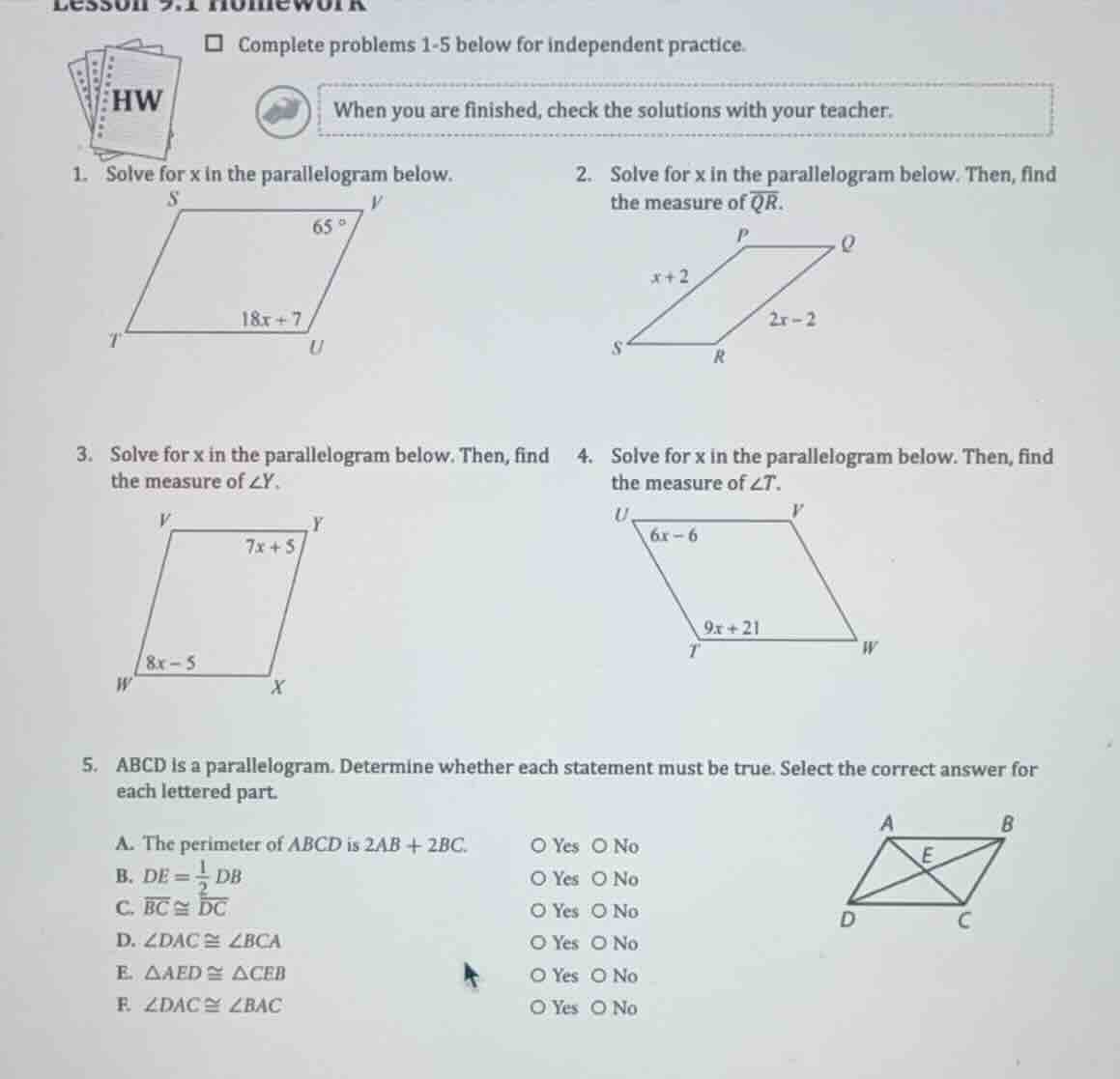
- solve for (x) in the parallelogram below.
- solve for (x) in the parallelogram below. then, find the measure of (overline{qr}).
- solve for (x) in the parallelogram below. then, find the measure of (angle y).
- solve for (x) in the parallelogram below. then, find the measure of (angle t).
- (abcd) is a parallelogram. determine whether each statement must be true. select the correct answer for each lettered part.
a. the perimeter of (abcd) is (2ab + 2bc). yes no
b. (de = \frac{1}{2} db) yes no
c. (overline{bc} cong overline{dc}) yes no
d. (angle dac cong angle bca) yes no
e. (delta aed cong delta ceb) yes no
f. (angle dac cong angle bac) yes no
Solve for x in Question 1
Using the Consecutive Angles of Parallelogram and Solving Linear Equations knowledge points
Solve for x and QR in Question 2
Using the Parallelogram Theorems and Solving Linear Equations knowledge points
Solve for x and angle Y in Question 3
Using the Opposite Angles of Parallelogram and Solving Linear Equations knowledge points
Solve for x and angle T in Question 4
Using the Consecutive Angles of Parallelogram and Solving Linear Equations knowledge points
Analyze statements for Question 5
Using the Parallelogram Theorems and Parallelogram Diagonal Properties knowledge points
- A. Perimeter of ABCD is \(2AB + 2BC\): Since opposite sides are equal (\(AB = CD\) and \(BC = DA\)), the perimeter is \(AB + BC + CD + DA = 2AB + 2BC\). (Yes)
- B. \(DE = \frac{1}{2}DB\): Diagonals of a parallelogram bisect each other, so \(E\) is the midpoint of \(DB\). (Yes)
- C. \(\overline{BC} \cong \overline{DC}\): Consecutive sides are not necessarily congruent in a general parallelogram. (No)
- D. \(\angle DAC \cong \angle BCA\): Since \(AD \parallel BC\), alternate interior angles are congruent. (Yes)
- E. \(\Delta AED \cong \Delta CEB\): By SAS or ASA using bisected diagonals and vertical angles, the opposite triangles are congruent. (Yes)
- F. \(\angle DAC \cong \angle BAC\): Diagonals do not necessarily bisect the angles in a general parallelogram. (No)

Snap & solve any problem in the app
Get step-by-step solutions on Sovi AI
Photo-based solutions with guided steps
Explore more problems and detailed explanations
Question 1
\(x = 6\)
Question 2
\(x = 4\), \(QR = 6\)
Question 3
\(x = 10\), \(m\angle Y = 75^\circ\)
Question 4
\(x = 11\), \(m\angle T = 120^\circ\)
Question 5
- A. The perimeter of ABCD is \(2AB + 2BC\).
- Yes (Correct answer)
- No
- B. \(DE = \frac{1}{2}DB\)
- Yes (Correct answer)
- No
- C. \(\overline{BC} \cong \overline{DC}\)
- Yes
- No (Correct answer)
- D. \(\angle DAC \cong \angle BCA\)
- Yes (Correct answer)
- No
- E. \(\Delta AED \cong \Delta CEB\)
- Yes (Correct answer)
- No
- F. \(\angle DAC \cong \angle BAC\)
- Yes
- No (Correct answer)